Limit Orders vs Market Orders in Prediction Markets: When Each Wins
You thought you were buying at 0.54. The screen said 0.54. You clicked buy, set the size, confirmed. Your fill confirmation showed 0.578. Two and a half cents gone before the market moved a tick in your direction.
That is not a fee. That is not slippage in the abstract. That is the cost of using a market order on a thin Polymarket book and most traders do it on every single trade without realising the fill price and the screen price are two different numbers.
Table of Contents
Quick Answer
On Polymarket, a market order buys immediately at the best available ask, which on thin markets can be 3-6 cents above the mid-price you see on screen. A limit order buys only at your specified price, with no slippage guarantee but no fill guarantee either. The correct choice depends on three variables: how fast your edge is closing, how liquid the market is relative to your size, and whether you are entering or exiting. Most retail traders use market orders when limit orders would serve them better on 70% of their trades.
Key Takeaways
- The screen price on Polymarket is the mid-point between bid and ask. Your market order fills at the ask. On a market with a 4-cent spread, you pay 2 cents above the displayed price before any probability-based analysis applies. Over 200 positions per year at an average 2-cent spread tax, that is 400 cents of uncounted execution cost.
- A limit order on Polymarket gives you price certainty but not fill certainty. A Limit GTC placed at the mid-point fills with zero spread slippage when a seller meets you there, and it can sit unfilled for hours if the market moves away. That non-fill is an opportunity cost, not a cost you can see in your P&L.
- Placing limit orders at or below the mid-price is the most underused execution approach on Polymarket. A limit buy at the mid-price fills with zero spread slippage when a seller meets you there. On stable markets with no time pressure, it is the highest-EV entry approach available. Almost no retail traders use it.
- The decision between limit and market order is not about discipline – it is about correctly identifying whether the edge has a measured lifetime in minutes or a stable window of hours. The same probability estimate warrants a market order in one context and a limit order in the other.
- Breaking a large position into smaller limit orders spread over time reduces market impact on thin books without requiring the full position to fill at a single price. On a $3,000 entry into a $25,000-volume market, entering in $300-500 increments using Limit GTC orders at descending prices typically saves 2-4 cents per share versus a single market order sweep.
- Unfilled limit orders are a silent risk. An order placed at 0.52 on a market that has since moved to 0.68 on news is still sitting in the book waiting to fill at a price that now represents a terrible entry. Set maximum order age on every limit order placed on an active market.
How Order Types Work on Polymarket
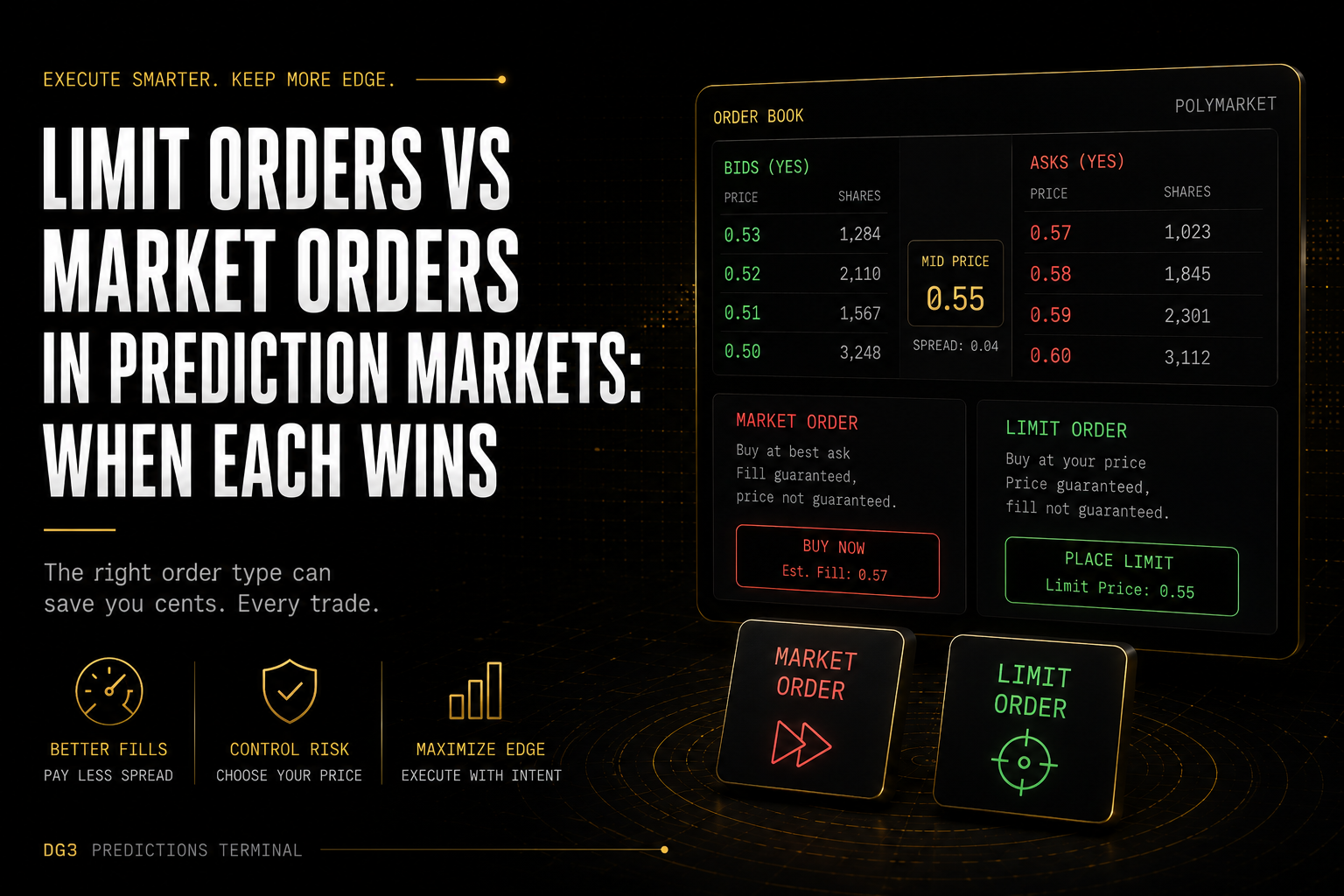
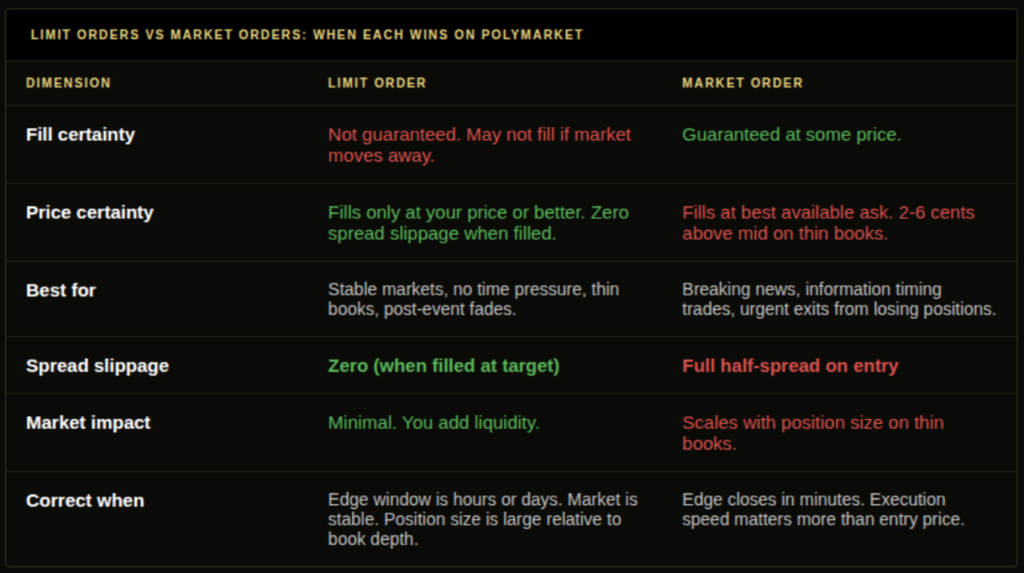
Market order: Buy or sell immediately at the best currently available price. Fill is guaranteed at some price. That price is not guaranteed to match what you saw on screen.
Limit order: Buy or sell only at your specified price or better. The price is guaranteed if filled. The fill itself is not guaranteed.
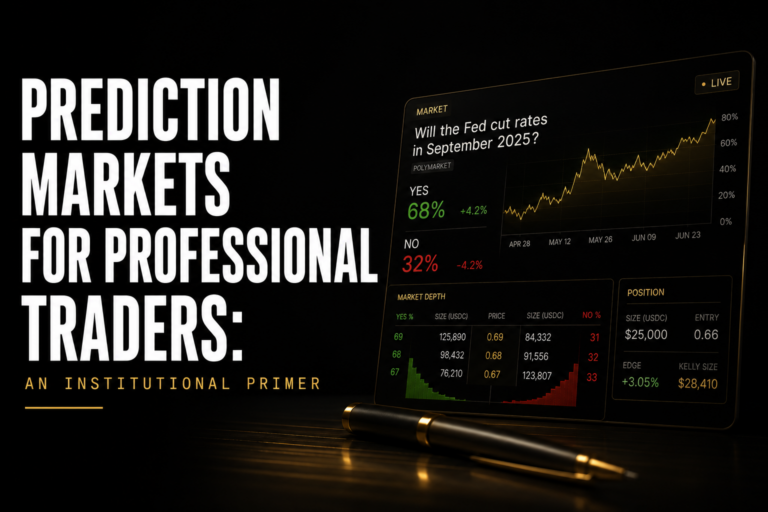
Polymarket uses a Central Limit Order Book (CLOB). YES and NO shares trade like a financial exchange with a bid side (buyers) and an ask side (sellers). The bid-ask spread is the gap between them. A market order crosses the spread and fills at the ask for buys, the bid for sells. A limit order sits on one side of the book and waits for the other side to come to it.
The spread matters more on Polymarket than on most financial markets because the fee structure already penalises spread-crossing. Polymarket takes 2% on winning positions. Add 3 cents of spread slippage on entry and you have paid 5 cents before your probability analysis even begins. On a position with a genuine 8-cent gross edge, that is 62% of your edge gone on execution alone.
Most traders do not calculate this. They see the mid-price, feel confident in the edge, and click buy. The fill comes back worse than expected. They note it vaguely and move on. Over a year of trading, the accumulated spread tax is often larger than the fees disclosed on Polymarket’s fee page.
The 4 Scenarios That Determine Which Order Type Wins
Scenario 1: Breaking news, edge closing in minutes (market order wins)
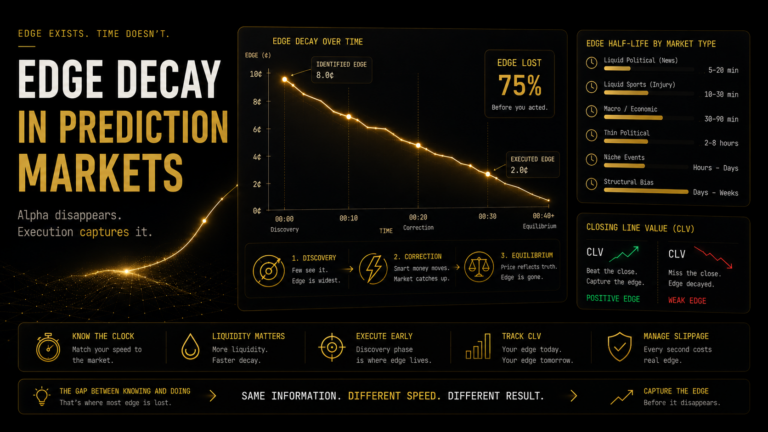
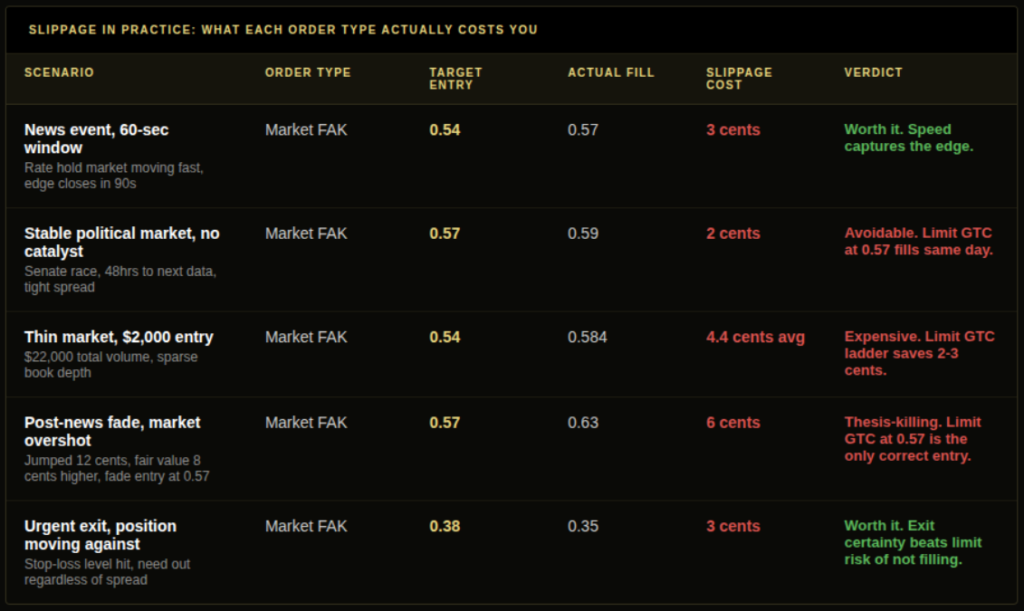
The injury confirmation landed at 14:23. The Polymarket match winner market sits at 0.41. Your model says 0.55 after this news. Every second of delay costs you cents as informed traders push toward the new equilibrium. A limit order at 0.43 will never fill – the market is moving away from it. Market order, accept the slippage as the cost of an information timing trade, size for the spread tax in your EV calculation.
This is the one scenario where market orders are unambiguously correct. Speed is worth more than price.
Scenario 2: Stable market, slow-moving event, no immediate catalyst (limit order wins)
A Senate race market is at 0.58. No news expected for 48 hours. Your model says 0.65. Place a Limit GTC at 0.57-0.58, sit in the book, and let the market come to you. A market order fills at 0.60-0.61. A limit order at 0.58 saves 2-3 cents per share with no additional risk if nothing breaks in the next few hours. Over 100 positions like this per year, that is 200-300 cents of recoverable edge.
Scenario 3: Large position, thin market (TWAP or limit ladder wins)
You want 400 shares on a market with $22,000 in total volume. The order book shows 60 shares at 0.54, 80 at 0.56, 40 at 0.58, 220 at 0.61. A market order for 400 shares clears the book and your average fill is 0.584. You intended to enter at 0.54. Instead, place a Limit GTC at 0.54, wait for it to fill, then add another order. Or place separate Limit GTC orders at 0.54, 0.52, and 0.50 simultaneously, accumulating at descending prices if the market dips. Both approaches produce fills closer to fair value without the single-order market impact.
Scenario 4: Post-event fade, market has overshot (limit order wins)
The market jumped 12 cents on news. You believe fair value is 8 cents higher, not 12. The current ask is 0.63. Your target entry for the fade is 0.57. A limit at 0.57 sits in the book and fills when the correction reaches your level. A market order right now at 0.63 turns your fade thesis into a momentum entry at exactly the wrong price.
The Decision Framework in 3 Questions
Before every entry, ask these three questions in order:
Question 1: Is this time-sensitive? If yes, news event, information timing trade, reference book arb closing fast, use a market order. Size down to account for spread slippage. Accept it as the cost of speed.
If no, go to Question 2.
Question 2: How liquid is this market relative to my position size? If the market has over $200,000 in volume and a sub-2-cent spread, and your position is under $2,000: market orders on non-urgent entries are usually fine. The slippage is 0.5-1 cent. The convenience is worth it.
If the market is thin (under $50,000 volume, spread over 3 cents) or your position size is large relative to book depth: use limit orders at or near mid, spread across multiple price levels if needed. A market order into a thin book is a voluntary donation to the order book.
Question 3: Entry or exit? Exits have different urgency than entries. If a market is moving against you and you need out, a market order is usually right regardless of spread. Getting out is the priority. If you are taking profit on a position that moved in your direction, a limit order at your target exit price often fills without giving anything back.
Placing Limit Orders at Mid: The Highest-EV Entry on Stable Markets
Placing a GTC (Good Till Cancelled) limit buy at the mid-price sits in the order book and fills only if a seller comes to your level. Zero spread slippage. No accidental crossing of the spread.
Why this matters: a limit buy at 0.54 on a market with best ask at 0.56 adds depth at 0.54 and fills only if a seller meets you there. You pay 0 cents of spread slippage when it fills, versus 2 cents if you hit the ask with a market order.
The risk is that it might not fill. The benefit, when it does: the best available entry price in the market without waiting for a price dip. For stable non-time-sensitive positions, a well-placed limit GTC order is consistently the highest-EV entry approach. Polymarket’s Trade Desk supports Limit GTC directly.
Most retail traders on Polymarket default to market orders on every trade. That is exactly why the spread tax accumulates silently across their trade history.
Common Mistakes
The most expensive order-type mistake is using market orders on thin books for large positions because it feels faster and simpler. The simplicity is real. The cost is invisible until you check your actual average fill prices against your intended entry prices, which most traders never do. If you have not audited your fills over the past 30 trades, you do not know what your actual execution cost has been. You know what you think it has been.
The second mistake is using limit orders in time-sensitive situations and watching the edge disappear without filling. A limit at 0.54 on a market moving to 0.67 on news is not discipline. It is a missed trade dressed up as patience. The discipline is knowing which context calls for which tool.
The third mistake is placing limit orders without a time limit. A limit order placed 3 hours ago on an active market is a stale order that may no longer reflect your probability estimate. Set maximum order age, 5-15 minutes on active markets, and cancel or reprice anything that has not filled within that window. The Automating Polymarket Trades guide covers order age management for systematic traders.
Frequently Asked Questions
Q: What is the difference between a limit order and a market order on Polymarket? A: A market order fills immediately at the best currently available ask price, guaranteeing execution but not price. On thin markets the ask can be 3-6 cents above the mid-price displayed on screen. A limit order fills only at your specified price, guaranteeing price but not execution. The fill price you see on screen is the mid-point. Your market order fill price is the ask.
Q: When should you use a market order on prediction markets? A: When execution speed matters more than entry price. Specific cases: information timing trades where the edge closes in minutes, news events where every second of delay costs cents, and urgent exits from positions where the priority is getting out rather than optimising the exit price. Outside these time-sensitive situations, limit orders are the better tool.
Q: When does a limit order fail to fill? A: When the market moves away from your specified price before the order is matched. A limit buy at 0.52 on a market repricing to 0.67 on breaking news will sit unfilled while the edge disappears. Limit orders fail in time-sensitive situations. The solution is matching order type to urgency, not defaulting to limit orders on every trade.
Q: How do I enter a large position on a thin Polymarket market without blowing through the order book? A: Break the position into smaller Limit GTC orders at descending prices. A $3,000 position entered in $300-500 increments lets the order book reload between fills, reducing market impact and averaging the entry price. Place separate orders at different price levels and let them fill as the market moves to each level. Use it when your target position is large relative to the market’s current depth.
Q: Does Polymarket have limit orders? A: Yes. Polymarket’s CLOB supports limit orders (GTC and GTD) and market orders (FAK and FOK). The native interface allows limit order placement. Limit GTC and Limit GTD orders are available natively on Polymarket and in DG3’s Trade Desk. More complex execution strategies, like spreading entry across multiple price levels over time, can be done by placing multiple limit orders or using the CLOB API directly.
Q: Should I use limit or market orders on Polymarket for most trades? A: For markets with over $200,000 in volume, tight spreads, and position sizes under $2,000: market orders on non-time-sensitive entries are acceptable. For thin markets under $50,000 volume, large positions, or entries with no time pressure: limit orders consistently produce better fills. The single highest-impact habit is placing Limit GTC orders at or near mid-price on stable markets rather than defaulting to market orders on every trade.
Q: What is the best order type for non-time-sensitive entries on Polymarket? A: A Limit GTC (Good Till Cancelled) order placed at or below the mid-price. It sits in the order book and fills only when a seller meets your price, guaranteeing zero spread slippage on entry. If the market moves away without filling, the order remains open until you cancel it. This is the best available entry approach for stable positions with no time pressure.
Final Thoughts
Order type is the last decision entirely within your control before the market determines the outcome. After you click execute, you are subject to what the order book gives you. Before you click execute, you choose how much you pay to participate.
Most traders treat order type as an afterthought. They size the position, calculate the edge, decide to trade, and click the fastest available button. The fastest button is almost always the market order. On a thin book, the market order is almost always expensive.
Before every entry: is this time-sensitive enough to justify market order certainty? If yes, click buy. If no, place the limit, set the order age limit, and let the market come to you. That single question, applied consistently across 200 positions per year, recovers more edge than most probability model improvements ever will.
Also read:
Slippage in Prediction Markets: What Your Fill Actually Cost You
Execution Speed in Prediction Markets: Why Milliseconds Cost Cents
Gas-Aware Betting