
How Do Prediction Markets Work? Contracts, Prices, and Payouts Explained
You buy a contract that says YES. It costs 37 cents. If you are right, it pays 1.00. If you are wrong, it pays zero. That is the entire mechanics of a prediction market in three sentences.
The part that takes longer to explain is what happens between the 37-cent purchase and the resolution, and specifically, how the price got to 37 cents in the first place, why it changes every few minutes, and what that price actually tells you about the probability of the outcome.
Table of Contents
Quick Answer
Prediction markets work by converting collective probability estimates into tradeable binary contracts. Each YES or NO share resolves at either $1.00 (if the outcome occurred) or $0.00 (if it did not). The current price of a YES share equals the market’s implied probability that the outcome will occur. Prices update continuously as participants trade, and the price at any moment represents the aggregate of all information currently reflected in the market.
Key Takeaways
- A prediction market price is a probability expressed in dollars. A YES contract priced at 0.62 is the market saying there is a 62% implied probability that the event will happen. Buying at 0.62 means you believe the true probability is higher. Selling at 0.62 means you believe it is lower.
- Prices are set by supply and demand in a two-sided order book, not by a house or market operator. When more participants want to buy YES than sell it, the price rises. When sellers outweigh buyers, it falls. This is the same mechanism as any financial exchange, just applied to event outcomes rather than company shares.
- The payout structure is always the same: $1.00 per share if the contract resolves YES, $0.00 if it resolves NO. The profit on any position is the resolution price minus the entry price. On a YES position entered at 0.37 that resolves at $1.00, the profit is $0.63 per share before fees.
- You do not need to hold a position until resolution. You can buy at 0.37, watch the price move to 0.58 as the market updates its probability estimate, and sell at 0.58 without waiting for the event to happen. The profit is the same: $0.21 per share.
- Prediction market prices are more accurate than polls in most verified comparisons, because participants back their beliefs with real money. The combination of financial incentive and a two-sided market produces a more honest price than a survey of stated opinions.
- The spread between the YES price and the NO price (which is implicitly 1 minus the YES price on a binary market) represents the market’s margin and the current state of uncertainty. A tight spread (YES at 0.60, NO at 0.42, sum of 1.02) indicates confidence and liquidity. A wide implied gap indicates uncertainty or thin liquidity.
- Resolution is the moment an outcome is confirmed and contracts are settled. On Polymarket, an Oracle process verifies the outcome against publicly available data and resolves the market. Each share in the winning outcome settles at $1.00. Losing outcome shares settle at $0.00.
How Prediction Market Contracts Work
Binary prediction market contract: A contract that resolves at either $1.00 (outcome occurred) or $0.00 (outcome did not occur). Purchased at a price between $0.01 and $0.99 that represents the market’s implied probability at the time of purchase.
Prediction market contracts on Polymarket are tokenised on Polygon, a blockchain network. This means every contract is on-chain, publicly verifiable, and settled automatically by smart contract without requiring a counterparty to pay you manually.
A typical market has two contracts: YES (the outcome will happen) and NO (the outcome will not happen). In multi-outcome markets, “Which team will win the tournament?”, there is one contract per possible outcome, and all contracts in a market must sum to $1.00 at resolution (only one outcome can win).
You can hold any number of shares in any outcome, in any dollar amount. If you buy 500 YES shares at $0.37 each, you spend $185. If the outcome resolves YES, you receive $500. Profit: $315. If it resolves NO, your $185 is lost.
How Prices Are Set and What They Mean
Implied probability: The probability of an outcome derived directly from the market price. A YES contract at 0.62 implies a 62% probability that the outcome will occur, as assessed by the market’s collective participants.
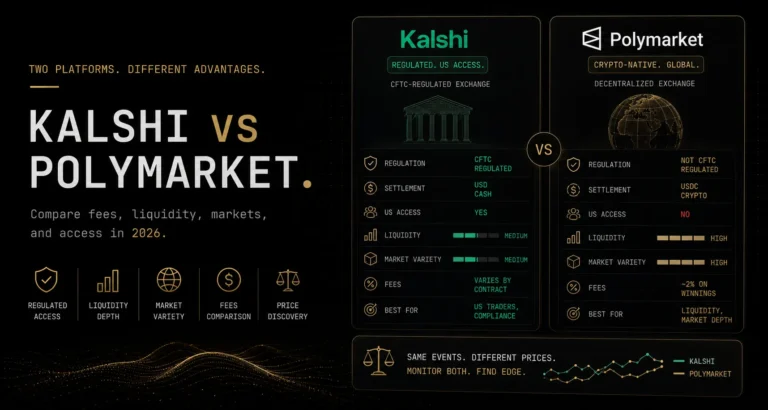
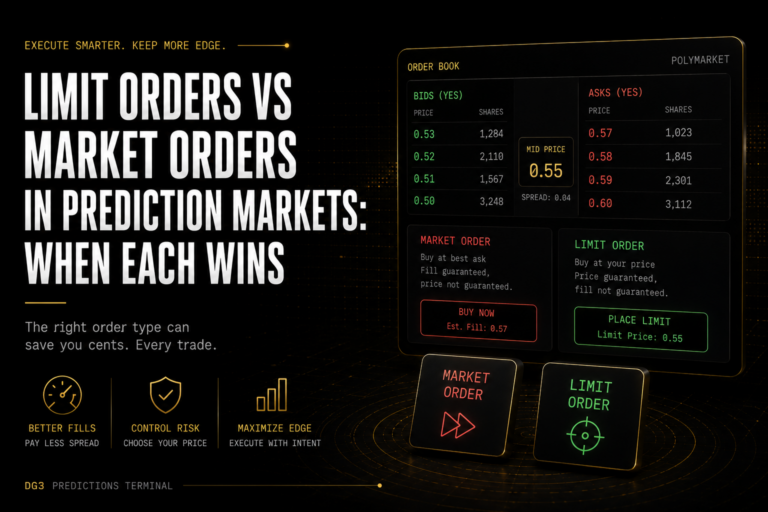
Prices on Polymarket are set by a Central Limit Order Book (CLOB), the same mechanism used by stock exchanges, futures markets, and crypto exchanges. Participants post bids (prices at which they will buy) and asks (prices at which they will sell). When a bid and ask match, a trade occurs and that price becomes the last-traded price.
The current YES price at any moment is the best available ask, the lowest price at which someone is willing to sell you a YES share. The implied NO price is 1.00 minus the current YES price (approximately, before fees).
When new information enters the market, an injury confirmation, a political development, a sporting result, participants update their probability estimates and trade accordingly. If the new information makes the YES outcome more likely, buyers push the price up. If it makes it less likely, sellers push the price down. The price movement reflects the market’s real-time aggregate probability update.
This is the core accuracy mechanism: because participants are committing real money to their probability estimates, the financial incentive to be right concentrates information efficiently into the price. Participants who consistently overestimate or underestimate outcomes lose money over time and eventually leave the market. Participants who are better calibrated make money and stay.
Also read: Market Efficiency in Prediction Markets: Are They Really Smarter Than the Crowd?
How Payouts Work: A Worked Example
Here is the complete flow for a single prediction market position.
Setup: Brazil wins the 2026 World Cup Group Stage, YES/NO market. Market opens two weeks before the group stage begins. Current YES price: 0.74 (74% implied probability).
Position entry: You believe the true probability of Brazil progressing from the group stage is 83%. The market is offering 0.74. Your edge is 9 cents. You buy 200 YES shares at $0.74 each. Total cost: $148.
During the event: Brazil wins their first two group games. The YES price rises to 0.91. You have the option to sell at 0.91 and realise $0.17 profit per share ($34 total) without waiting for the group stage to finish. You hold.
Resolution: Brazil qualifies from the group stage. The market resolves YES. Every YES share settles at $1.00. Your 200 shares: $200 received. Less entry cost of $148: profit of $52 (before the platform fee of approximately 2%).
If Brazil had not qualified: The market resolves NO. Your YES shares settle at $0.00. Your $148 is lost entirely.
The key insight is that you are not predicting a winner. You are assessing whether the market’s implied probability is accurate. When the market says 74% and you assess 83%, the difference is the edge. Whether Brazil wins is the variance.
Also read: What Is EV Trading? Expected Value Explained
What Happens When a Prediction Market Resolves
Resolution is the process by which a market determines which outcome occurred and settles all contracts accordingly.
On Polymarket, resolution works through an Oracle system. After the event concludes, a designated Oracle (typically UMA Protocol’s optimistic oracle) submits the resolution outcome based on publicly verifiable sources. Other participants can dispute the proposed resolution within a challenge window. If no dispute is raised, the market settles. If a dispute is raised, the Oracle process reviews the evidence and makes a final determination.
This system means that prediction markets on Polymarket can only cover events with clearly verifiable outcomes. “Will Brazil win the 2026 World Cup?” has a verifiable outcome at a known point in time. “Will Brazil have the best squad depth in 2026?” is not resolvable to a verifiable factual standard.
After resolution, smart contracts automatically distribute $1.00 to each holder of the winning outcome and $0.00 to each holder of the losing outcome. The settlement happens on-chain. No counterparty approval is required.
Multi-Outcome Markets
Not all prediction markets are binary YES/NO markets. Tournament winner markets, “which team will win the championship?” markets, and similar markets can have 10-32 possible outcomes, each with its own contract.
The payout structure is identical: one contract per possible outcome, each resolving at $1.00 (if that outcome won) or $0.00 (if it did not). Only one outcome can resolve at $1.00. The sum of all outcome prices at any moment reflects the market’s probability distribution across all possible outcomes.
A tournament winner market with 10 teams might have prices like: Brazil 0.28, France 0.18, England 0.12, Argentina 0.11, Spain 0.09 … and so on. These sum to approximately 1.00 (with slight variation due to platform margin). Each price is the market’s implied probability for that team winning.
Trading a multi-outcome market works the same as trading a binary market. You buy the outcome you believe is underpriced relative to its true probability. If the market says Brazil has 28% chance and you assess 37%, you buy Brazil shares. If Brazil wins, your shares resolve at $1.00. If any other team wins, your shares resolve at $0.00.
Common Mistakes
Mistake 1: Confusing the YES price with the probability of a good outcome. A YES price of 0.74 means the market assigns a 74% probability that the outcome will happen. It does not mean you should bet on it because it is “likely.” The trade is only correct if you believe the true probability is meaningfully higher than 74%. Buying a 74-cent YES that has a true probability of 72% is a losing trade in expectation, regardless of whether it wins.
Mistake 2: Not accounting for the platform fee in edge calculations. Polymarket charges approximately 2% on market orders. This means the real edge threshold for a position to be positive EV is not zero, it is the amount needed to cover the fee. A 1-cent edge on a binary market is often not enough after the 2% fee is applied. The minimum viable edge depends on the market price level.
Mistake 3: Treating resolution as the only exit. You can exit a prediction market position at any time by selling your shares at the current market price. If you buy YES at 0.37 and the price rises to 0.58 before the event happens, you can sell at 0.58 and take the $0.21 profit per share. Most beginning prediction market traders do not realise that exit before resolution is not just possible, it is often the correct play.
Mistake 4: Misreading multi-outcome markets as independent bets. In a 10-team tournament winner market, buying three different teams at 0.28, 0.18, and 0.12 feels like diversification. The sum of the three positions resolves at a maximum of $1.00 because only one team can win. The three positions are not independent, they are a portfolio with explicit correlation. Sizing each independently using Kelly without accounting for the shared outcome structure leads to systematic oversizing.
Mistake 5: Acting on price without checking liquidity first. A price of 0.37 on a YES contract is only meaningful if there is enough liquidity for your intended position size at that price. On a thin market, a $2,000 order at 0.37 might clear the available depth and result in an average fill of 0.41. The displayed price is not the guaranteed fill price. Check the order book depth before sizing.
Frequently Asked Questions
Q: How do prediction markets actually work step by step? A: An event is listed with possible outcomes. Each outcome has a YES and NO contract (or one contract per outcome in multi-outcome markets). Participants trade shares at prices between 0 and 1 based on their probability estimates. The price at any moment reflects the aggregate probability implied by the market. When the event resolves, YES holders in the winning outcome receive $1.00 per share. All other holders receive $0.00.
Q: What is a binary prediction market contract? A: A contract that resolves at either $1.00 (if the outcome occurred) or $0.00 (if it did not). Purchased at a price between $0.01 and $0.99. The current price is the market’s implied probability of the outcome occurring.
Q: How do you make money on prediction markets? A: By buying contracts at prices that are lower than the true probability of the outcome occurring, or selling contracts at prices higher than the true probability. The edge is the difference between your probability estimate and the market’s price. Over many positions with consistent positive edge, the mathematics produces profit even accounting for individual losses from variance.
Q: How are prediction market prices set? A: By a two-sided order book (CLOB). Participants post bids (buy orders) and asks (sell orders). When a bid and ask match, a trade occurs. The current price is the best available ask for buyers. Prices change as new information arrives and participants update their probability estimates.
Q: What happens when a prediction market resolves? A: An Oracle system verifies the outcome against publicly available sources and submits the resolution. After a challenge window, smart contracts automatically settle: $1.00 per share to holders of the winning outcome, $0.00 to holders of all other outcomes. On Polymarket, this process uses the UMA Protocol optimistic oracle.
Q: How is prediction market trading different from sports betting? A: Three key differences. First, you trade against a two-sided CLOB of other participants, not against a house with a built-in margin. Second, you can exit before resolution by selling your shares at the current market price. Third, prices are more accurate on average because real money creates stronger incentive to be calibrated than stated survey opinions.
Q: Can you exit a prediction market position early? A: Yes. Selling your shares at the current market price exits your position. If you bought YES at 0.37 and the price has moved to 0.58, selling at 0.58 realises $0.21 profit per share without waiting for the event to resolve. This is one of the primary advantages of prediction market structure over fixed-odds sportsbook betting, where you cannot exit a bet before the event settles.
Q: What is the minimum viable edge to trade prediction markets profitably? A: After the approximately 2% platform fee on market orders, the minimum edge depends on the market price level. At a YES price of 0.50, a 2% fee costs 2 cents per share. Any edge below 2 cents is wiped by fees. A general starting threshold for professional-level trading is a minimum of 3-4 cents of edge after fees, sustained across a large sample with calibrated probability estimates.
Final Thoughts
Prediction markets are not complicated once you understand the three core mechanics: price equals implied probability, payout is always $1.00 or $0.00, and you can exit before resolution by selling your shares.
Everything else, edge calculation, Kelly sizing, CLV tracking, wallet signal classification, is built on top of those three mechanics. The infrastructure can get sophisticated. The underlying structure is simple.
The part that most beginning traders underestimate is the two-sided nature of the market. You are not betting against a house with a fixed margin. You are trading against other participants, some of whom are systematically better calibrated than you, some of whom are not. Identifying which is which, and what the market’s current probability estimate implies about your own edge, is the skill that compounds over time.
Also read: What Is EV Trading? Expected Value Explained
What Is a Prediction Market Terminal? (And Why Traders Outgrow Raw Polymarket)
Fair Value Prediction Markets