CS2 Market Predictions 2026: What Skin Prices and Tournament Odds Are Telling You
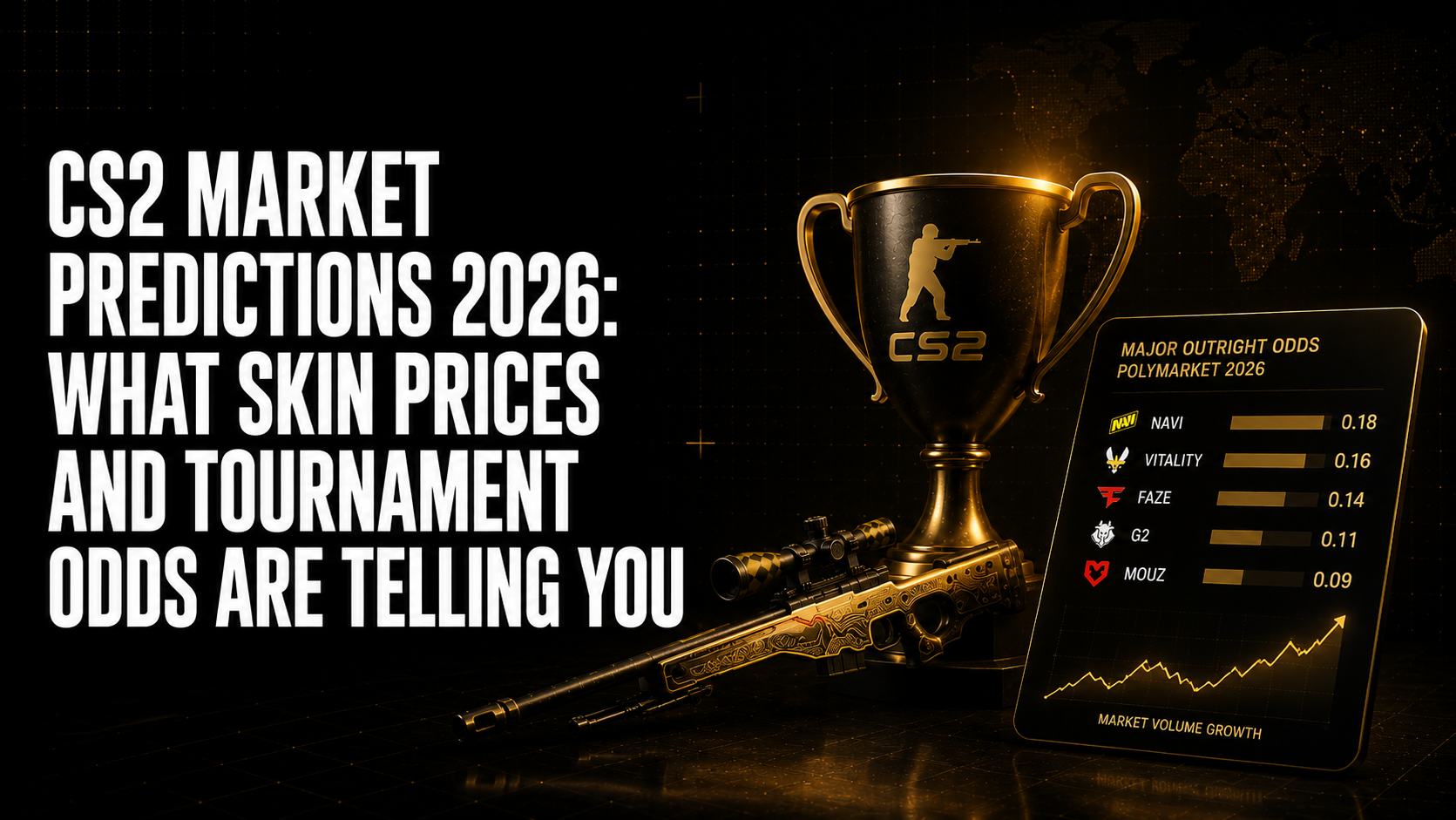
Two numbers. The Polymarket odds on NaVi to win the next CS2 major: 0.18. The average price of a NaVi player signature sticker capsule: trending down 12% over the past six weeks. Both numbers point the same direction. That’s not coincidence. That’s rarely coincidence. Whether you read it as a skin investment signal or a prediction market signal depends entirely on which market you’re in.
The question for 2026 isn’t whether CS2 markets are active. They are. They are. The question is what the data inside those markets is actually saying.
Table of Contents
Quick Answer
Two markets. Different signals. Here’s what each is saying.
CS2 market predictions for 2026 across both skin and prediction markets point toward a bifurcated landscape: skin prices are likely to remain range-bound as case opening economics normalise, while CS2 prediction market volume is forecast to grow with the expanded tournament calendar. Tournament odds on Polymarket in 2026 show tightening field competitiveness, with no dominant tier-1 team commanding the same win probability premium seen in 2023-2024.
Key Takeaways
- CS2 market predictions 2026 for the skin segment point to continued normalisation after the post-launch peak. Case opening rates have moderated, CS2 player count growth has stabilised, and high-value item prices reflect a market that has priced in the initial CS2 hype cycle.
- The 2026 CS2 tournament calendar is the most notable variable for both skin and prediction markets. More majors and international events mean more case opening demand spikes, more viewership-driven sticker capsule speculation, and more prediction market volume across a wider distribution of fixtures.
- CS2 prediction market volume grew approximately 14x from 2022 to 2025 on Polymarket. The 2026 trajectory assumes continued growth with three specific catalysts: expanded Valve major investment, increasing attention from disciplined prediction market traders, and growing Polymarket liquidity depth on esports categories generally.
- Tournament odds in 2026 suggest the tier-1 field is more competitive than at any point in the past three years. No team currently commands a tournament outright probability above 0.22 on Polymarket for upcoming majors, compared to NAVI in 2021-2022 when s1mple-era tournament outrights regularly opened at 0.32-0.38.
- Skin price prediction for 2026 follows two scenarios: a catalyst scenario (Valve announces a major new operation, notable case release, or content expansion) in which top-tier item prices recover 15-30% from 2025 lows. and a baseline scenario (no notable content catalyst) in which prices remain range-bound with major-correlated volatility of 8-20% around tournament windows.
- CS2 prediction market odds in 2026 are not a useful direct signal for skin price movement. The information lag between match resolution and skin price adjustment (48 hours to 2 weeks) means the two markets are effectively non-overlapping in their usable timeframes.
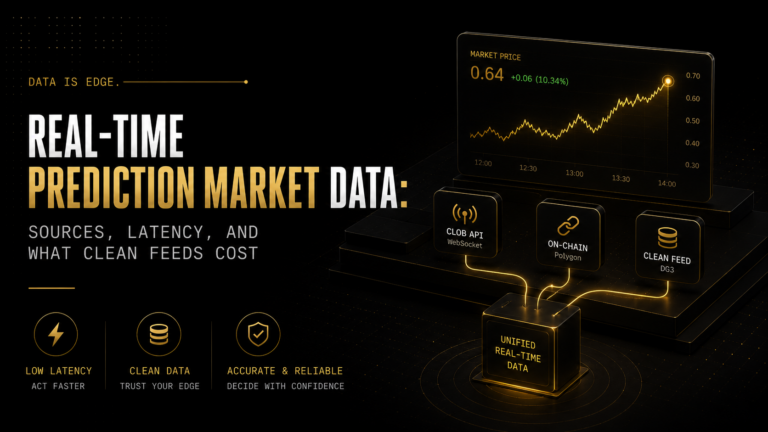
- The most data-rich signal in CS2 markets for 2026 remains HLTV.org ranking movement and the sharp Pinnacle line for match-level pricing. Polymarket’s CS2 prediction market prices provide a real-time secondary calibration point but tend to lag Pinnacle by 8-20 minutes on notable news events.
CS2 Market Predictions 2026: What the Tournament Calendar Signals
The CS2 tournament calendar in 2026 represents the fullest schedule the game has had since the CS:GO era. Valve’s expanded major investment continues, ESL and BLAST have maintained their premium event categories, and IEA (Intel Extreme Masters partnership events) fill the calendar gaps.
For prediction market traders, the implications are clear: more events means more trading opportunities, more liquidity depth from a growing participant pool, and, critically, more data points for calibrating your CS2 match model across a wider set of opponent matchups and tournament formats.
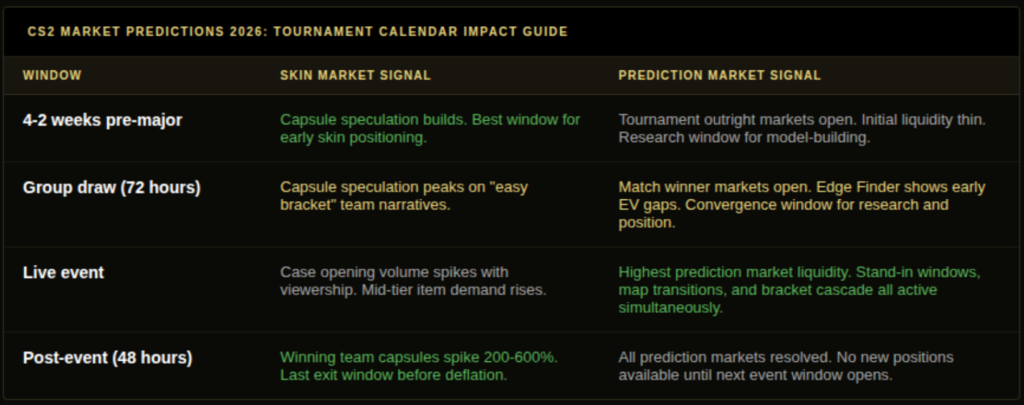
For skin investors, the calendar matters differently. Each major creates a speculative window for the associated capsule series, typically 2-4 weeks before the event. Team performance through the qualification phase affects speculation on which teams will generate the most viewership, and therefore the most case opening demand, during the event itself.
The practical calendar impact on prediction markets: Polymarket CS2 match winner markets will be more continuous in 2026 than in any previous year. There will be weeks with active prediction markets across ESL, BLAST, and IEA events simultaneously. Traders who build deep CS2 models in the first half of 2026 will find more opportunities to deploy that research than the same research investment would have generated in 2024.
Also read: CS2 Prediction Markets: The Complete Guide for Traders in 2026
What Prediction Market Odds Are Saying About CS2 in 2026
The current distribution of CS2 tournament outright odds on Polymarket tells you something that HLTV rankings don’t: the field is genuinely competitive in a way it hasn’t been since the 2019-2020 period.
In 2021-2022, NaVi with s1mple opened as tournament favourites at 0.30+ on most major outrights. The market was pricing genuine dominance. In 2023-2024, the field tightened but FaZe and G2 maintained consistent premiums. In early 2026, no team commands that kind of market premium. The highest current outright probability on upcoming Polymarket CS2 major markets sits at approximately 0.18-0.22 depending on the event. Seven or eight teams are within 4-6 cents of each other.
The implication for prediction market traders: the era of “fade the favourite” as a consistent positive EV strategy is over for now. When the field is this compressed, the mispricings are in specific match-level situations, stand-in windows, map pool mismatches, overtime dynamics, rather than outright overpricing of a dominant team.
The implication for skin market speculators: without a clear dominant team, pre-major capsule speculation is more distributed. The speculative premium that used to concentrate on one or two team capsule series is spreading across a wider set of potential finalists. Lower individual capsule upside, but more teams where early positioning has positive expected value.
CS2 Skin Price Forecast 2026
CS2 market predictions for 2026 on the skin side are inherently speculative, but the variables that drive CS2 market cap are trackable. Three scenarios are worth modelling.
Baseline scenario (no major content catalyst): Skin prices remain range-bound. High-value items (Karambit Doppler Phase 2, AWP Dragon Lore, StatTrak Factory New knife tiers) stay within 15% of current levels. Case opening volume continues at normalised rates. The skin market generates returns primarily through float value arbitrage within item tiers rather than market-wide appreciation.
Catalyst scenario (notable Valve content release): A major new CS2 operation, notable case expansion, or new content announcement drives a case opening surge. Short-term demand spike pushes mid-tier and high-tier item prices up 20-40% in the 4-6 weeks post-announcement. This scenario played out in the CS:GO era during operations and has historically been the primary catalyst for sustained skin price recovery. Whether Valve executes it in 2026 is the key unknown.
Major performance scenario (dominant team emerges): If one team dominates the 2026 major circuit, winning two of the three scheduled majors, their player signature capsules and associated team items experience the kind of 200-500% price surge seen with previous dominant team capsule series. Prediction market odds in early 2026 don’t support this scenario for any specific team, but the skin market has historically overreacted to team dominance narratives.
For tracking CS2 market predictions 2026 skin trends: PriceEmpire provides historical skin price data with tournament-correlated overlays. Steam Charts tracks CS2 player count trends. Both give leading indicator context for skin price direction that no prediction market price will provide.
Also read: CS2 Skin Market vs Prediction Markets: Two Ways to Trade Counter-Strike
Where CS2 Market Predictions 2026 Signals Converge
There’s one period where skin market data and prediction market data point at the same trade: the 72-hour window around a CS2 major group draw.
When the major bracket is released, two things happen simultaneously. Prediction market match winner prices open for group stage matches with initial liquidity. Skin capsule speculation intensifies as participants try to anticipate which teams will have breakout performance, and therefore the most valuable capsule series.
Your prediction market research in this window (full match probability model, map pool analysis, roster confirmation) generates two outputs that converge: a Polymarket position list ranked by edge gap, and a view on which team is likely to have a deeper-than-expected tournament run that the capsule speculation market hasn’t fully priced.
That convergence window, the 48-72 hours after the group draw and before the first match, is the only period where a single well-built research model is genuinely relevant to both markets simultaneously. Outside that window, they diverge.
Common Mistakes in CS2 Market Predictions 2026 Analysis
Mistake 1: Using 2021-2022 skin market data to forecast 2026. The CS2 skin market in 2026 operates with different dynamics than the CSGO peak. Player count growth, case opening economics, and competitive team dynamics have all shifted. Historical skin ROI figures from the peak period are not a reliable guide to 2026 returns.
Mistake 2: Treating compressed tournament outright odds as a signal to avoid CS2 prediction markets.
A competitive field means fewer outright opportunities, not fewer opportunities overall. Match-level mispricings, stand-in windows, map pool edges, overtime dynamics, are independent of field competitiveness. The match-level edge sources identified in the CS2 prediction markets guide apply regardless of how tightly clustered the outright probabilities are.
Mistake 3: Ignoring the tournament calendar timing for skin positions.
Skin speculation around a major has a defined window: 2-4 weeks before the event. Buying capsule speculation the week before the major is buying into a crowded trade. The edge in the skin-capsule calendar trade is in early positioning, not in chasing the pre-event spike.
Mistake 4: Conflating CS2 prediction market volume growth with skin market price recovery.
Prediction market volume growing 14x from 2022-2025 is a market maturation signal. It says nothing about skin prices. The participant pools are largely distinct.
Frequently Asked Questions
Q: What are CS2 market predictions for 2026? A: Skin prices are forecast to remain range-bound absent a notable Valve content catalyst, with major-correlated volatility of 8-20% around tournament windows. Prediction market volume is forecast to continue growing with the expanded 2026 tournament calendar. Field competitiveness in tournament outrights is higher than at any point in the past three years.
Q: How does the CS2 tournament calendar affect skin market prices? A: Each major creates a 2-4 week pre-event speculative window for the associated capsule series. During the event, case opening volume spikes correlate with increased demand for mid-tier items. Post-event, winning team capsules and sticker prices spike 200-600% for the winning roster.
Q: What does CS2 prediction market data say about 2026? A: Tournament outright odds show a genuinely competitive field with no team commanding more than 0.18-0.22 probability on upcoming majors. Match-level mispricings remain the primary edge source. Stand-in windows, map pool mismatches, and overtime dynamics continue to generate the most consistent prediction market opportunities.
Q: How does a CS2 major affect skin prices? A: Case opening volume spikes during major viewership peaks, increasing demand for mid-tier items generally. Player signature sticker prices for the winning team’s capsule typically increase 200-600% in the 48 hours post-event. Pre-major capsule speculation concentrates in the 2-4 weeks before the event and deflates post-draw when expectations are established.
Q: How does DG3 track CS2 prediction market odds in 2026? A: DG3’s Edge Finder surfaces active CS2 Polymarket markets ranked by EV gap against the Signal no-vig benchmark continuously. Tournament outright markets, group stage qualification markets, and match winner markets for upcoming events are all visible in the Edge Finder ranking as they open. The EV chip on each market shows the current divergence between Polymarket price and the sharpest available benchmark.
Final Thoughts
CS2 market predictions for 2026 come down to one thing.
Knowing which signal belongs to which market.
The skin market’s signals, case opening volume, player count trends, Valve content cadence, are macroeconomic. They move over weeks. The prediction market signals, match odds, stand-in announcements, map veto outcomes, are event-driven. They move over minutes.
Conflating the two is the most common CS2 trading mistake.
Here’s what that looks like: holding skin positions based on prediction market outcomes that have already resolved, or trading prediction markets based on skin price trends that operate on completely different time horizons.
The 2026 calendar offers both markets their best trading environment in three years. Use it well. The research required to exploit them well is partly overlapping and partly distinct. Build the parts that overlap once. Then use them separately, in the timeframes where each actually works.
Also read: CS2 Prediction Markets: The Complete Guide for Traders in 2026
CS2 Skin Market vs Prediction Markets: Two Ways to Trade Counter-Strike
Market Efficiency in Prediction Markets: Are They Really Smarter Than the Crowd?