
4 Types of Crypto Event Prediction Markets
The ETF approval market on Polymarket closed at $0.94 the morning of January 10th, 2024. The SEC approved Bitcoin spot ETFs that same day. Most participants made 6 cents per dollar. The traders who had been in at $0.47 six weeks earlier made $0.53.
The difference wasn’t luck. It was position timing relative to a known catalyst with a defined resolution date. That’s the structure crypto event markets offer that most trading environments don’t: a clear event, a binary outcome, and a deadline.
Table of Contents
Quick Answer
Crypto event prediction markets – binary contracts on specific Bitcoin and Ethereum milestones or protocol catalysts, ETF decisions, all-time high crossings, halving events, upgrade activations. They’re available on Polymarket and Kalshi and resolve on clearly defined criteria. The edge in these markets comes from having a better probability model for the event than the current market price reflects, and from positioning before narrative momentum pushes prices toward the outcome.
Key Takeaways
- Crypto event prediction markets differ from spot crypto trading in one critical way: they’re binary. Whether BTC crosses $100,000 at any point before December 31st resolves at $1.00 or $0.00 regardless of how far above or below that level BTC actually trades. The magnitude of the price move doesn’t change your payout, only whether the threshold is crossed.
- The four major crypto event market categories on Polymarket are: BTC price milestone markets (does BTC exceed $X by date Y), ETF and regulatory decision markets (does the SEC approve / does the CFTC regulate / does a specific bill pass), protocol upgrade and activation markets (does Ethereum complete the X upgrade by date Y), and macro correlation markets (does BTC outperform gold / does BTC reach new ATH before a specific election).
- Bitcoin halving markets are the longest-horizon crypto event binary contracts. They resolve on a verifiable on-chain event, the block subsidy halving, with a predictable date range but no exact timestamp. Halvings typically generate the highest Polymarket crypto market volumes of any scheduled crypto catalyst.
- The primary research edge in BTC price milestone markets is probability modelling, not news. The question “will BTC exceed $120,000 by March 31st” is a quant problem: what is the probability distribution of BTC’s price path over the relevant time horizon, and what’s the probability mass above that threshold? Traders who model this more accurately than the market consensus find edge.
- Regulatory decision markets (ETF approvals, CFTC jurisdiction rulings) have a different edge structure: information asymmetry. People with genuine insight into regulatory timing, from public filings, administrative schedules, and political signal tracking, have edge over participants who are pricing based on narrative alone. The SEC approval example above was readable from public docket activity weeks before resolution.
- Protocol upgrade markets are the most technically demanding crypto event category. Assessing probability that an Ethereum upgrade activates on a specific date requires reading EIP implementation status, validator participation rates, and developer consensus, signals that are publicly available but that most Polymarket participants don’t track.
- DG3’s Edge Finder covers all active Polymarket crypto event markets alongside sports markets. The EV chip on each crypto market shows the devigged gap between current Polymarket pricing and the Pinnacle Signal benchmark where applicable. For crypto-specific research, the News tab surfaces protocol announcements and regulatory filings scoped to open markets.
The Four Crypto Event Prediction Market Categories
Crypto event prediction market: A binary contract that resolves at $1.00 if a specific crypto milestone or protocol catalyst occurs before the stated deadline, and $0.00 if it doesn’t. The contract price reflects the market’s current probability estimate for the outcome.
Category 1, BTC price milestone markets: The most liquid crypto event category on Polymarket. Contracts ask whether BTC will exceed (or fall below) a specific dollar threshold by a specific date. The threshold and date are fixed at market creation. These markets are driven by options-market-style probability modelling, what’s the probability mass above $X in BTC’s price distribution over the relevant horizon? Historical volatility, current volatility term structure, and risk-adjusted path probability determine the fair value.
Category 2, ETF and regulatory decision markets: Binary contracts on specific government or regulatory actions. Will the SEC approve a Bitcoin spot ETF by date X? Will the CFTC classify ETH as a commodity? These markets are driven by information asymmetry rather than price modelling. The edge is in reading the regulatory process accurately, administrative docket timing, political environment, precedent cases, rather than making a directional bet on BTC’s price.
Category 3, Protocol upgrade and activation markets: Contracts on whether a specific Ethereum, Solana, or Bitcoin protocol upgrade will activate by a given date. Research requires tracking EIP or BIP status, testnet results, and developer consensus. These markets carry lower liquidity than price milestone markets but higher information asymmetry, the participant pool doing genuine protocol research is small.
Category 4, Macro correlation and comparative markets: Will BTC outperform the S&P 500 in Q4? Will Bitcoin reach a new ATH before the next halving? These markets require modelling the joint probability of two events, which is more complex than single-event binary contracts. Correlation assumptions between BTC and macro assets matter notably for these estimates.
Also read: Trading the News: An Event Driven Playbook for Prediction Markets
How Crypto Event Markets Differ From Sports Markets
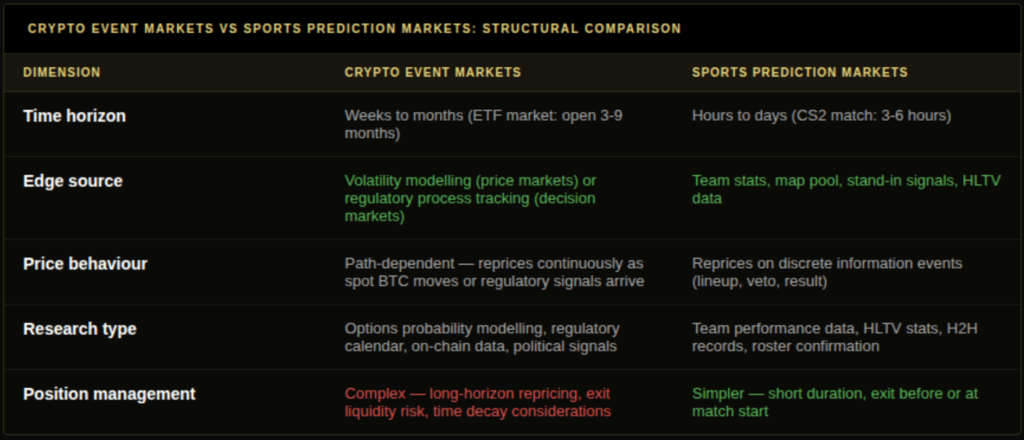
The mechanics are the same, binary contracts, CLOB structure, binary resolution. The research is almost completely different.
Sports prediction markets resolve on a real-world event that occurs at a fixed time. The research is about team and player performance: form, lineup, matchup analysis, map pool. The edge window is typically hours to days around the event.
Crypto event prediction markets resolve on either a market condition (price threshold crossing) or an institutional action (regulatory decision, protocol activation). The research is about probability modelling and information asymmetry. The edge window can be weeks to months, these markets often stay open for 3-6 months before resolution.
Three structural differences that matter for strategy:
Time horizon: A CS2 match winner market lasts 3 hours. A “BTC exceeds $150,000 by December 2026” market might be open for 9 months. Position management across a 9-month crypto event market requires thinking about exit timing, price path dependency, and interim news events in a way that a same-day sports market doesn’t.
Research type: Sports edge is research-intensive in a narrow, structured way (team stats, lineup data). Crypto event edge requires broad context: macro conditions, regulatory calendar, on-chain data, developer activity, institutional flow signals. The research surface is wider.
Price path dependency: A BTC price milestone market’s price will move substantially as BTC’s spot price moves, before resolution. A match winner market’s price moves on information about who will win. Managing a crypto event position as spot BTC price moves (and your option-like contract reprices accordingly) is a different operational challenge than managing a sports position.
BTC Milestone Crypto Event Prediction Market Research: What Drives Edge
For BTC price milestone markets specifically, the probability modelling approach determines edge quality.
The core question: given BTC’s current price, its historical volatility, and the current implied volatility term structure, what is the probability that BTC trades above threshold T at any point between now and date D?
This is a barrier-crossing probability problem, similar to path-dependent option pricing. The relevant inputs:
Historical and implied volatility: BTC’s 30-day realized volatility and the implied volatility from BTC options (available from Deribit and CME Bitcoin options). Higher volatility increases the probability of any specific threshold crossing, a key input that casual participants often ignore.
Current market regime: BTC volatility clusters. A market in a low-volatility consolidation phase has a different threshold-crossing probability than the same spot price during a high-volatility expansion phase. Regime-adjusted probability estimates outperform naive historical-volatility models.
Time to resolution: More time means higher crossing probability for the same threshold. A “$120,000 BTC before December 31st” market opened in January has a very different probability profile from the same market opened in October. Polymarket prices sometimes lag the time-decay adjustment that makes out-of-the-money milestone markets cheaper as the deadline approaches without the threshold being crossed.
Macro correlation: BTC’s price correlation with risk assets (particularly Nasdaq) affects the probability distribution during periods of broad market stress. A threshold-crossing probability model that ignores macro regime context will underperform one that incorporates it.
Also read: Information Asymmetry: Who Knows What, and When, in Event Markets
Regulatory Event Markets: Where Information Asymmetry Lives
The SEC’s Bitcoin spot ETF decision is the clearest documented example of information asymmetry in crypto prediction markets. The relevant information wasn’t inside information, it was public, in administrative dockets and political signals, but it required active tracking to interpret correctly.
For regulatory crypto event markets in 2026, the relevant information sources are:
SEC and CFTC public dockets: Regulatory comment periods, response timelines, and commissioner statements are public. Administrative decision timelines have historical precedent. Traders who model regulatory process accurately find systematic edge over participants pricing based on general crypto sentiment.
Congressional legislative calendar: Crypto-specific legislation (stablecoin bills, market structure bills) has a legislative calendar that’s partially predictable from committee schedules and co-sponsorship patterns. Prediction markets on legislative outcomes respond faster to political developments than most casual participants track.
Political signal tracking: Regulatory appointments, administration policy statements, and enforcement action patterns are leading indicators of regulatory decision probability. These signals are public but require active monitoring to extract from the noise of general political news.
The edge structure in regulatory markets is fundamentally different from price milestone markets. You’re not building a volatility model, you’re building a political and institutional process model.
Common Mistakes in Crypto Event Prediction Markets Trading
Mistake 1: Confusing the direction of BTC with the probability of threshold crossing. BTC going up doesn’t mean “BTC exceeds $120,000 by March” is more valuable than its current price implies. The contract’s fair value depends on the probability of crossing the specific threshold, not just BTC’s direction. If BTC is at $95,000 and the threshold is $120,000, the crossing probability depends on volatility and time, not just whether BTC is trending up.
Mistake 2: Ignoring time decay on out-of-the-money milestone markets.
A “$150,000 BTC by year end” contract at $0.18 in January might be fairly priced relative to the probability distribution. The same contract at $0.18 in October (with BTC at $90,000) is almost certainly mispriced in one direction, time has collapsed but the price hasn’t moved. Check whether a contract’s price has adjusted for the time remaining.
Mistake 3: Trading regulatory markets on sentiment rather than process.
“The political environment feels positive for crypto” is not a regulatory probability model. Regulatory decisions follow institutional processes with documented timelines. The traders who consistently find edge in ETF and CFTC decision markets are the ones tracking the process, not the sentiment.
Mistake 4: Treating protocol upgrade markets as simpler than they are.
“Ethereum is upgrading, so this market should be close to $1.00” ignores the specific deadline question. Protocol upgrades slip frequently. The probability that upgrade X activates before date Y is a function of testnet completion, validator coordination, and developer consensus, not just whether the upgrade is planned.
Mistake 5: Not managing position size relative to the contract’s time horizon. A 9-month crypto event market position will reprice notably before resolution. Sizing as if you’ll hold to resolution without considering what happens to the position if BTC moves materially against you is a risk management error that doesn’t exist for same-day sports markets.
Frequently Asked Questions
Q: What crypto event markets are available on Polymarket? A: Four main categories: BTC and ETH price milestone markets (does BTC exceed $X by date Y), ETF and regulatory decision markets (specific SEC, CFTC, or legislative outcomes), protocol upgrade and activation markets (does a specific EIP or BIP activate by date Y), and macro correlation markets (BTC vs gold, BTC ATH relative to other events). New markets open around major crypto calendar events.
Q: How do you trade BTC milestone markets? A: Build a threshold-crossing probability model using current spot price, historical and implied volatility (from Deribit or CME Bitcoin options), time to resolution, and macro regime context. Compare your model’s probability to the devigged Polymarket price. Enter when the gap exceeds your fee-adjusted edge threshold.
Q: What protocol events create the best prediction market opportunities? A: Events with genuine uncertainty about timing: protocol upgrade activations with known technical prerequisites but variable coordination timelines, regulatory decisions with public administrative processes that most participants aren’t tracking closely, and halving-correlated price milestone markets where volatility modelling creates edge over narrative-driven pricing.
Q: How do crypto event markets differ from sports markets? A: Sports markets resolve in hours on a single event driven by team performance. Crypto event markets stay open for weeks to months, resolve on price conditions or institutional actions, and require probability modelling or regulatory process tracking rather than team stats research. Position management is more complex because the contract reprices continuously as spot prices and regulatory signals evolve.
Q: How does DG3 track crypto event signals? A: DG3’s Edge Finder ranks all active Polymarket markets, including crypto event markets, by EV gap against the Signal benchmark. The News tab surfaces protocol announcements and regulatory filings scoped to open crypto markets via Optic Odds. The Sharps tab shows CLV-qualified wallet entries on specific crypto event markets, filtering crowd noise from informed capital flows.
Final Thoughts
Crypto event prediction markets are structurally different from every other prediction market category on Polymarket. The time horizons are longer, the research surface is wider, and the edge sources, volatility modelling for price milestone markets, institutional process tracking for regulatory markets, protocol monitoring for upgrade markets, don’t overlap much with sports or political market research.
The traders who consistently find edge in these markets have built specialised research processes for each category. The ETF approval traders who were in at $0.47 weren’t guessing. They were tracking SEC docket activity and modelling administrative timelines. That research is available to anyone. Most people don’t do it.
The crypto event prediction markets structure is there. The information is public. The edge exists for the people who build the right tools to extract it.
Also read: Trading the News: An Event Driven Playbook for Prediction Markets
Information Asymmetry: Who Knows What, and When, in Event Markets
What Is a Prediction Market Terminal? (And Why Traders Outgrow Raw Polymarket)