3-Way No Vig Calculator: 3 Proven Steps for the Draw
You entered the home team into a two-way no vig calculator. You input 1.25, and a fair price came out.
Everything checked out nicely. You simply didn’t include the draw in it at all. A two-way tool doesn’t have a slot for one.
That’s the whole problem with a 1X2 line. Three outcomes split one hundred percent. A tool built for two of them will hand you a confident, wrong answer.
A 3-way no vig calculator exists for one reason. Football, and every sport that allows a draw, doesn’t split cleanly in two. Leave the draw out and you don’t remove its share of the margin. You just dump it onto the two outcomes you kept.
Table of Contents
Quick Answer
A 3-way no vig calculator removes a bookmaker’s margin from a 1X2 line. It turns all three prices, home, draw and away, into implied probability, adds them up, then divides each one by that total. Drop the draw and the other two outcomes absorb its share of the margin. On a lopsided line, that can overstate a favorite’s fair chance by more than 15 percentage points.
Key Takeaways
- A 3-way no vig calculator needs all three 1X2 prices at once. Feed it two and the draw’s share of the vig quietly lands on whichever outcomes you did include, usually the favorite.
- On a close match, the standard proportional method and the additive method land within a point of each other. The method barely matters there.
- On a heavy favorite, they pull apart fast. A home side at 1.25 can show a fair chance that differs by two full points depending on which devig method you use.
- “Proportional” and “multiplicative” are the same calculation. Both divide each implied probability by the total. The real split is between that method and additive, not between those two names.
- Additive removes the same number of percentage points from every outcome, no matter its size. That hits a 6 percent away price much harder, in relative terms, than an 80 percent home price.
- Overround on a three-way football line is usually 4 to 6 percent at a mainstream book. At a sharp book like Pinnacle, it’s usually 2 to 3 percent. That’s roughly double a clean two-way line at the same book.
- A three-way fair price is still an estimate, not a fact. Treat it the same way you’d treat any devigged number.
What Makes Three-Way Devigging Different
The core operation is the same one you’d run on a moneyline.
Convert every price to implied probability. Add them up. Divide each by the total. What changes is what “every price” means.
A two-way market has two slots. A 1X2 market has three, and the draw isn’t a rounding error sitting between the other two. On a competitive fixture, it often carries 22 to 28 percent of the implied probability. That’s more than most people mentally set aside for it.
Here’s where it actually costs money. Picture someone running a 1X2 line through a two-way no vig calculator out of habit. They enter only home and away, because that’s the format they know.
The tool divides out a margin using two numbers instead of three, exactly as instructed. So the draw’s entire slice lands on whichever side they entered.
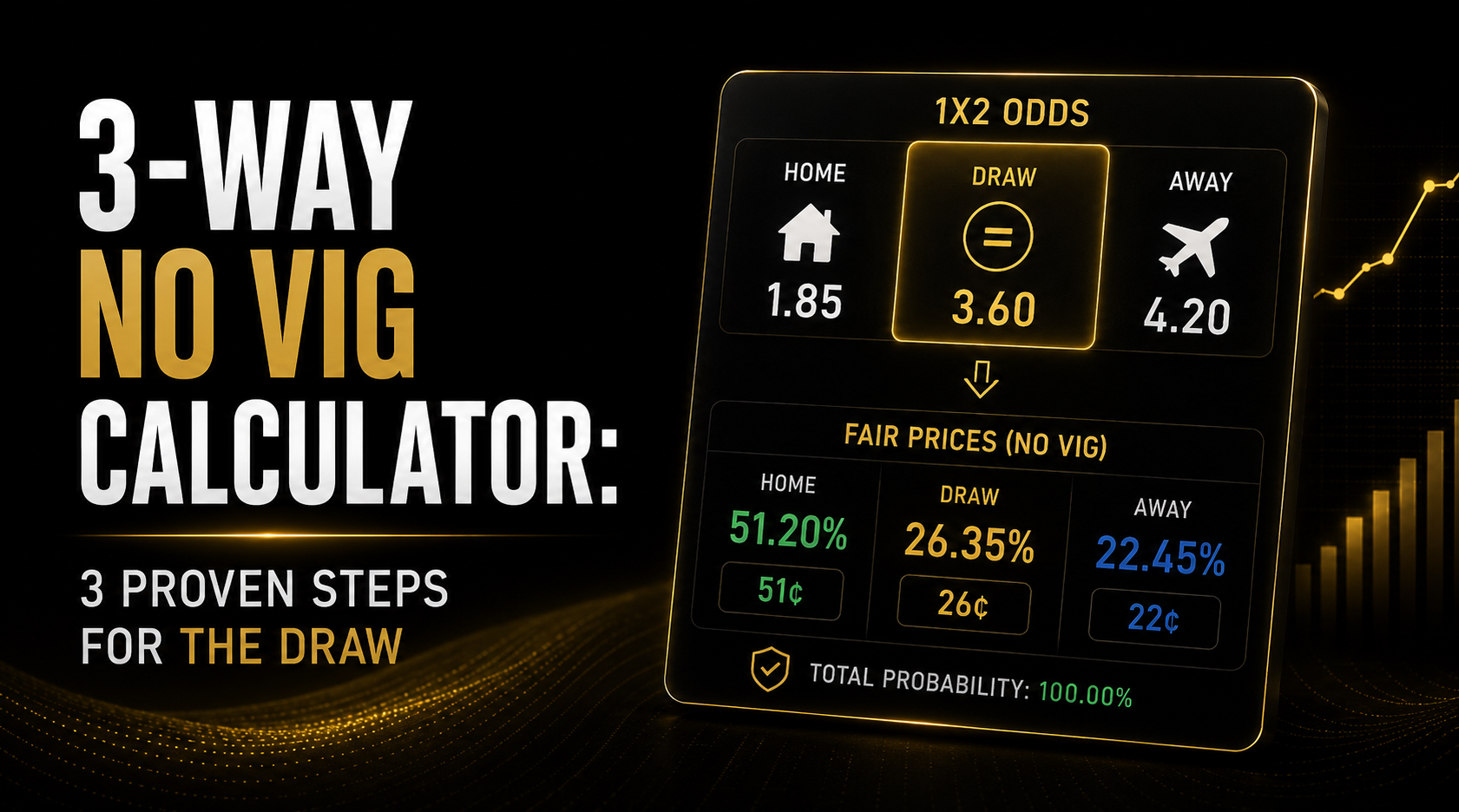
Use a line like this: home 1.85, draw 3.60, away 4.20. Enter only home and away into a two-way tool and the home side comes back near 69.4 percent.
Run the same match through a proper 3-way calculator with the draw included, and the home side settles at 51.2 percent. That’s an 18-point gap. The more confident-looking number is the wrong one.
How to Run the Math
Same three steps as a two-way devig, run across three numbers instead of two.
- Convert each price to implied probability. For decimal odds, that’s 1 divided by the price. Home at 1.85 is 54.05 percent. Draw at 3.60 is 27.78 percent. Away at 4.20 is 23.81 percent.
- Add all three together. 54.05 plus 27.78 plus 23.81 is 105.64 percent. The 5.64 points above 100 is the book’s margin on this line.
- Divide each outcome by that total. Home becomes 51.16 percent, draw becomes 26.29 percent, away becomes 22.54 percent. They now sum to 100 percent. Each one is the fair, no-vig chance for that result.
Read the home number back as a price and it lands near 51 cents. That’s the number worth checking against a live market price on the same fixture, not the 54.05 percent the raw odds implied.
Where Proportional and Additive Actually Disagree
The proportional technique, often called the multiplicative method, divides each implied probability by the total sum. That’s the calculation above. The industry default exists for two reasons. It’s simple, and it never produces an impossible negative number.
The additive method works differently. Instead of dividing, it subtracts an equal number of percentage points from every outcome.
Say the margin is 5.64 points across three outcomes. Additive removes 1.88 points from each one, flat. It doesn’t matter if that outcome started at 54 percent or 4 percent.
On a competitive match, these two barely diverge. On a heavy favorite, they pull apart. This is the comparison worth checking before you trust either one.avorite, they pull apart. This is the comparison worth checking before you trust either one.
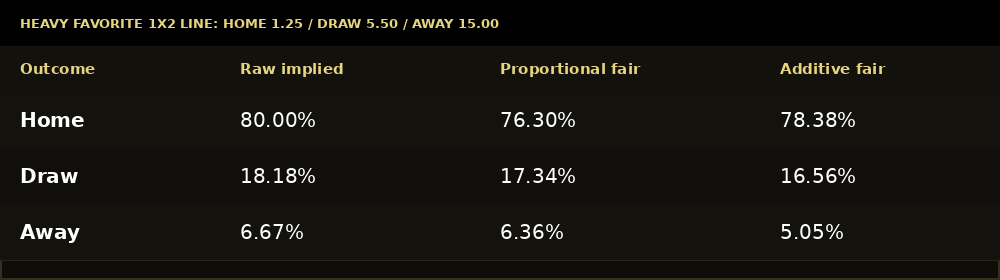
Look at the away column. Proportional keeps it at 6.36 percent. Additive drags it to 5.05 percent. That’s a relative cut of about 20 percent on that single number, while the home price barely moves.
That’s the favorite-longshot bias appearing as plain arithmetic. Books tend to overprice longshots against their true chance. Additive removes a flat number of points instead of a proportional share, so it happens to land closer to right on the extreme end. Punishing the small number harder isn’t correcting a bias on purpose.
Neither answer is the fair price for certain. A calculator using proportional gives you 6.36 percent on that away price. One running additive gives you 5.05 percent. If your trading threshold sits between those two numbers, the method you picked decided the trade before kickoff.
Read Wikipedia’s summary of the favourite-longshot bias to learn why longshot prices become overpriced in the first place. It covers the original horse-racing research behind this pattern.
Overround on Three-Way Football Lines
A standard two-way -110/-110 line runs about 4.76 percent overround. Three-way football lines usually run higher. That’s not because the book is greedier. There’s simply a third outcome to price, and three prices leave more room for the margin to hide.
Mainstream retail books commonly run 4 to 6 percent overround on a 1X2 line. Pinnacle sets prices to attract sharp betting volume, not to protect against it. So it usually runs 2 to 3 percent on the same fixture.
That gap compounds. A retail line gives you a bigger, messier margin to remove than Pinnacle does. Whatever the book got wrong about the draw comes along too.
Overround: The margin by which a bookmaker’s listed odds total more than 100 percent once translated into implied probability. The excess is the book’s structural edge. A three-way market spreads that excess across home, draw and away instead of two sides. That’s part of why three-way margins look higher at a glance, even when the book isn’t charging more per outcome.
Which Method Should You Actually Use
Most of the time, the answer is proportional. The default has a reason.
It’s simple. It never breaks with a negative number. In a near-balanced match, it agrees with every other method.
Reach for something else only when the line is genuinely lopsided. A rough guide: the favorite sits below 1.40, or the longshot sits above 8.00. That’s where the gap in the table above starts mattering.
Power and Shin both correct for the favorite-longshot bias in a more intentional way than additive does. Designers built both to avoid the negative-probability problem that additive can hit on extreme longshots. If you only learn one method beyond proportional, make it power. Most pro bettors use it because it adjusts the longshot without overshooting the middle of the market, the way Shin sometimes does.
Here’s a quick sanity check that skips a second formula entirely. Run the line through proportional, then check how far the favorite sits from evens.
Inside 1.60, trust the proportional number as it stands. Below 1.40, treat it as a rough estimate. Widen your entry threshold to cover the gap you saw in the table above. That one adjustment catches most of the practical damage, with nothing new to calculate.
Common Mistakes on Three-Way Lines
Dropping the draw to fit a two-way tool. This is the most expensive habit here. A two-way calculator has no slot for a third outcome, so people quietly leave the draw out.
The home side then reads 15 to 20 points too high on a lopsided fixture. That inflated number looks like a great price right up until it settles.
Assuming proportional and additive will agree. They do, closely, on a competitive match. They diverge hard on a heavy favorite, and if you’ve only ever devigged balanced fixtures, you won’t have noticed yet.
Comparing the fair price against a soft book’s line. A 3-way no vig calculator only gives you something useful if the input is trustworthy. Devig a book that has an 8 percent overround on a lopsided fixture.
You have modeled the book’s view of the draw, not the market’s.
Forgetting the draw has its own liquidity story. A draw priced at 26 percent fair might trade thin next to the home and away legs on a prediction market. The fair price tells you what to pay. It doesn’t tell you whether size is actually sitting there to fill it.
Treating fair probability as settled fact. Every method here, proportional or additive, is a model of how the book spread its margin. None of them observe the true chance directly.
Two independent sharp lines agreeing within a point of each other is a stronger signal than one line run through one method. That’s the same convergence test worth running on any fair value estimate before you size a position off it.
Frequently Asked Questions
Q: How do you devig a three-way market? A: Convert home, draw and away prices to implied probability. Add all three together, then divide each by that total. The result is three numbers that sum to 100 percent, not the raw total.
The raw total usually runs from 102 to 108 percent, depending on the book.
Q: Why does the draw change the no vig calculation? A: The draw carries a real share of the total chance, often 20 to 28 percent on a competitive fixture. Leave it out and that share doesn’t disappear. It lands on whichever two outcomes you did enter, usually inflating the favorite’s fair price.
Q: Which devig method is best for football? A: There’s no single right answer, but proportional is the standard default. It’s simple and never produces a negative number. On heavily lopsided 1X2 lines, methods that correct the favorite-longshot bias, like power or Shin, track results more closely, especially on the extreme underdog price.
Q: Can you use a two-way no vig calculator on a 1X2 market? A: Not accurately. A two-way tool has no field for the draw. Run a 1X2 line through a two-way tool and you either drop an outcome, or you get a result that doesn’t sum to 100 percent across all three outcomes.
Q: What is the overround on a typical three-way football line? A: Mainstream sportsbooks commonly run 4 to 6 percent overround on a standard 1X2 line. Sharp books like Pinnacle typically run 2 to 3 percent on the same fixture. That’s part of why a sharp line makes a cleaner input for a 3-way no vig calculator.
Q: Is a 3-way no vig calculator different from a regular no vig calculator? A: Only in how many prices it accepts. The underlying math, implied probability summed and rescaled, is identical. A 3-way version uses three input fields instead of two, so you won’t drop a draw by accident.
Q: Does the draw carry more vig than the favorite or the underdog? A: It varies by book. But the draw often occupies a bigger share of the margin on lopsided fixtures. Casual bettors often price the draw less accurately. That’s part of why including it properly matters more on skewed matches than balanced ones.
Q: What does “no vig calculator soccer” typically refer to? A: Almost always a 3-way tool. Soccer’s 1X2 format is the most common three-outcome market bettors run into. That’s why a soccer-specific no vig calculator needs three input fields by default instead of two.
Q: How much does the devig method actually change my entry price? A: On a competitive match, a fraction of a point either way, rarely enough to change a decision. On a heavy favorite, the gap between methods can be two or more points on the favorite. It can be a much bigger swing on the longshot leg. That’s exactly the situation where checking a second method earns its keep.
Final Thoughts
The two-way habit is hard to unlearn because it works fine right up until it doesn’t. Most weekends give you competitive fixtures where proportional and additive land close enough that the method barely matters. Then a heavy favorite arrives, and the shortcut that felt harmless all season quietly overstates the price you thought you had.
A 3-way no vig calculator isn’t solving a different problem than a two-way one. The draw is refusing to disappear before the math starts. That’s a small design choice with an outsized effect on a Saturday with a lopsided fixture list.
Run the draw through it every time, even when it looks like the least interesting number on the coupon. It’s usually the one hiding the biggest gap between what the book is charging and what the market thinks.