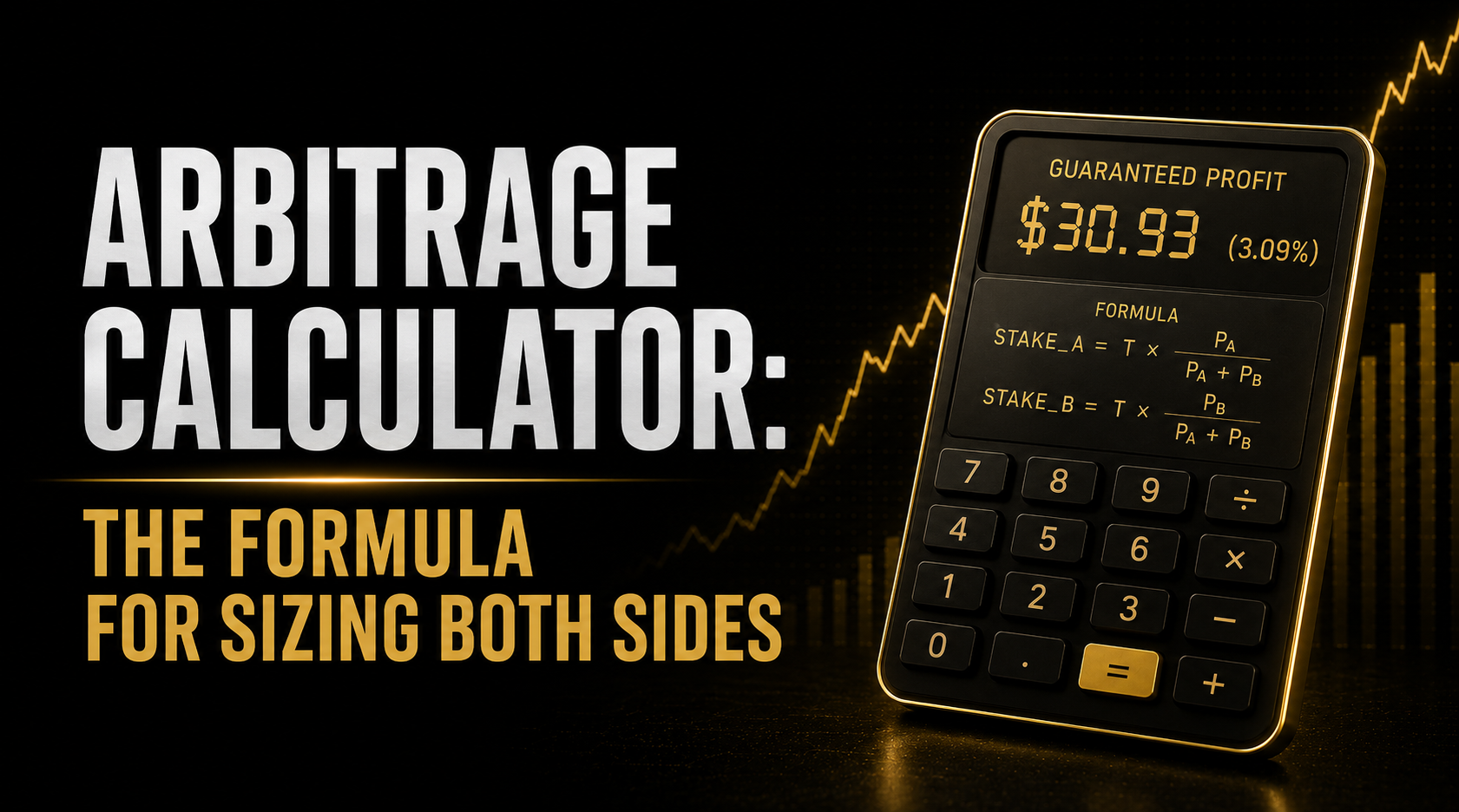
Arbitrage Calculator: The Formula for Sizing Both Sides
You spot it. Polymarket has YES at 46 cents. Kalshi has NO at 51 cents on the same event. Add those together and you get 97, not 100. That gap is a real arbitrage.
Here’s where most people get it wrong. They put the same dollar amount on each side. That’s not how you lock in a guaranteed profit regardless of which way the event breaks. It’s how you lock in an uneven one, and sometimes a smaller one than the gap actually offers.
An arbitrage calculator exists to fix exactly this. Not to find the gap, you already found that, but to tell you how much to put on each side so your profit is identical no matter which outcome hits.
Table of Contents
Quick Answer
An arbitrage calculator sizes two offsetting positions so your profit is the same regardless of which outcome happens. You don’t split the stake evenly. You split it proportional to each leg’s price, putting more money on the cheaper side and less on the more expensive one. Done right, a 3-cent gap between two venues returns roughly 3 percent on the total stake, guaranteed, before fees.
Key Takeaways
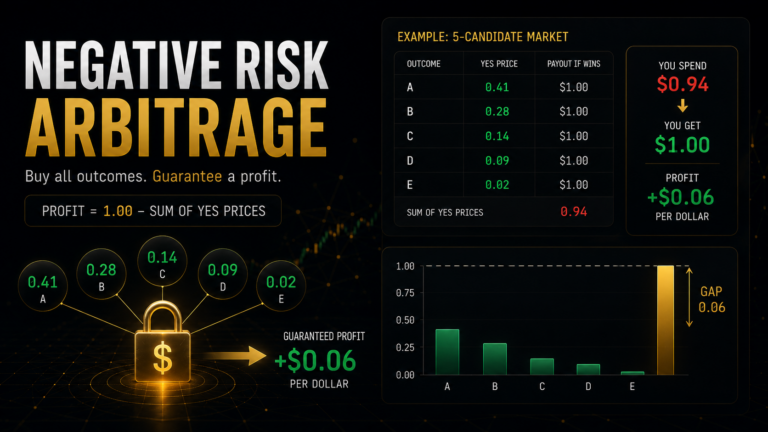
- Arbitrage exists when the same event prices differently enough across two venues that buying both sides costs less than the guaranteed $1 payout.
- Splitting your stake evenly across both legs is the most common mistake. It doesn’t guarantee equal profit unless the two prices happen to be identical.
- The correct split is proportional: stake on each leg equals your total stake times that leg’s price, divided by the sum of both prices.
- A gap has to clear your total transaction cost, fees on both venues plus any slippage from buying size, or the arb isn’t real once you actually execute it.
- Arbitrage opportunities close fast once enough people are watching for them. The math staying correct doesn’t mean the gap stays open long enough to fill both legs.
- Two-way arbitrage across prediction markets is simpler than sportsbook arbitrage, because every contract pays exactly $1 regardless of size, with no odds-format conversion needed first.
What Arbitrage Betting Actually Means
Arbitrage (arb): A position built from two or more offsetting bets on the same event, priced such that the total cost is less than the guaranteed payout, producing a profit regardless of the outcome. The word gets used loosely for “a good bet.” A real arb isn’t a good bet. It’s not a bet at all in the normal sense, since you’re not exposed to which outcome happens. You’re exposed only to execution risk: filling both legs at the prices you planned on, before either venue moves.
On a prediction market, this is more mechanically clean than classic sportsbook arbitrage. Every contract settles at exactly $1 if it resolves YES, and $0 if it resolves NO. Buy YES on one venue and NO on the other for the same event, and one of your two positions always pays out in full. The only question is whether the combined cost of both positions is less than that guaranteed dollar.
This two-venue version is distinct from intra-market arbitrage on Polymarket itself, where the mispricing sits between related contracts on the same platform rather than between two separate venues. The sizing principle below applies to both, but the execution risk is different: one venue is faster to fill than two.
The Sizing Formula
Here’s the part a naive even split gets wrong. If the two prices aren’t equal, splitting your stake 50/50 doesn’t produce equal profit on both outcomes; it produces a bigger profit if one specific outcome hits and a smaller one if the other does.
To guarantee the exact same profit regardless of outcome, size each leg proportional to its price:
Stake on Leg A = Total stake × (Price A ÷ (Price A + Price B)) Stake on Leg B = Total stake × (Price B ÷ (Price A + Price B))
This works because a cheaper leg buys more shares per dollar, and a more expensive leg buys fewer. Weighting your stake by price cancels that difference out, so the payout, and therefore the profit, lands identical no matter which side resolves true.
The Arbitrage Calculator: Run Your Own Numbers
The formula above is exactly what powers the calculator on this page. Enter both venue prices and your total stake, and it returns the proportional split and the guaranteed profit instantly, no manual arithmetic required.
That’s worth using even when the math is simple, because the calculator removes the one place people actually make mistakes under time pressure: typing the wrong price into the wrong side, or rounding a stake in a way that quietly breaks the equal-profit guarantee. The worked example below shows exactly what the calculator is doing under the hood, so you know what a correct output should look like before you trust it with real size.
How an Arb Actually Gets Priced: A Worked Two-Venue Example
Back to the Polymarket YES at 46 cents, Kalshi NO at 51 cents example. The combined price is 97 cents. That 3-cent gap under 100 is the raw edge before you size anything.
Say you want to put $1,000 total to work across both legs.
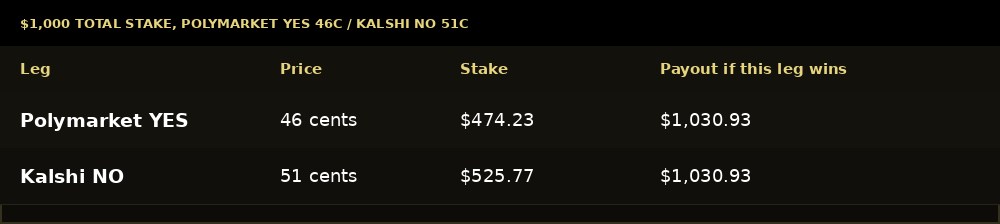
Stake the YES leg at $1,000 × (46 ÷ 97) = $474.23. Stake the NO leg at $1,000 × (51 ÷ 97) = $525.77.
If the event resolves YES, the Polymarket leg pays $474.23 ÷ 0.46 = $1,030.93. If it resolves NO, the Kalshi leg pays $525.77 ÷ 0.51 = $1,030.93. Same number either way. Profit is $30.93 on $1,000, or 3.09 percent, locked in before either outcome happens.
Compare that to splitting $500 and $500 evenly instead: a YES resolution would pay $500 ÷ 0.46 = $1,086.96, a NO resolution would pay $500 ÷ 0.51 = $980.39. One outcome nets you a much bigger win, the other nets you an actual loss. That’s not arbitrage anymore. That’s a directional bet that happens to look safe on the surface.
Where the Edge Disappears
A 3-cent gap on paper doesn’t mean a 3-cent gap in your account. Three things eat into it before you ever see the money.
Fees on both venues. Every leg you fill likely carries its own fee, whether that’s a flat percentage or a per-contract charge. Run both fee schedules against the position size before assuming the full gap survives to settlement.
Slippage on size. Prices quoted on screen are for the next share, not for your entire order. A gap that looks like 3 cents at quote size can shrink once you’re actually filling $500 into a thin order book, because your own buying moves the price against you partway through the fill. This is the same slippage mechanic that erodes edge on any single-venue position, just happening on two order books instead of one.
Execution timing. You’re filling two separate venues, not one. If the second leg fills a few seconds after the first, at a worse price than you planned, you’ve locked in a smaller edge than the calculation promised or, in a bad case, no edge at all.
The floor for a two-way arb to still be worth doing after all of this typically sits meaningfully above a bare breakeven gap. If your calculator says the raw gap is 1 cent, fees and slippage on two separate venues can eat that entirely before you ever collect it.
Is Arbitrage Betting Still Profitable in 2026?
Yes, but the easy version of this trade got harder as more people started watching for it. Wide, obvious gaps that used to sit open for hours now close in minutes once a market moves, because pricing tools and monitoring scripts across both retail sportsbooks and prediction markets have gotten faster and more common.
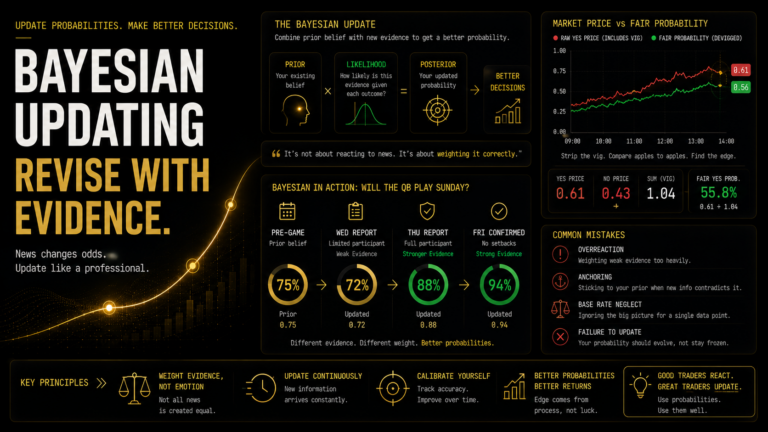
What’s changed less is the underlying mechanism. Two venues with different participant bases, different information flows, and different liquidity will keep producing pricing gaps, because nothing about combining a regulated exchange with a crypto-native one, or a sportsbook with a prediction market, makes their prices converge instantly. The opportunity is smaller and more competitive than it was, not gone. Reading fair value across venues is the same underlying skill that spots these gaps in the first place, whether you’re arbing them or just trading the mispricing directionally.
Common Mistakes
Splitting the stake evenly instead of proportionally. This is the single most common error, and it silently turns a guaranteed-profit position into a directional bet with uneven outcomes.
Ignoring fees until after finding the gap. A gap has to clear both venues’ fees plus slippage to be worth executing. Check this before sizing the position, not after.
Assuming quoted prices are your fill prices. Quotes are for the top of the book. Anything beyond the first few shares fills at a worse price, and a thin order book on either leg can erase the edge before you finish the position.
Treating the two legs as simultaneous when they aren’t. Manual execution across two separate platforms takes time. A gap can close between filling leg one and filling leg two, leaving you with an unhedged position instead of a locked-in arb.
Forgetting resolution risk when the two venues don’t define the event identically. If Polymarket’s contract and Kalshi’s contract resolve on slightly different criteria for what counts as the outcome, you don’t have a clean arbitrage. You have two separate bets that happen to usually agree.
Frequently Asked Questions
Q: How do you size an arbitrage bet across two venues? A: Stake each leg proportional to its price: stake on a leg equals your total stake times that leg’s price, divided by the sum of both prices. This guarantees identical profit regardless of which outcome resolves true, unlike an even split.
Q: What’s a good arbitrage calculator formula? A: Stake A = Total × (Price A ÷ (Price A + Price B)), and Stake B = Total × (Price B ÷ (Price A + Price B)). Profit works out to Total × (1 ÷ (Price A + Price B) − 1), before fees and slippage.
Q: Is sports arbitrage betting still profitable in 2026? A: Yes, but gaps are smaller and close faster than in past years, since more tools and traders now watch for them across both sportsbooks and prediction markets. The mechanism that creates gaps, different venues with different participants and liquidity, hasn’t gone away.
Q: Can you lose money on an arbitrage bet? A: Yes, if execution risk isn’t accounted for. If one leg fills at a worse price than planned, if fees exceed the gap, or if the two venues don’t resolve the event identically, what looked like a locked-in profit can turn into a real loss.
Q: How big does the price gap need to be to arbitrage profitably? A: Big enough to clear both venues’ fees plus expected slippage on your position size. A 1 to 2 cent gap can vanish entirely after transaction costs on two separate platforms; gaps need to clear that floor with room to spare, not just clear zero.
Q: Is arbitrage betting the same as an arb bet? A: Yes, “arb bet” and “arbitrage bet” describe the same thing: a position built from offsetting bets on the same event, priced so the total cost is under the guaranteed payout.
Final Thoughts
The math behind an arbitrage calculator is simple once you see it: weight each stake by its own price, not by an even split. The harder part was never the formula. It’s fees eating the edge, slippage moving the price mid-fill, and two venues taking their own sweet time to both execute.
Treat the calculator’s output as the starting size, not the guaranteed profit. The gap between what the formula says and what actually lands in your account is entirely made up of the things listed above, and every one of them is checkable before you commit capital, not after. Run your own two prices through the calculator above before you size anything for real; it’s faster than redoing this math by hand every time a new gap shows up.