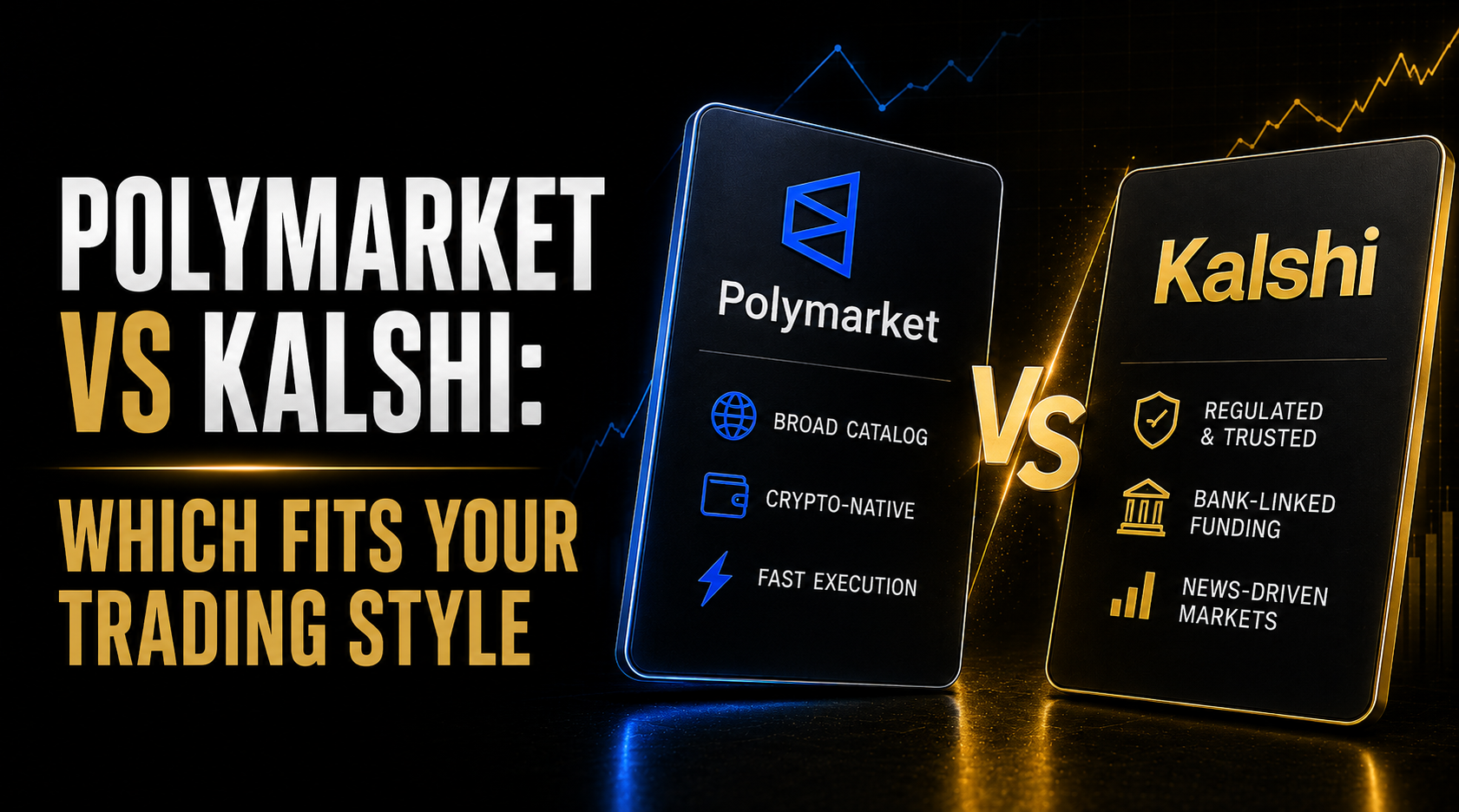
Polymarket vs Kalshi: Which Fits Your Trading Style
Two traders watch the same Fed rate decision market. One’s been running size on Polymarket for a year and can’t get comfortable on Kalshi. The other started on Kalshi and finds Polymarket’s interface disorienting.
Neither is wrong about fees, and neither is really arguing about liquidity. They’re arguing about fit. The platform that rewards your actual trading habits matters more than the platform that wins a spreadsheet comparison, and that’s the question this piece answers instead of re-running the fees and liquidity numbers you’ve probably already seen.
Table of Contents
Quick Answer
Kalshi tends to fit traders who want regulatory certainty, a bank-linked funding flow, and categories that map closely to news and economic data. Polymarket tends to fit traders who want the broadest event catalog, crypto-native execution speed, and comfort operating without a KYC gate. Neither is objectively better; they reward different habits and different risk tolerances around regulatory structure.
Key Takeaways
- Kalshi’s KYC-first, bank-account model suits traders who want a paper trail and regulatory certainty over frictionless setup.
- Polymarket’s wallet-first model suits traders already comfortable holding and moving crypto, and who value catalog breadth over structural oversight.
- Kalshi vs Polymarket volume and kalshi vs polymarket market share both shift by category. Neither platform leads across every market type.
- A trader migrating from a traditional sportsbook usually finds Kalshi’s UI and event framing more familiar than Polymarket’s.
- Slippage behaves differently on each platform, and it matters more to a scalper running frequent small trades than to someone holding a single directional position to resolution.
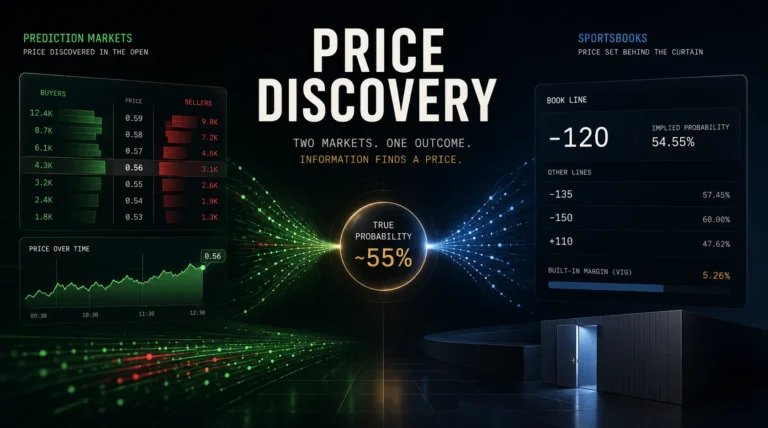
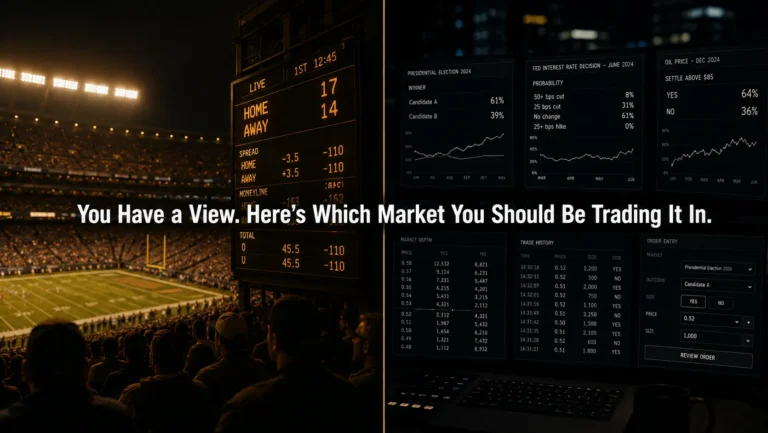
- Kalshi vs Polymarket vs DraftKings isn’t really a three-way comparison. DraftKings is a sportsbook with fixed odds; the other two are order-book markets where the price moves as you trade.
Match Your Style to the Platform
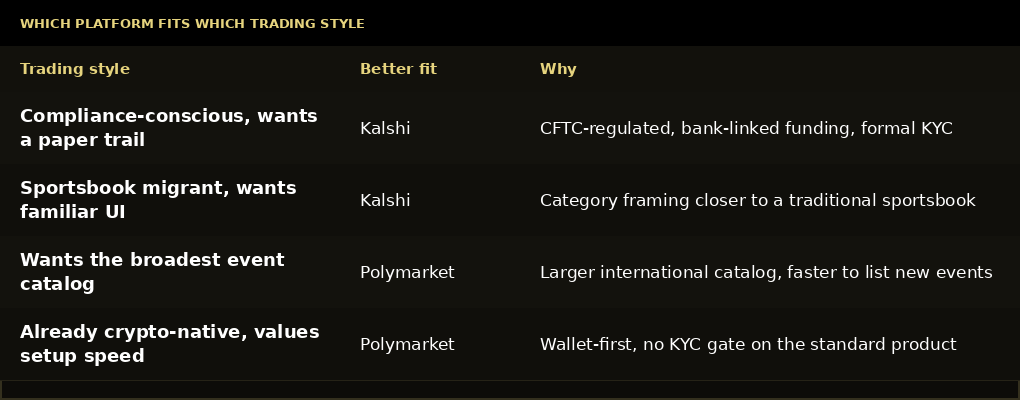
None of this replaces the fees-and-liquidity math. If a specific trade is more profitable on one venue net of costs, that number wins regardless of style fit. This table is for the more common case: two roughly comparable prices, and the deciding factor is which platform you’ll actually execute well on. Kalshi’s side of that table only holds because it’s registered with the Commodity Futures Trading Commission as a designated contract market, a specific regulatory status worth understanding on its own terms rather than taking “regulated” at face value.
What Reddit Gets Right and Wrong About Kalshi vs Polymarket
The recurring theme across kalshi vs polymarket reddit and polymarket vs kalshi reddit discussion is usually some version of “which one is cheaper,” and that framing undersells the real difference. Reddit tends to get the fee comparison roughly right, since fee schedules are public and easy to check. Where threads tend to go wrong is treating the platforms as interchangeable once you adjust for fees, when the funding model, KYC requirement, and catalog differences matter just as much to whether you’ll actually use the platform consistently.
The other recurring miss: threads comparing kalshi vs polymarket vs draftkings as if they’re the same category of product. DraftKings prices a fixed line and takes the other side of your bet. Kalshi and Polymarket are both order-book markets where you’re trading against other participants, and the price moves as size trades through it. That’s a structural difference, not a fee difference, and it changes how you should think about execution on either one.
Slippage: The Style-Dependent Cost Nobody Prices In Upfront
What is slippage in trading Kalshi, practically speaking? The same mechanic covered in DG3’s broader slippage piece: your fill price moves against you as your order works through the available size at each price level. It applies to both platforms, but it bites differently depending on your style.
A trader holding one position to resolution barely notices slippage, since it’s a one-time cost on entry and exit. A trader scalping small edges repeatedly feels it on every single trade, and thin order books on lower-volume markets make it worse on both venues. If your style is high-frequency and size-sensitive, check depth at your typical trade size on both platforms before assuming either one is structurally cheaper to trade on.
Can You Use Polymarket in the US? Access, Legality and How to Trade
This deserves a direct answer rather than a footnote: yes, with important caveats, and the caveats are the part worth reading before you assume either “fully blocked” or “fully open.” Polymarket’s original wallet-based product has restricted US access. A separate, regulated product path exists for US residents, and how it’s positioned continues to develop. Confirm the current access and legality position directly on Polymarket’s own site or with your own legal counsel before assuming last year’s framing still applies; this is a genuinely moving target and not something to take on faith from any single blog, including this one.
For the fuller regulatory and fee picture beyond just US access, the complete Kalshi vs Polymarket comparison covers that ground in depth. For the operational side, funding both accounts, KYC, and withdrawal timing, the execution-focused guide picks up where this piece leaves off.
Common Mistakes
Picking a platform based on a single fee comparison and ignoring style fit. The cheaper platform on paper isn’t the better platform if its funding model or interface means you trade less often or less confidently.
Treating Kalshi vs Polymarket volume and market share as fixed. Both shift by category and by news cycle. A platform that leads on political markets this month isn’t guaranteed to lead on sports or economic data markets too.
Assuming Reddit sentiment reflects your specific use case. Community threads skew toward whoever’s most vocal that week, usually people annoyed about a fee or a UI change, not a representative sample of typical experience.
Ignoring slippage until a scalping strategy stops working. A style that trades frequently and in size needs to check order book depth on both platforms, not just headline liquidity numbers.
Frequently Asked Questions
Q: What is slippage in trading Kalshi? A: The gap between the price you expected and the price you actually filled at, caused by your own order working through the available size at each price level in the order book. It applies on Polymarket too, and matters more to high-frequency styles than to buy-and-hold positions.
Q: What does Reddit get right and wrong about Kalshi vs Polymarket? A: Fee comparisons on Reddit are usually roughly accurate, since fee schedules are public. Where threads tend to miss is treating the platforms as interchangeable once fees are equal, when funding model, KYC, and catalog differences matter just as much to which one you’ll actually use well.
Q: How do I trade weather markets on Kalshi? A: Weather markets on Kalshi work the same as any other series: browse the weather category, review the current market prices, and place an order like you would on any other Kalshi contract.
Q: Can you use Polymarket in the US? A: Access and legality here have shifted and continue to develop. Confirm the current position directly with Polymarket or your own counsel rather than relying on any single source, including this one, since this is an area that changes.
Q: Is Kalshi vs Polymarket vs DraftKings a fair three-way comparison? A: Not structurally. DraftKings is a fixed-odds sportsbook. Kalshi and Polymarket are both order-book markets where your own trading affects the price. Compare Kalshi and Polymarket to each other, and compare either one to DraftKings on a different axis, cost structure and format, not identical mechanics.
Final Thoughts
Fees and liquidity are the easy comparison because they’re the easy numbers to pull. Style fit is harder to quantify, and it’s the reason two traders can look at the same fee schedule and reach opposite conclusions about which platform is “better.”
If you’re still deciding, the honest test isn’t a spreadsheet. It’s funding a small account on each platform and running a handful of real trades through both. The one where you actually execute cleanly and check the app without dreading it is very likely the one that fits, regardless of what the fee comparison says.