How to Trade Sports on Polymarket: The Complete Playbook
The match winner market on Polymarket moves 9 cents in the hour before kickoff. The spread contracts. Large wallets enter on the away team. The home team’s key midfielder has just been ruled out in the pre-game press conference.
Most traders are still watching the pre-match show.
Sports prediction markets on Polymarket reward speed of interpretation, not speed of reaction. The traders who make consistent money are not the ones who see the news first. They’re the ones who already know what it means.
That distinction is everything. They are the ones who have already formed a probability estimate, know how much the midfielder’s absence should move the price, and can compare that against the current market in 60 seconds.
Table of Contents
Quick Answer
Sports markets move fast.
Knowing how to trade sports on Polymarket comes down to one skill: taking probability positions on match outcomes, tournament outrights, player props, and total goals markets using binary or multi-outcome contracts. The primary edge sources are information timing (acting before injury news fully reprices the market), domain expertise (understanding what a specific injury or lineup change actually means for win probability), and pre-event positioning on scheduled catalysts with known timing like team sheets, injury report windows, and tournament draws.
Key Takeaways
- Sports prediction markets are more efficient than most traders expect. Less efficient than the sharpest sportsbooks.
That gap is where the work happens. The participant pool is larger and more diverse than casual observers assume, which means obvious mispricings are arbitraged quickly. The exploitable inefficiencies are in specific windows: the 30-60 minutes after new information drops before the market has fully absorbed it, and in market types with thin liquidity where crowd pricing lags the informed view.
- The most consistent edge source is not picking winners. It is correctly assessing what specific news means for the probability before the rest of the market processes it. An injury to a backup midfielder is not the same as an injury to the primary striker. Most participants cannot distinguish between them in real time. You can, if you know the team.
- Team sheet release windows are the highest-density signal period in football prediction markets. In the 30-60 minutes between team sheet publication and kickoff, the market is absorbing multiple pieces of simultaneous information: lineup confirmations, notable absences, formation choices, and injury status changes. Being positioned before the team sheet drops, with a probability estimate already formed, is where pre-event edge lives.
- Sharp sportsbook line comparison is the fastest external validator for your probability estimate. If Pinnacle has moved 3 cents in the home team’s direction after the team sheet and Polymarket has not yet fully absorbed it, the divergence is both a directional signal and a potential entry price. The reference book and Polymarket should converge, the question is which way and how fast.
- Total goals markets are systematically underresearched.
Fewer participants. Shallower depth. Slower correction. Most casual Polymarket sports traders focus on match winners. This means the analytical depth in total goals, first team to score, and half-time result markets is shallower, and the participant pool is smaller. The trade-off is thinner liquidity. That limits position size, not edge.
- Tournament outright markets offer a different edge profile than match markets. The time horizon is longer, the probability estimates are more model-dependent, and the participant pool includes more systematic capital. Edge in outrights is harder to find but longer-lasting when found, a well-researched pre-tournament position can persist through multiple group games as the market slowly absorbs the same information your model already processed.
- Holding every position until resolution is usually wrong. Prediction market prices update continuously. If your thesis has played out, the injury proved minor, the team won their first game, the market has repriced to your fair value, selling at the current price and rotating capital to the next opportunity is almost always better than waiting for the resolution payout.
What Sports Markets Are Available on Polymarket
Start here.
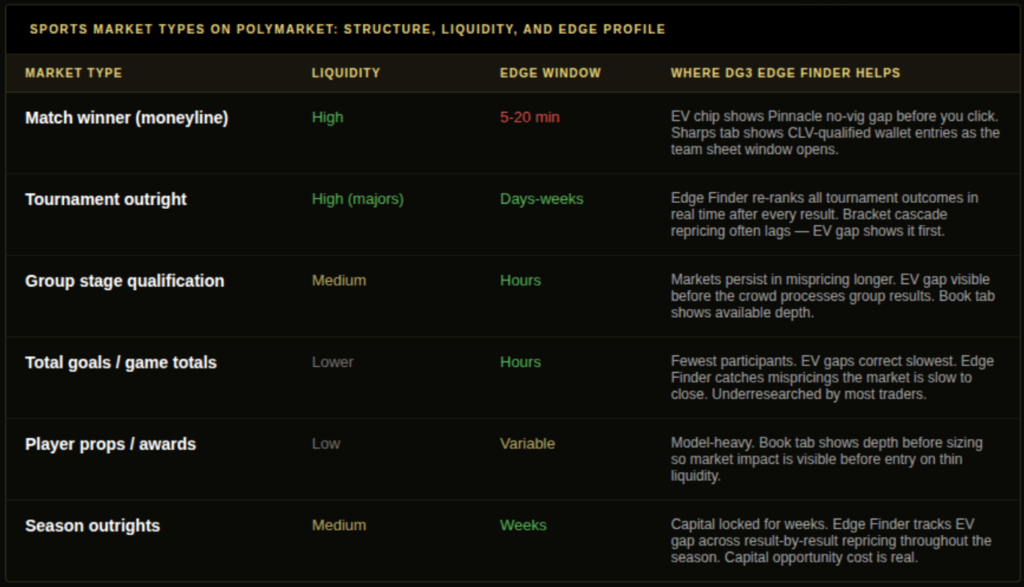
Polymarket runs a wide range of sports markets, with depth concentrated in football (soccer), American sports (NFL, NBA, MLB, NHL), cricket, esports, and tennis during major tournaments.
Match winner markets: Binary YES/NO on each team winning, plus a separate draw contract for football. The most liquid sports market type on Polymarket.
Tournament outright markets: Multi-outcome contracts on which team will win a tournament. During the 2026 FIFA World Cup, the winner market exceeded $2.6 billion in total volume. Outright markets run for the full tournament duration.
Group stage markets: Which team advances from the group, which team finishes top of the group. Medium liquidity. Opens at tournament start, resolves after group stage completion.
Player props and individual awards: Markets on individual performance outcomes, top scorer, Ballon d’Or winner, award markets. Typically lower liquidity and more model-dependent than team markets.
Total goals / game totals: Binary contracts on whether a match will produce over or under a total goals threshold. Lower liquidity than match winners but systematically underresearched.
Season outrights: Which team wins the league, who finishes in the top four, relegation markets. Long time horizon, high model dependency.
Also read: Sports Betting vs Prediction Markets
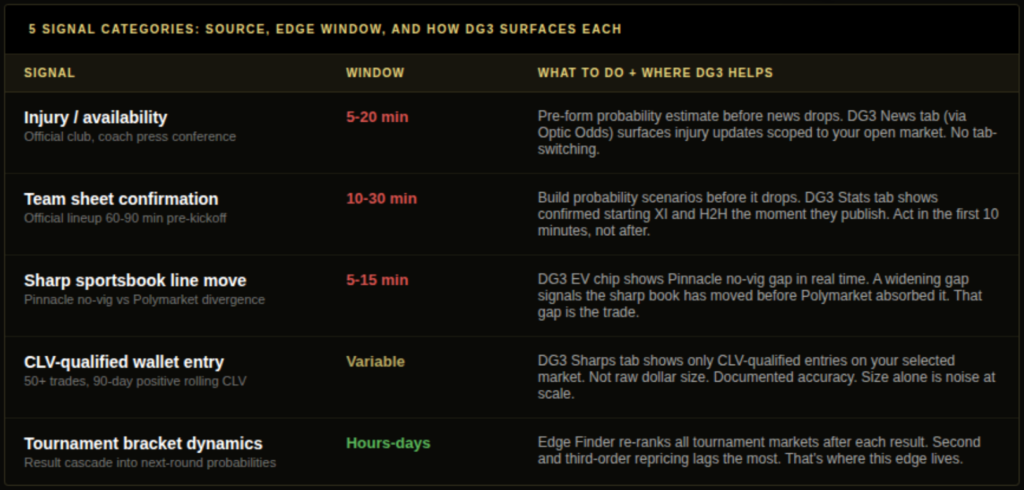
The 5 Signals That Move Sports Prediction Market Prices
Signal 1: Injury and Availability News
The most impactful signal category in sports prediction markets. The mechanism: a key player’s availability directly affects win probability, and the market’s price adjustment typically lags the informed interpretation by 5-20 minutes.
Not all injuries are equal. A confirmed absence of a primary striker affects win probability meaningfully. A knock to a backup midfielder does not. The edge is in correctly classifying the injury impact before the market’s aggregate reaction catches up.
Track: official club announcements, local football press, manager press conferences (typically 60-90 minutes before kickoff for major leagues), and the club’s injury report (NFL: Wednesday practice report through Friday official designation).
Signal 2: Team Sheet and Lineup Confirmation
The moment the official starting eleven is published for a football match. This happens at different times by league: Premier League and Champions League publish confirmed lineups approximately 75 minutes before kickoff. La Liga: 60-75 minutes before. Other leagues vary.
The market begins pricing the team sheet information the moment it drops. In the 10-15 minutes after publication, the market is absorbing the full lineup simultaneously, starting players, notable absences, formation choices, and tactical implications. Traders who have pre-formed probability estimates for different lineup scenarios can act in that window before the market reaches the new equilibrium.
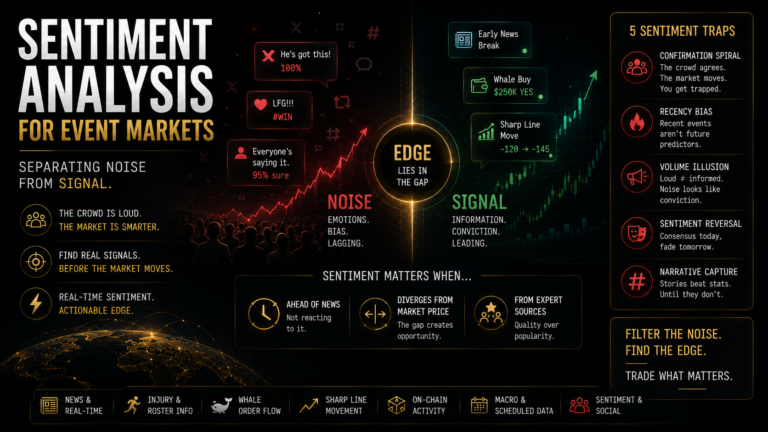
Signal 3: Sharp Sportsbook Line Movement
Pinnacle, Bet365, and similar sharp-accepting books move their lines when informed capital enters. When a sharp book moves meaningfully before the Polymarket price has fully adjusted, the divergence is both a directional signal and a window for entry.
The divergence narrows within minutes on liquid Polymarket markets. On thinner markets, it can persist longer. The comparison requires devigging both lines before comparing, since raw sportsbook prices and Polymarket prices include different margins.
Also read: Line Movement in Prediction Markets: Reading Sharp Moves Before They Finish
Signal 4: Large Wallet Order Flow
On-chain transaction data shows every trade on Polymarket by wallet address and size. Large entries from wallets with a documented track record of positive CLV – wallets like the one that built a $427,000 YES on Spain at 6 cents in the Morocco match, which closed at 94 cents, 50+ resolved trades in 90 days with positive rolling CLV, are meaningful signal. Size alone is not signal. Qualified size is.
The Sharps tab in DG3’s Intelligence pane shows only CLV-qualified wallet entries on the selected market. This is the practical implementation of the qualification logic: not every $30,000 order, only orders from wallets with documented accuracy.
Signal 5: Tournament Context and Bracket Dynamics
In knockout tournaments, each result changes the probability distribution for subsequent rounds. After Brazil beats France in the quarter-final, Brazil’s outright winner probability increases, France’s becomes zero, and the outright probabilities of the remaining teams adjust to reflect the new field.
Sophisticated tournament traders model these dependencies explicitly: what does each possible quarter-final result imply for the semi-final matchups and the outright winner distribution? Markets often lag on second and third-order implications because the modelling is non-trivial and most participants are reacting to first-order results.
Also read: Trading Signals That Actually Move Event Markets
How to Trade Sports on Polymarket: The Pre-Match Research Workflow
A consistent sports trading process has five stages. The specific research content varies by sport. The workflow is the same.
Stage 1: Form your probability estimate independently. Before opening Polymarket or any odds feed, estimate the probability of each outcome based on your own research. For football: squad depth and key player availability, recent form in this competition, home/away record, head-to-head history, and any available reference sportsbook line for calibration. Write the number down.
Stage 2: Compare against the devigged fair value. Open Polymarket and devig the current price. Compare your estimate against the honest market benchmark, not the raw price. If your estimate is 0.68 and the devigged fair value is 0.60, your edge is 8 cents. If the devigged fair value is 0.65 and your estimate is 0.68, your edge is 3 cents, potentially below the fee threshold.
Stage 3: Check the reference book. Look up the same market on Pinnacle or another sharp-accepting book. Devig their line. If the devigged Pinnacle probability is 0.64 and your estimate is 0.68, and the Polymarket devigged price is 0.60, you have two independent signals both suggesting Polymarket is underpricing the outcome. The convergence of your model and the reference book is not proof of edge, but it is a stronger foundation than your model alone.
Stage 4: Assess the order book. Check the depth available at your target entry price. How much can you buy at 0.60 before the price moves? If you want to enter $800 and the depth at 0.60 is only 400 shares ($240), a market order will move the price meaningfully against you before filling. Use a limit GTC order and let the position fill over time, or accept a higher average entry price.
Stage 5: Execute and record. Place the order. Record: entry price, your pre-entry probability estimate, the devigged fair value at entry, and your reasoning. This is the calibration input you will review in 90 days.
Start Here When the Research Is Done
Most traders do the research right. Form a probability estimate, check the reference book, read the order book.
Then they open Polymarket’s native interface, build an order from scratch, and by the time the form is submitted, 8 cents of the team sheet window are gone.
DG3 is a prediction market terminal built on top of Polymarket.
It compresses the gap between finishing your research and acting on it.
Search works differently here. Type “arsenal scorer” or “rcb vs csk toss” and results come back ranked by edge value, not by volume, not alphabetically. Every result row shows the live Polymarket price and an EV chip: the gap between the current price and the Pinnacle no-vig line. You see the edge picture before you click anything.
Once inside a match or stream, the Edge Finder surfaces every related Polymarket market ranked by EV gap in real time. Match winner, totals, first scorer, group stage, ordered by which one has the widest gap from fair value at this exact moment. If the team sheet just dropped and a market has repriced 9 cents, it moves to the top of the ranked list. You don’t need to know it happened. The ranking tells you.
The Intelligence pane sits alongside every market you open. The Book tab shows the live Polymarket order book, depth, spread, and mid-price, before you size anything. The Sharps tab shows entries from wallets with a documented positive Closing Line Value track record (50+ resolved trades, 90-day window), scoped to the specific market you are looking at. The News tab (via Optic Odds) surfaces injury confirmations and match updates tied to that market as they land. The Stats tab shows confirmed lineups and head-to-head data the moment they publish.
When you are ready, clicking any outcome chip in the Edge Finder pre-fills the Trade Desk with that outcome and the current Polymarket price. In 1-Click mode, the order goes through in under 2 seconds.
Your wallet, your USDC, your positions, all of it is on Polymarket. DG3 is what you see before each trade. And how fast you move when it matters.
Also read: What Is a Prediction Market Terminal? (And Why Traders Outgrow Raw Polymarket)
Common Mistakes
Mistake 1: Trading outside your domain knowledge. Learning how to trade sports on Polymarket profitably starts with restricting yourself to sports you actually follow. Prediction market signal interpretation depends on prior expectations. If you don’t know what a typical pre-match price movement looks like on a Champions League match, you cannot identify anomalies. You cannot read a signal without a baseline. Restrict high-conviction entries to sports and leagues you follow closely enough to have baseline expectations about normal price behaviour.
Mistake 2: Acting on raw transaction size without wallet context. A $45,000 entry on the away team looks meaningful. If the wallet making that entry has no resolved position history, it is size without signal. The same $45,000 from a wallet with 71 resolved trades and positive rolling CLV is a different data point entirely. Most free sports tracking tools show the dollar amount without the qualification context.
Mistake 3: Entering match markets after the team sheet drops and the initial move is complete. The team sheet drops. The market moves 8 cents toward one team in the next 12 minutes as the injury news is absorbed. You see the move and consider entering at the new equilibrium. By this point, the edge from the team sheet news has already been priced. You are not entering on the information, you are entering after it. The trades that capture team sheet edge are the ones placed in the 0-10 minutes after publication, not the 30-minute period after the market has finished absorbing it.
Mistake 4: Ignoring the time-to-resolution on pre-market positions. A tournament outright position entered 6 weeks before the tournament requires 6 weeks of capital deployment before resolution. That capital cannot be used for match-level opportunities with higher turnover in the same period. Tournament outrights have a place in a sports trading portfolio, but the opportunity cost of capital held for 6 weeks at a 5% position is real.
Mistake 5: Treating total goals markets as lower priority than match winners. The analytical depth on total goals markets is genuinely shallower than on match winners, because fewer participants focus on them. This means the edge opportunities are more persistent when they exist. A trader with a strong goals model (xG-based, weather-adjusted, venue-adjusted) operating in a less competitive market is better positioned than the same trader competing in the highly contested match winner market.
Frequently Asked Questions
Q: What sports markets are available on Polymarket and how to trade sports on Polymarket effectively? A: Match winners (football, NFL, NBA, cricket, tennis, esports), tournament outrights, group stage qualification, player award markets, total goals/game totals, and season-long markets. Liquidity is deepest in football match winners and major tournament outrights during active competition windows.
Q: How is sports trading on Polymarket different from sports betting? A: Three key differences. First, you trade against a two-sided order book of other participants, not against a house margin. Second, you can exit your position before resolution by selling shares at the current price. Third, you can take positions on both sides of the same market, buying YES on one team and YES on another via separate orders, with the prices reflecting the probability distribution across all outcomes.
Q: What signals move sports prediction market prices? A: Five primary categories: injury and availability news, team sheet and lineup confirmation, sharp sportsbook line movement, large wallet order flow with CLV qualification, and tournament context/bracket dynamics. The most impactful single signal is typically a confirmed key player absence in the 90-minute window before a major match.
Q: How do you research a sports trade on Polymarket? A: Form a probability estimate independently before checking the market price. Devig the current Polymarket price to get the honest benchmark. Compare against a sharp reference book’s devigged line for external validation. Check the order book depth before sizing. Record the entry price and your estimate for calibration review.
Q: How does DG3 help with sports market trading? A: DG3’s Edge Finder ranks active sports markets by the gap between current Polymarket price and fair value in real time. When a team sheet drops and a market reprices, the affected market rises in the Edge Finder ranking. The Intelligence pane’s Sharps tab shows CLV-qualified wallet entries on the selected market as they occur. The Book tab shows live order book depth before you commit to a size.
Q: When should you exit a sports prediction market position before resolution? A: When the price has moved to your fair value estimate, capturing the edge the trade was designed for. If you bought a match winner YES at 0.42 because you estimated true probability at 0.60, and the market has repriced to 0.59 after the team sheet confirmed no key absences, the thesis has played out. Selling at 0.59 and rotating to the next opportunity is typically better than waiting for the $1.00 resolution payout.
Final Thoughts
Sports prediction markets are not an easy edge. The participant pool on major football matches is more sophisticated than it was in 2022, liquidity is deeper, and obvious mispricings arbitrage faster.
The persistent edges are in timing and interpretation: being positioned before scheduled catalysts rather than reacting to them, correctly classifying what specific news means for probability faster than the aggregate market, and operating in market types (total goals, group qualification, player awards) where the analytical depth of the participant pool is shallower.
If you want to know how to trade sports on Polymarket and make it work consistently, domain knowledge is the non-negotiable variable. A trader who deeply understands how Premier League fixture congestion affects team selection, or how dew conditions shift IPL second-innings win probability at specific venues, carries an advantage that does not arbitrage away the same week someone else discovers it.
Build the domain. The edge follows. A trader who deeply understands how Premier League fixture scheduling affects team selection, or how dew conditions affect IPL second-innings teams at specific venues, has a permanent advantage over participants who lack that context. That advantage narrows over time as the market matures, which means the best time to build the domain is now.
Also read: Sports Betting vs Prediction Markets
Trading Signals That Actually Move Event Markets
Line Movement in Prediction Markets: Reading Sharp Moves Before They Finish
NFL Prediction Markets