NFL Prediction Markets: A Trader Guide for the 2026 Season
The Thursday Night injury report lands at 4:00 PM Eastern. By 4:06 PM, the Polymarket game winner market for Sunday’s match has moved 7 cents. By 4:11 PM it has moved another 4. You read the report at 4:09 PM and thought: this changes things.
It did. It just changed things 9 minutes before you were watching.
NFL prediction markets in 2026 are not simple. They are populated by traders who follow beat reporters, monitor injury designations, and have built probability models on three seasons of snap count data. But they are not efficient. The crowd is large and often emotional. The signal-to-noise ratio on certain market types is genuinely exploitable. And the season runs for 18 weeks, which means a systematic approach compounds across a volume of games that weekly sports cannot match.
Table of Contents
Quick Answer
NFL prediction markets on Polymarket in 2026 cover game winners, spreads, totals, season-long award futures, Super Bowl outrights, and player props. The best edge opportunities sit in injury-signal timing (acting on practice reports before the line fully adjusts), load management interpretation (correctly reading rest-day decisions by teams in playoff positions), game-total markets on weather games (wind and temperature have calculable effects that crowd pricing systematically underweights), and series-level futures (the Super Bowl winner market is less efficient than the game-by-game markets because fewer domain experts trade it relative to its volume).
Key Takeaways
- NFL prediction markets are the highest-volume sports category on Polymarket during the regular season. That volume creates tighter spreads on game winner markets but also means the crowd is larger and more reactive to noise signals like injury designations that rarely affect game outcomes.
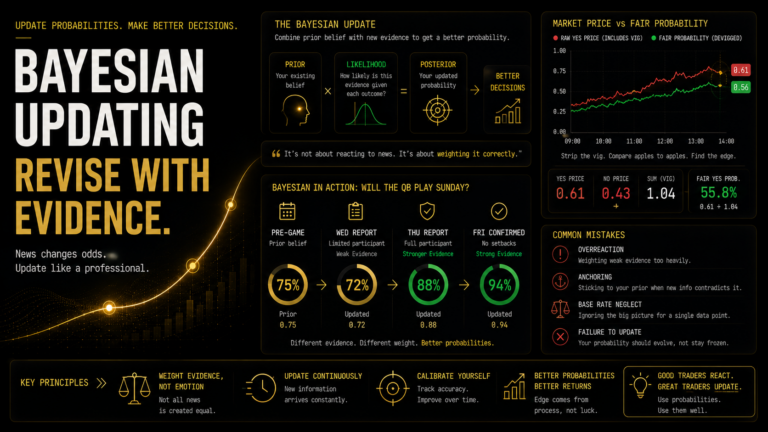
- The Wednesday-to-Friday practice report window is the most exploitable information timing gap in NFL prediction markets. A Limited designation on Wednesday for a skill player moves markets immediately. A Full participation on Friday reverses most of that move. A trader who correctly interprets the Wednesday designation as precautionary noise rather than genuine concern has a 48-hour edge window on the reversal.
- Weather markets are systematically mispriced by the NFL prediction market crowd in the same direction as the general public: they overweight game-winner adjustments and underweight total-points adjustments. A game with forecast sustained wind above 20 mph in an open stadium reduces expected scoring by approximately 3-7 points. Game totals on these matchups are frequently priced as if the weather impact is 40-50% of the actual statistical effect.
- Super Bowl outrights and conference championship futures trade at notably wider edge windows than individual game markets. The crowd thins out on futures because fewer participants model multi-round tournament probabilities accurately. A team at 12% to win the Super Bowl after Week 4 with a 3-1 record, 14th-ranked DVOA, and a healthy quarterback entering their bye week is often 3-5 cents underpriced relative to correct probability.
- The load management signal is less applicable to NFL than to NBA (teams rarely rest key players during the regular season except for late-week decisions by teams with clinched seeding), but game-time decision designations within 90 minutes of kickoff on Polymarket are the highest-value execution window in the NFL calendar.
- Most NFL prediction market traders lose not because they read games wrong but because they follow public narrative rather than probability. The crowd prices games based on last week’s highlights. The edge is in knowing this week’s numbers.
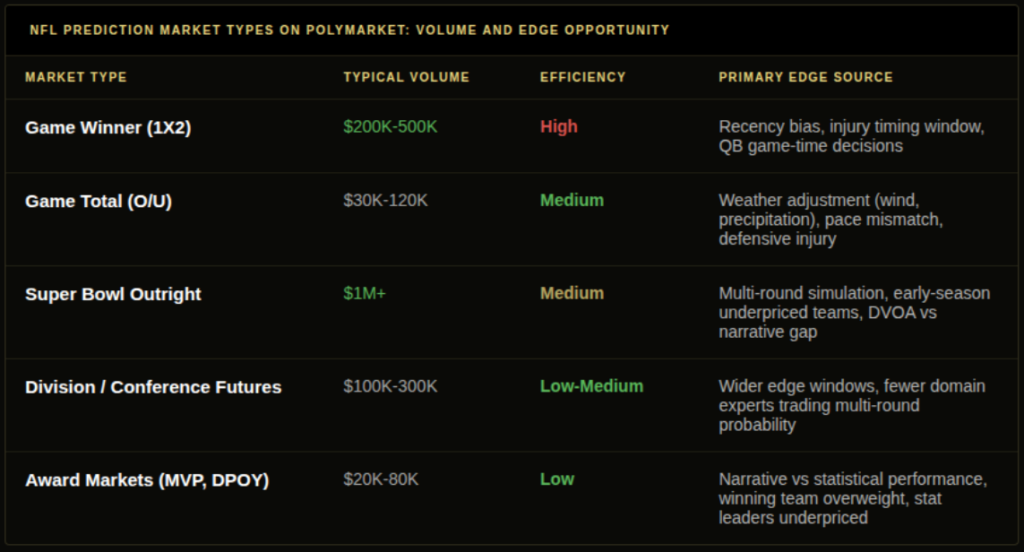
What NFL Markets Are Available on Polymarket
Game Winner Markets
The most liquid NFL market type on Polymarket. For divisional games and prime-time matchups, total volume frequently exceeds $500,000. Spreads are tight, typically 1-2 cents on mid-price. The efficiency is high relative to other sports on the platform.
Where game winner markets have exploitable gaps: recency bias. A team that lost badly in Week 3 is often underpriced in Week 4 relative to their true probability, because the crowd prices last week’s performance more heavily than season-long quality indicators like DVOA, DVOA adjusted for opponent, and health-adjusted roster quality. Conversely, a team that won a blowout on a +7 turnover differential is frequently overpriced the following week.
Game Total Markets (Over/Under)
Historically the most mispriced NFL market type on prediction markets because fewer informed traders specifically model totals versus game winners. The crowd follows ESPN narratives about offensive firepower. The edge traders follow pace-adjusted EPA per drive, red zone efficiency, and the three specific conditions that drive total mispricing: weather, defensive injuries, and pace mismatch between teams.
Season-Long Futures
Super Bowl winner, conference champion, and division winner markets. Less efficient than game-by-game because the probability modeling is harder (requires multi-round simulation) and fewer domain experts actively trade these markets relative to the dollar volume. The edge window is wider and longer. A Super Bowl winner market will not close a 4-cent mispricing in 11 minutes the way a game winner market will.
Award Markets
MVP, Defensive Player of the Year, Offensive Rookie of the Year. These are the least efficient NFL markets on Polymarket because narrative drives pricing more heavily than performance, and the typical prediction market trader does not have the weekly performance tracking to correctly update probabilities as the season develops. A running back on a winning team is frequently overpriced for MVP. A quarterback on a losing team who is having a statistically elite season is frequently underpriced.
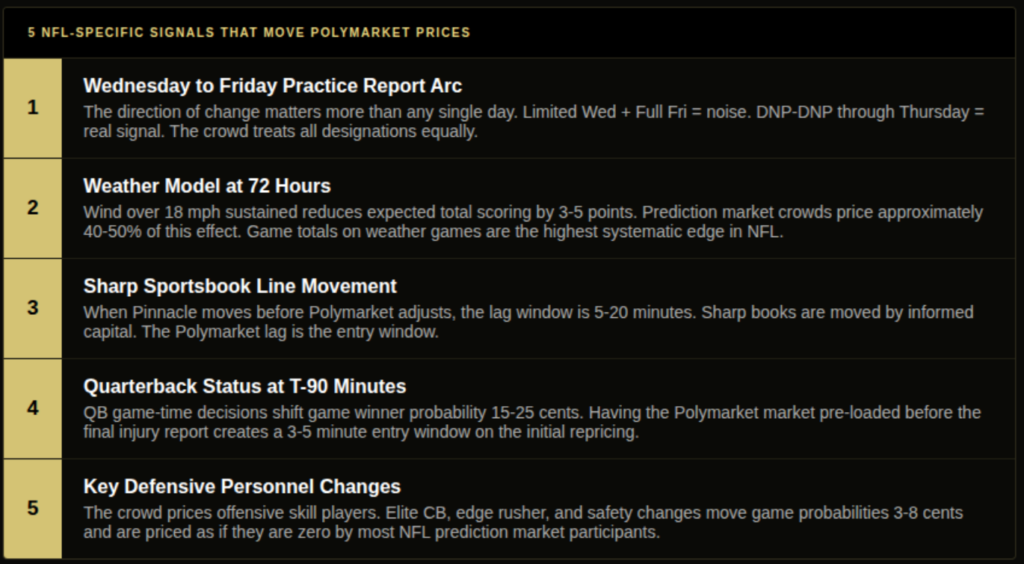
The 5 NFL-Specific Signals That Move Prediction Market Prices
Signal 1: The Wednesday-to-Friday Practice Report Arc
NFL teams release practice participation reports Wednesday, Thursday, and Friday. The arc matters more than any single report. A Limited on Wednesday followed by Full on Thursday is a non-event, typically a precautionary designation. A DNP on Wednesday followed by Limited on Thursday is worth monitoring. A DNP-DNP through Thursday for a starting skill position player is a real signal worth sizing on.
The crowd treats every injury designation with the same weight. It does not distinguish between a quarterback’s ankle that is managed weekly as a maintenance issue and a true practice absence caused by a new injury. That non-distinction is where the edge lives.
Signal 2: The Weather Model at 72 Hours
Weather forecasting models become accurate enough to trade at approximately 72 hours before game time. The surface-level adjustment most markets make (cold game = lower total, rain game = lower total) is correct in direction but wrong in magnitude. Wind is the most underweighted variable. A 25 mph sustained crosswind in an outdoor stadium reduces field goal percentage by approximately 8-12%, reduces deep passing attempts by 15-20%, and reduces scoring by a statistically consistent 3-5 points per game. The prediction market crowd prices this at roughly half the actual effect.
Signal 3: Line Movement From Sharp Sportsbooks
When Pinnacle or a similar sharp-money book moves a line sharply before Polymarket adjusts, there is a lag window of 5-20 minutes on NFL game winner markets. The Polymarket crowd is not constantly monitoring Pinnacle line movement. Sharp-money books are moved by informed capital. The direction of Pinnacle’s line is the signal. The Polymarket lag is the entry window. For how this signal type works systematically, the Trading Signals guide covers the full framework.
Signal 4: Quarterback Status Within 90 Minutes of Kickoff
Game-time decisions on NFL starting quarterbacks are the highest-impact single information event in NFL prediction markets. A backup quarterback starting instead of a starter shifts game winner probability by 15-25 cents depending on the quality gap. The Polymarket market moves fast when this information becomes official, but not instantaneously. Having the Polymarket market open and pre-loaded before the final injury report comes out gives you a 3-5 minute window on the initial repricing.
Signal 5: Key Defensive Personnel Changes
Crowd pricing in NFL prediction markets focuses almost entirely on offensive skill players. The starting cornerback against a receiving-dependent offense, the edge rusher who affects the opposing quarterback’s time in pocket, the safety who eliminates certain play concepts from an offense’s game plan: these personnel changes move game probabilities by 3-8 cents and are priced by the crowd as if they are zero.
The Pre-Game NFL Research Workflow
You have 6 hours before kickoff. Here is what the systematic approach looks like versus the crowd approach.
The crowd approach: check the injury report headlines, see who is in and out, form a directional view, click buy.
The systematic approach:
Read the Thursday practice report and compare it to the Wednesday report. Identify which designations changed and in which direction. Assess whether each designation is noise (managed weekly, appeared Limited last week with the same injury, has been playing through it all season) or signal (new injury, has not practiced fully since the injury, team declined to provide an update).
Check the weather model for the next 24 hours, specifically wind speed and precipitation at game time. If wind exceeds 18 mph sustained or precipitation exceeds 0.15 inches per hour at game time, adjust total expectations downward by a specific number of points based on historical data.
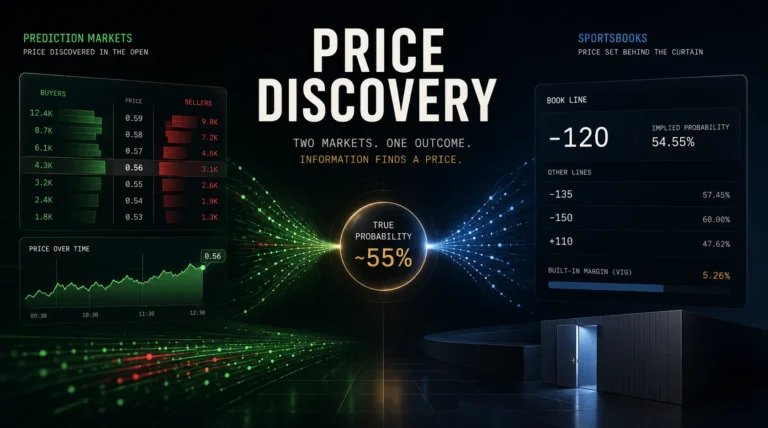
Check the Pinnacle line against the current Polymarket price. If they diverge by more than 2 cents after devigging both, identify which direction Pinnacle has moved and whether Polymarket has followed or lagged.
Form a probability estimate for each market you are considering. Write it down before you check the Polymarket price. Then check. Then calculate the edge.
This takes 25-35 minutes per game. Most traders spend 3 minutes. That gap is why the edge exists.
Common Mistakes
NFL prediction markets attract the largest crowd of casual sports viewers of any category on Polymarket. Most of them are trading their fandom. They price games based on team record, recent performance highlights, and quarterback narratives that may have been accurate 4 weeks ago and are no longer relevant. That noise is the environment where systematic edge lives.
The most expensive mistake is sizing on NFL game winner markets based on confidence rather than edge. You are highly confident the Chiefs win this week. So is 71% of the prediction market crowd. The price already reflects that confidence. Your confidence is not edge. Your probability estimate being higher or lower than the devigged market price, for a specific verifiable reason, is edge.
The second mistake is ignoring game totals entirely in favour of game winners. Game totals have lower volume, wider spreads, and a less informed crowd. That combination is the definition of an exploitable market type. A systematic totals approach built on weather adjustment, pace mismatch, and defensive injury signals will outperform a game winner approach over an NFL season, with less competition.
The third mistake is trading Super Bowl futures in September based on preseason rankings. The August consensus on Super Bowl probabilities is based almost entirely on offseason moves, coaching changes, and draft class assessments. It does not reflect the injury variance, chemistry development, and scheme adjustments that determine outcomes in January. September futures markets are frequently the most mispriced of the entire season.
How DG3 Covers NFL Markets
DG3’s Edge Finder shows which NFL markets have the widest gap between current price and fair value, updated in real time as prices shift. The Intelligence pane’s Whale tab tracks large wallet entries on the selected market, helping identify whether a price move in the pre-game window is driven by informed capital or retail noise.
The Fair Value Engine deviggs current Polymarket NFL prices and ranks markets by the gap between price and fair value. On a week with 8-9 games, that ranking tells you which markets are worth the research time before you spend 35 minutes on a game where the edge is 0.8 cents.
The Edge Finder shows NFL game markets ranked by divergence from fair value in real time.
Frequently Asked Questions
Q: What NFL markets are available on Polymarket? A: Polymarket offers NFL game winner markets (the most liquid), game total (over/under) markets, Super Bowl and conference championship outrights, division winner futures, and award markets including MVP and Defensive Player of the Year. Liquidity is highest on prime-time game winners and Super Bowl outrights, with moderate liquidity on divisional game winners and thinner liquidity on regular-season totals and award markets.
Q: What are the best NFL market types to trade on Polymarket? A: Game totals and season-long futures offer the best risk-adjusted edge relative to competition. Game winner markets are heavily traded by informed participants which compresses edges, while totals markets are dominated by casual bettors making weather, pace, and defensive-injury adjustments that systematic traders can exploit. Season-long futures have wider edge windows because multi-round probability modeling is harder and fewer domain experts trade them.
Q: What signals move NFL prediction market prices? A: Five primary signals: Wednesday-to-Friday practice report arc (injury designations that change direction over the week), weather models at 72-hour accuracy (wind and precipitation effects on totals), sharp sportsbook line movement before Polymarket adjusts, quarterback game-time decision announcements within 90 minutes of kickoff, and key defensive personnel changes that the crowd systematically underweights relative to their actual probability impact.
Q: How do you build a pre-game NFL research workflow? A: Read the practice report arc across Wednesday to Friday rather than treating any single day’s designation as the signal. Check weather models for wind above 18 mph and precipitation above 0.15 inches per hour at game time. Compare the Pinnacle devigged price against current Polymarket prices and look for lags. Form your probability estimate before checking the Polymarket price. Write it down. Then calculate the edge gap.
Q: How does DG3 cover NFL markets? A: DG3’s Edge Finder ranks all active NFL markets by the gap between current Polymarket price and fair value, updated in real time. The Intelligence pane’s Whale tab shows large wallet activity on the selected market, helping distinguish informed moves from reactive noise during the pre-game window.
Q: What is the weather edge in NFL prediction markets? A: Weather effects, particularly sustained wind above 18-20 mph, are systematically underpriced in NFL game total markets. The statistical effect of wind on scoring is approximately 3-5 points per game in outdoor stadiums. Prediction market crowds typically price 40-50% of this effect, leaving 1.5-2.5 cents of edge on game totals for weather games when the model is applied consistently.
Q: Is trading NFL on Polymarket profitable? A: For systematic traders with a research workflow covering injury signals, weather adjustments, and line movement from sharp books, NFL prediction markets offer consistent edge. For traders following public narrative and team records, they offer consistent losses to the traders who are doing the work. The NFL category has the highest casual trader volume of any sports category on Polymarket, which is simultaneously the reason the crowd is mispriced and the reason it feels like you have an edge when you do not.
Final Thoughts
The NFL calendar is 18 weeks of regular season plus four playoff rounds and a Super Bowl. That is 270+ game markets per season on Polymarket, more surface area than any other sports category. A systematic approach that is right 54% of the time on game totals at an average 5-cent edge, applied across 80 markets per season, compounds into a meaningful positive expectation.
Most NFL traders on Polymarket are trading their opinions about teams. The traders making consistent money are trading the gap between what the crowd thinks and what the numbers say. Those two things diverge the most on game totals, on futures markets, and on the Wednesday-Friday injury window.
The season starts September 10, 2026. The first practice reports come out September 9. The edge window opens before the first game.
For how NFL prediction market signals fit into the broader signal hierarchy, the Sports Betting vs Prediction Markets guide covers the structural differences that make prediction markets uniquely exploitable for systematic sports traders.
Also read:
Sports Betting vs Prediction Markets
Kelly Criterion for Prediction Markets: Sizing Positions When Odds Move
Edge Decay in Prediction Markets: Why Alpha Disappears