
Crypto Event Trading Strategy: How Prediction Market Traders Build Repeatable Edge
Most of what passes for crypto event trading strategy is a list of coins someone got lucky on last cycle dressed up as a framework. Real strategy is a repeatable decision process applied consistently, one that tells you which setups to touch and which to leave alone whether the market is euphoric, terrified, or sitting sideways waiting for a catalyst.
The distinction matters because the market doesn’t reward conviction. It rewards calibration.
Table of Contents
Start With the Event, Not the Asset
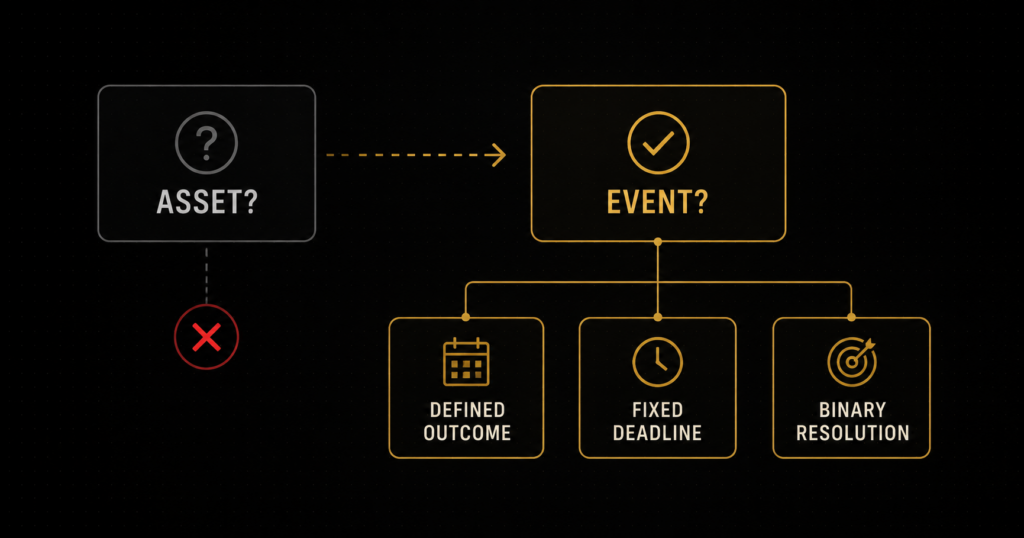
Most traders start with an asset they already like and then go looking for a reason to trade it. That’s backwards.
A crypto event trading strategy starts with a specific, resolvable event, an ETF decision, a regulatory deadline, a BTC price threshold by a fixed date, and asks what the market is currently pricing for that exact outcome. The asset is the vehicle. The event is the actual trade.
When someone describes “Bitcoin” as a trade idea with no specific catalyst, date, or resolution criteria attached, they’re describing a feeling, not a position. Feelings don’t have bounded risk. Feelings don’t resolve cleanly at $1.00 or $0.00. The discipline of beginning with the event rather than the asset is the first filter that separates a strategy from a hunch.
On Polymarket, this translates directly. A BTC price milestone contract will BTC exceed $80,000 before September 30 has a specific event, a specific deadline, and a specific resolution mechanism. That’s a trade. “I’m bullish on Bitcoin” is not. The same structure applies to a CS2 match winner (Team Spirit beats NAVI, series resolves 2-1), a football outright (Arsenal wins the Premier League by May 18), or a US election market. The framework is identical across every category. The platform is the same. The edge methodology doesn’t change based on the sport.
Separate the Catalyst From the Narrative
Every cycle produces narrative waves. AI coins, real-world asset tokenisation, the next Layer 2, modular chains, the next generation of DeFi. Narratives move prices even when nothing concrete has happened. A disciplined crypto event trading strategy filters out narrative-driven noise and focuses exclusively on contracts tied to something that resolves one way or another.
Did a specific ETF get approved by a specific date? Yes or no. Did a specific price threshold get crossed by a specific deadline? Yes or no. Did a specific protocol upgrade activate by the announced date? Yes or no.
This filtering step alone eliminates most of the “trades” that flood crypto social media, because most of them aren’t tied to anything that resolves cleanly. It also directly addresses the information asymmetry problem in event markets, narrative-driven markets are dominated by crowd sentiment, while events with clear resolution criteria are priced more precisely by participants who’ve done the underlying research.
The most exploitable inefficiencies in crypto prediction markets exist at the intersection of: a clear binary outcome, a defined timeline, and a participant pool that’s pricing based on narrative rather than process analysis. The SEC ETF approval market in early 2024 was the textbook example. The crowd was pricing sentiment. The participants tracking SEC administrative docket timelines were pricing process. The process traders were at $0.47. The crowd caught up eventually, at $0.94.
The same lag exists on CS2 stand-in announcements (12-25 minutes on average), football team sheet publications (10-20 minutes), and political regulatory filings. DG3’s Edge Finder surfaces the gap in real time across all of them.
The Pre-Trade Checklist That Filters Everything Else Out
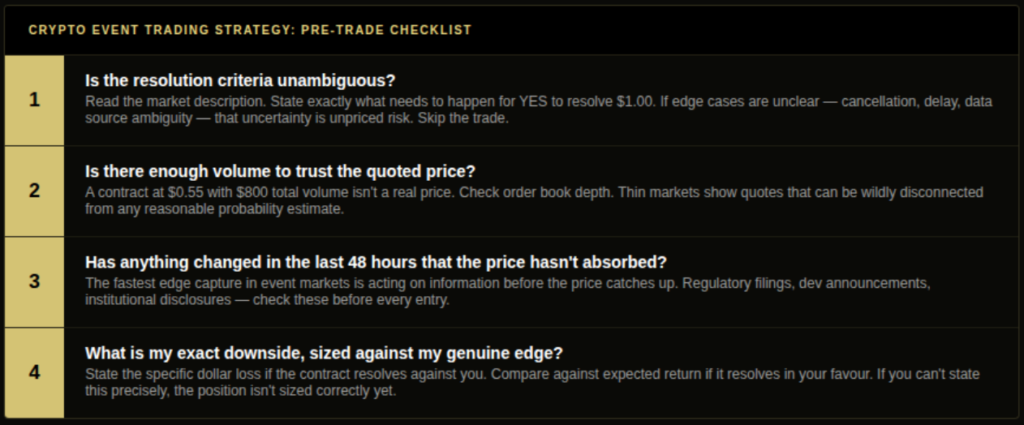
Before touching any crypto event contract, run four questions:
1. Is the resolution criteria unambiguous? Can you read the market description and state with confidence exactly what needs to happen for YES to resolve at $1.00? If there’s any ambiguity about edge cases, what happens if the ETF approval is delayed, what counts as “crossing” the price threshold, which data source determines resolution, that ambiguity is risk you haven’t priced in. Ambiguous resolution is particularly dangerous in regulatory markets where outcomes can be technically correct but contested.
2. Is there enough volume behind the current price to trust the quote? A BTC milestone market trading at $0.55 with $800 in total volume is not a price, it’s a suggestion. Thin markets can show prices that are wildly disconnected from any reasonable probability estimate simply because there haven’t been enough participants to tighten them. Liquidity analysis in prediction markets, specifically checking order book depth before sizing, is a non-negotiable step for any serious crypto event trader.
3. Has anything changed in the last 48 hours that the price hasn’t caught up to yet? This is the information asymmetry check. Crypto prediction market prices lag real-world developments by minutes to hours on notable news events. A regulatory filing, a developer announcement (trackable through GitHub commit activity), a protocol delay notice, an institutional purchase disclosure, any of these can move a market’s fair value without the Polymarket price having fully adjusted. Checking what’s happened in the last 48 hours before entering is the simplest form of edge capture in event markets.
4. What is my downside if I’m wrong, and is it sized correctly against my edge? Not “what could go wrong” in a general sense. The specific dollar loss if the contract resolves against you, measured against the expected return if it resolves in your favour, measured against your total trading capital. If you can’t state this precisely, the position isn’t sized correctly yet.
If any of these four comes back weak, the correct response is to skip the trade entirely. Not to override it with a stronger narrative. Not to accept that “this one is different.” Skip it. The discipline of a complete checklist is worth more in the long run than any individual position that passed three out of four criteria.

Sizing Is the Strategy
Most people equate strategy with picking the right side of a trade. The bigger lever, the one that actually determines long-run performance, is how you size each position relative to your genuine edge.
A contract priced at $0.70 where your research puts fair value at $0.75 has real edge. It’s 5 cents of edge. That’s not a 70% of bankroll trade. It’s a modest edge that deserves a modest position.
A contract priced at $0.55 where your research puts fair value at $0.73 has substantial edge, 18 cents. That warrants a larger position, sized according to Kelly criterion principles that account for both the edge magnitude and the outcome variance.
The dangerous version: overconfidence in a small edge. A trader who identifies 3 cents of edge and sizes it like 15 cents of edge, consistently, will lose money even when their directional read is correct. Positive EV trading is about the combination of accurate edge identification and calibrated sizing, not about the prediction accuracy alone.
One additional check before sizing up on any crypto event contract: ask yourself why the market hasn’t already closed the gap. Prediction markets are not always efficient, but they’re usually not wildly wrong. If you’re seeing 15 cents of edge against the current price, either your model is capturing something the market genuinely hasn’t priced, or your model has an error. The discipline is in honestly distinguishing between those two possibilities before deploying capital.
Handling Regulatory and Macro Event Risk
Crypto event trading carries a wrinkle that most other prediction market categories don’t face as acutely: regulatory and macro events move contract pricing hard and fast, often faster than spot markets react.
A surprise SEC filing, a regulatory comment at a Congressional hearing, a Fed statement that implies rate path changes, these can reprice a cluster of related contracts within minutes. The participants who saw the filing first, or who were in the hearing room, have already acted.
For regulatory event markets specifically, position sizes should be smaller by default, not because the edge is lower, but because the variance around regulatory timelines is genuinely higher. Regulatory bodies don’t operate on predictable schedules the way protocol upgrades or price mechanics do. The SEC proved this repeatedly through 2021-2023. The CFTC classification questions being litigated in 2025-2026 are in the same category.
The practical rule: on any contract where the resolution depends on a single human or institutional decision rather than a verifiable on-chain event or price data, apply a variance discount to your sizing. The underlying expected value calculation doesn’t change. The position size does. Bankroll management across correlated crypto event positions is the framework that prevents a single regulatory surprise from causing disproportionate drawdown.
The Journal That Reveals Your Real Process
One habit from systematic trading that translates directly into crypto event markets: keeping a written record of every contract you seriously consider, taken or skipped.
For each one, record the resolution date, the price when you looked at it, your own independent fair value estimate, the volume behind the quote, and what you decided. This is not a mental note. A written record that can be reviewed six months later.
The value isn’t in tracking your wins. It’s in what the record reveals about your skipped setups. Six months of honest journaling will show you whether your skipped trades would have lost money, confirming the checklist is working, or whether you’re leaving edge on the table by being too conservative.
It also surfaces systematic biases that are invisible trade by trade. If you consistently overpay on narrative-driven contracts during periods of high social media attention, entering at $0.55 on setups that cooler analysis would have priced at $0.40, that pattern won’t be obvious from any single trade. It’s only visible across a dataset. The trading psychology discipline to maintain this record and read it honestly is what separates a strategy that compounds from one that flat-lines.
Why a Boring Crypto Event Trading Strategy Beats Exciting Ones
The crypto event trading strategy that holds up over time is deliberately unglamorous. It skips most of the “interesting” setups. It passes on the contracts with compelling narratives and uncertain resolution criteria. It sizes down on markets that feel like sure things. It keeps records that include the bad entries.
The strategy that doesn’t hold up is the one built around the excitement of getting a big call right and experiencing the narrative validation of watching a contract move from $0.40 to $0.92. That strategy produces great stories and inconsistent returns.
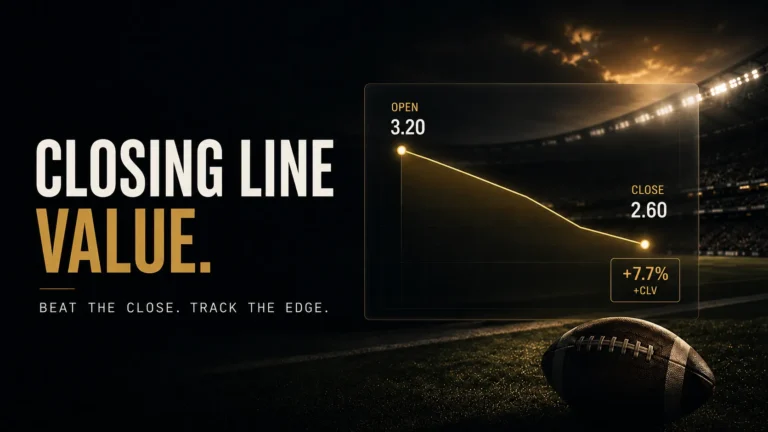
The market doesn’t know or care about your conviction level. What it measures, over time, is closing line value, whether your entries consistently preceded the market moving in your direction. That’s the scorecard. Everything else is narrative.
Build the process. Run the checklist. Size to the edge. Keep the record. Repeat. The process works on a BTC ETF decision. It works on a CS2 major outright. It works on a football match winner. The market is Polymarket. The framework is the same. The terminal that surfaces edge across all of it – ranked by EV gap, filtered by CLV-qualified signal, executed in under 2 seconds – is DG3.
Frequently Asked Questions
Q: What is a crypto event trading strategy? A: A crypto event trading strategy is a repeatable process for identifying, evaluating, and sizing positions on specific, resolvable crypto events on prediction markets, ETF decisions, price milestone contracts, protocol upgrade timelines, regulatory outcomes. It differs from directional crypto trading in that every position is tied to a binary outcome with defined resolution criteria and a specific deadline.
Q: How do you identify good crypto event trades on Polymarket? A: Run four checks before any position: is the resolution criteria unambiguous, is there sufficient volume to trust the quoted price, has anything happened in the last 48 hours that the price hasn’t absorbed yet, and is the position sized correctly against your genuine edge. If any of the four fails, skip the trade.
Q: How should you size crypto event positions? A: Based on the gap between your independent probability estimate and the devigged market price, your edge, and the Kelly fraction that corresponds to that edge given the binary outcome structure. Small edge gets small position. Large edge gets larger position, subject to a cap that accounts for regulatory or macro variance on contracts tied to institutional decisions.
Q: Are regulatory crypto event markets riskier than price milestone markets? A: Generally yes. Regulatory decisions depend on single human or institutional choices rather than verifiable market data, which means variance is genuinely higher. Standard practice is to apply smaller default position sizes to regulatory event contracts even when the expected value calculation looks attractive.
Q: How does keeping a trade journal improve crypto event trading? A: It makes systematic biases visible that are invisible trade by trade. Overpaying on narrative-driven setups, incorrectly skipping profitable contracts, sizing inconsistencies, these patterns only emerge from a dataset, not from memory. A journal that includes skipped setups alongside taken ones is the most honest source of feedback available about whether your checklist is actually working.
Q: What separates disciplined crypto event trading from speculative narrative trading? A: Resolution clarity. A disciplined strategy only trades contracts tied to specific, binary, objectively verifiable outcomes. Narrative trading involves taking positions based on directional feelings about an asset without a specific catalyst, deadline, or resolution mechanism. The distinction sounds simple. Applying it consistently when the market is generating compelling stories is the actual difficulty.
Also read: Crypto Event Markets: Trading BTC Milestones and Protocol Catalysts
Positive EV Trading: A Practical Framework for Prediction Markets
Closing Line Value: The Number That Tells You If You’re Actually Good