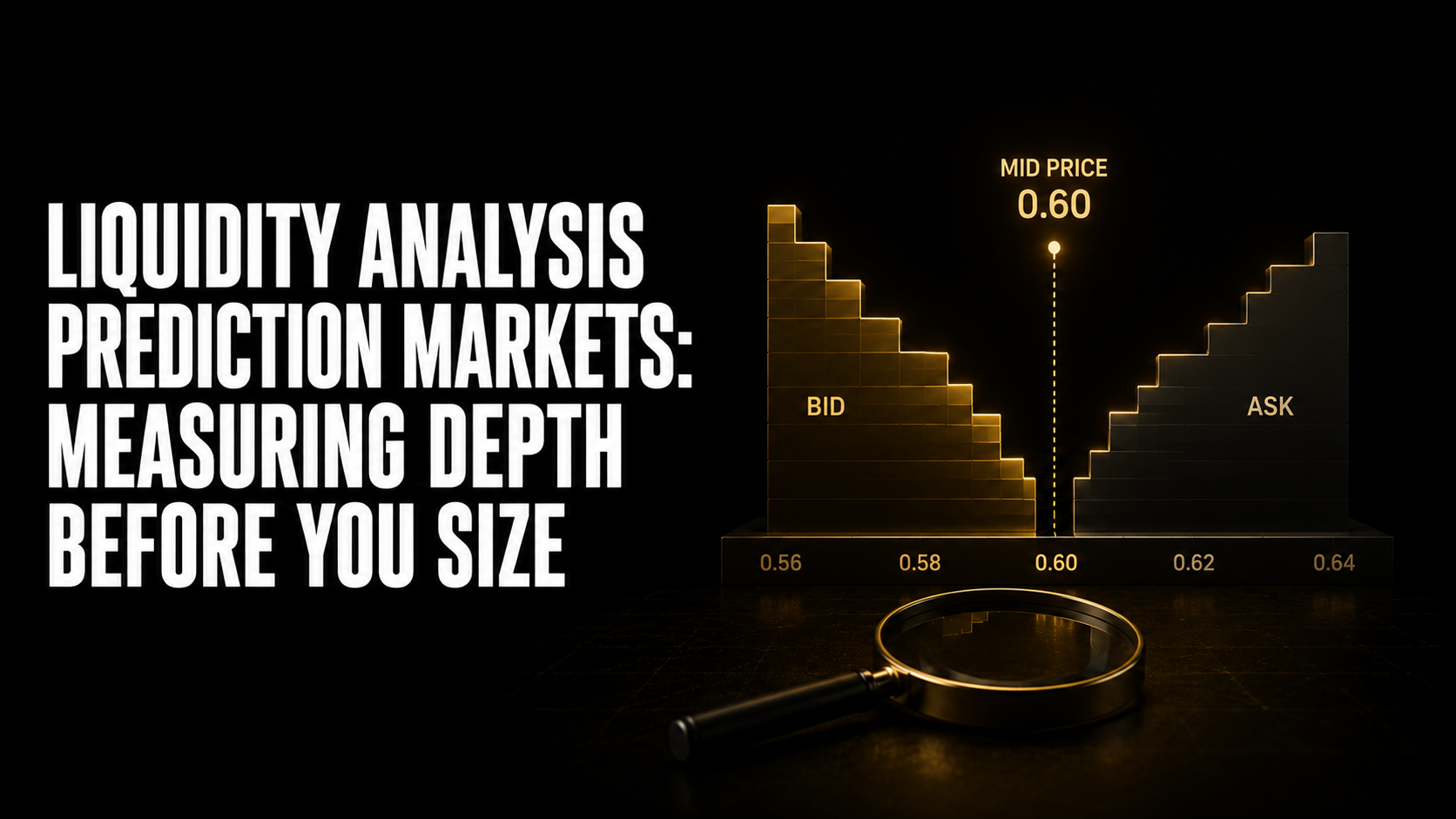
Liquidity Analysis in Prediction Markets: Measure Depth Before You Size
The market shows 0.58 YES. You want to enter $800. You place a market order. You fill at 0.62.
You paid 4 cents more than expected because you didn’t check the order book before sizing. The edge you thought you had was 6 cents. After the slippage, it’s 2 cents, and that’s before fees.
This is the problem liquidity analysis in prediction markets solves. Not a secondary check, not a nice-to-have – the step that determines whether a position with theoretical edge is actually worth taking.
Table of Contents
Quick Answer
Liquidity analysis prediction markets work starts with measuring order book depth at and near the current price before committing to a position size. The relevant questions: how many dollars of YES (or NO) are available within 2 cents of the mid-price? How much will a position of your intended size move the price against you? What’s the bid-ask spread, and what does it tell you about the market’s efficiency at this moment? DG3’s Book tab provides this view in real time, making liquidity analysis prediction markets workflow faster for every active Polymarket market before any order is placed.
Key Takeaways
- Prediction market liquidity analysis requires checking two distinct things: bid-ask spread (the immediate cost of entry) and order book depth (how much capital you can deploy before the price moves materially against you). Spread tells you the cost of the first dollar. Depth tells you the cost of the next $500.
- The bid-ask spread on a prediction market is the difference between the lowest available YES ask and the highest available YES bid. A 2-cent spread on a $0.60 market means you’re paying a 3.3% round-trip premium. A 10-cent spread means you’re paying 16.7%. Spread alone tells you whether a market is being actively traded and whether the current quoted price is real at any meaningful size.
- Order book depth is the dollar amount available at each price level in the CLOB. On Polymarket, depth is displayed as the number of shares available at each 1-cent price increment. Before placing any position above $200, checking depth at your target price and the 2-3 price levels above it determines the maximum position size you can take without meaningful self-inflicted slippage.
- Position sizing and liquidity analysis prediction markets work are directly linked. A market, on Polymarket or Kalshi, with $8,000 total volume and 200 shares available within 2 cents of mid supports a position of roughly $80-$120 cleanly. Sizing $400 into that market moves the price 4-6 cents against you before filling, which erodes or eliminates the edge you identified. Matching position size to available depth is not optional.
- Market order vs limit order choice is partly a liquidity decision. In thin markets, a market order fills at whatever price the book offers, potentially far from the current quoted price. A limit GTC order placed at the mid-price waits for the market to come to you but may not fill if the price moves away. In thin CS2 or political markets, limit orders are almost always the right execution choice.
- DG3’s Book tab in the Intelligence Pane shows the live order book for every selected Polymarket market. It updates in real time. The single best habit a prediction market trader can develop is checking the Book tab before any position above $200, the slippage that hits traders who skip it happens every day.
- Thin markets are not necessarily bad markets. A thin CS2 market with 8 cents of edge and $1,200 of available depth supports a $600-$800 position cleanly, which is meaningful for most participants. The error is sizing $2,000 into that market and then being surprised by the fill price.
The Core Components of Liquidity Analysis Prediction Markets Traders Track
Prediction market liquidity: The ease with which a position can be opened and closed at a price close to the current quoted price. High-liquidity markets have narrow spreads, deep order books at and near the mid-price, and low price impact from typical position sizes. Thin markets have wide spreads, shallow depth, and material price impact from moderate position sizes.
Liquidity analysis prediction markets tracking covers three measurable components:
Bid-ask spread: The gap between the lowest YES ask price and the highest YES bid price. A market quoted YES at $0.60 ask / $0.58 bid has a 2-cent spread. The spread is the minimum cost of opening and immediately closing a position, your break-even hurdle before any directional edge matters. Tight spreads (1-2 cents on liquid markets) indicate active market making and real two-sided participation. Wide spreads (8-15 cents on thin markets) indicate low activity and high effective transaction costs.
Order book depth: The cumulative dollar amount available at each price level. If 800 shares are available at $0.60, 400 at $0.61, and 200 at $0.62, your maximum clean fill at $0.60 is $800. Entering $1,200 means 400 shares fill at $0.61 and the remainder at $0.62, your average fill is higher than the quoted price. Depth is the metric that turns a quoted price into an actual executable price for your specific position size.
Price impact: The expected price movement caused by your own order. A $1,500 market order in a market with $800 of depth within 2 cents will move the price 3-4 cents as your order exhausts available liquidity at each level. Price impact is a direct cost, not a spread cost, it’s slippage, and it’s directly calculable from the order book before execution.
Also read: Slippage in Prediction Markets: What Your Fill Actually Cost You
How to Read Order Book Depth in Prediction Markets Liquidity Analysis
Reading a prediction market order book takes 20 seconds once the habit is established. Here’s what to look for:
Step 1, Check the spread: Open the Book tab on DG3 or the market’s order book on Polymarket native. What’s the gap between best ask and best bid? Under 3 cents: the market is reasonably liquid at current size. 4-7 cents: moderate liquidity, limit orders recommended. 8+ cents: thin market, size conservatively.
Step 2, Count depth within 2 cents of mid: How many shares (dollars) are available on the YES side within 2 cents of the current mid-price? This is your clean position size limit. Anything above this threshold will move the price during execution.
Step 3, Calculate your price impact: If you want to enter $600 and there are $350 available within 2 cents of mid, your order will exhaust that depth and start filling at worse prices. Estimate the average fill price across the depth levels you’ll consume. Subtract from your edge estimate. If the net edge is still positive, proceed. If not, use a smaller position or a limit order at the mid-price.
Step 4, Check depth on both sides: Look at both YES and NO depth. A market with deep YES depth but shallow NO depth has asymmetric liquidity, you can enter YES easily but exiting (selling YES or buying NO) may be difficult later. For long-horizon positions, consider exit liquidity as well as entry liquidity.
Example calculation:
- Market: CS2 match winner, Team Spirit YES
- Current mid: $0.63
- Available YES depth: 400 shares at $0.63, 250 at $0.64, 150 at $0.65
- Total within 2 cents: $650
- Your intended position: $500
- Expected price impact: $100 fills at $0.64, remainder at $0.63. Average fill: ~$0.633
- Your edge estimate: $0.70 closing price (model) vs $0.633 average fill = 6.7 cents net before 2% fee
- After fee: approximately 4.7 cents. Still above threshold. Proceed.
Position Sizing vs Liquidity Analysis: The Prediction Markets Decision Matrix
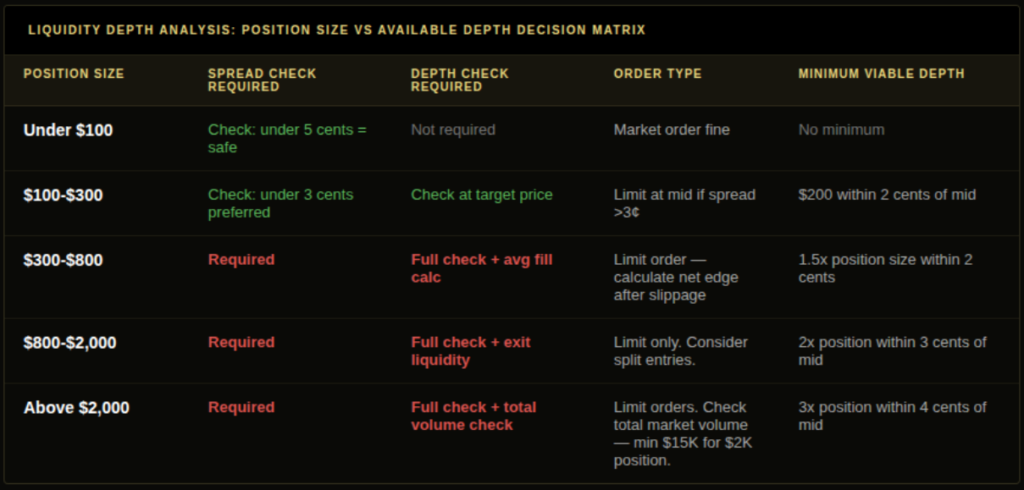
Not every position needs the same liquidity check. A $50 position in a thin market doesn’t require the same analysis as a $1,500 position. Here’s the practical framework:
Under $100: Check the spread. If it’s under 5 cents, market order is fine. Price impact on $100 is negligible in most markets.
$100-$300: Check spread and available depth at current price. Limit order at mid-price preferred in any market with spread above 3 cents.
$300-$800: Full depth check required. Calculate average expected fill across all depth levels your order will consume. Position only if net edge (after slippage and fees) exceeds your minimum threshold.
Above $800: Full depth check plus exit liquidity check. Any position above $800 requires confirming that the market’s total depth (not just the first 2 cents) can absorb your size without moving the price more than 3 cents against you. If not, split across multiple entries or use a limit order.
Above $2,000: Check total market volume as well as current order book. A market with $15,000 total volume can typically absorb $2,000 positions cleanly on liquid matches. A market with $2,000 total volume cannot. Total volume context matters for large positions.
Also read: Limit Orders vs Market Orders in Prediction Markets: When Each Wins
Thin vs Deep Markets: What the Spread Tells You
The bid-ask spread is a quick diagnostic for market health before you dig into the order book.
1-2 cent spread: Active market making. Real two-sided participation. This market is being watched closely by multiple participants. Limit orders near the mid will fill. Market orders are reasonably safe for positions under $500.
3-5 cent spread: Moderate liquidity. Some market making but not continuous. Limit orders at mid-price are recommended for anything above $200. Market impact on larger positions is material.
6-10 cent spread: Thin market. Wide spread means you’re paying 10-17% round-trip before any directional edge. Only viable if your edge estimate substantially exceeds the spread cost. Limit orders only. Don’t use market orders.
Above 10 cents: Very thin market. The spread itself may exceed your edge estimate on most positions. Consider whether the market has enough liquidity to be worth trading at any size, or whether a smaller position with a limit order is the only viable approach.
Zero spread (bid = ask): This occasionally appears on Polymarket when a market has just one active participant providing liquidity. A single participant providing the entire visible book can pull their orders instantly. Treat a zero spread as a warning sign, not a green light.
Using DG3’s Book Tab for Prediction Markets Liquidity Analysis
The Book tab in DG3’s Intelligence Pane gives you the live order book for any selected Polymarket market. It updates in real time and sits in the same interface as the EV chip, Sharps tab, and News tab.
Practical use in a live trading session:
- Edge Finder surfaces a CS2 match with a 7-cent EV gap
- You click into the market, Intelligence Pane opens
- You check the Book tab: 600 shares available within 2 cents of mid on YES side
- You’re planning a $400 position, within depth. Spread is 3 cents. Limit order at mid preferred.
- You check the Sharps tab: one CLV-qualified wallet entered YES in the last 30 minutes
- Three-way convergence: EV gap confirmed, liquidity supports position size, Sharps tab aligned
- 1-Click Trade executes. Under 2 seconds.
Without the Book tab check (step 3), a $400 position in a 3-cent spread market might fill at $0.64 when you expected $0.62. Two cents of slippage on a 7-cent edge converts a clean trade into a marginal one.
Also read: Market Making on Polymarket: How to Earn the Spread
Common Mistakes Prediction Market Traders Make With Liquidity Analysis
Mistake 1: Using market orders in thin prediction markets. A market order fills at whatever the book offers. In a CS2 T2 market with a 10-cent spread and $400 of depth within 3 cents, a $400 market order may fill at an average price 5-6 cents worse than the quoted mid. That’s the difference between a 6-cent edge trade and a 0-cent edge trade. Use limit orders in any market with a spread above 3 cents.
Mistake 2: Looking at total volume instead of current depth.
A market with $80,000 in total historical volume might have $200 of current order book depth if market makers have stepped back. Total volume is a lagging indicator. Current depth, visible in the order book right now, is what determines price impact on your specific order.
Mistake 3: Not checking exit liquidity on long-horizon positions.
You enter a 9-month crypto event market at $0.40. The market moves to $0.68. You want to exit. The YES side now has $120 of depth because most participants are holding to resolution. You’re trapped in a position you can’t exit at a reasonable price. For long-horizon markets, check that the NO side has sufficient depth to support your exit before entering.
Mistake 4: Treating depth as fixed.
Order book depth changes continuously. A market with $800 of depth at 2pm might have $200 of depth at 3pm if market makers reduced their quotes ahead of a scheduled announcement. Check depth immediately before placing any order, not 10 minutes before.
Mistake 5: Ignoring the spread as a cost component. A 6-cent spread means you’re paying 6 cents round-trip to enter and exit a position. If your edge estimate is 8 cents, the net edge after round-trip spread is 2 cents, and that’s before the 2% Polymarket fee. Always include spread cost and fee in your net edge calculation before committing to a position size.
Frequently Asked Questions
Q: How do you approach liquidity analysis prediction markets style? A: Check the bid-ask spread (gap between best YES ask and best YES bid) and order book depth (dollar amount available at each price level within 2 cents of mid). DG3’s Book tab shows the live order book for any selected market. For positions above $300, both checks are required before sizing.
Q: What is a thin market in prediction markets? A: A market with a wide bid-ask spread (typically 6+ cents), limited order book depth within 2-3 cents of mid, and high price impact from moderate-sized orders. Thin markets exist on lower-tier CS2 events, regional political markets, and early-open outright markets before liquidity develops.
Q: How does low liquidity affect your position size? A: Directly. A market with $400 of depth within 2 cents of mid supports a clean $300-$400 position. Sizing above the available depth moves the price against you during execution, slippage that reduces or eliminates the edge you identified. Match position size to depth.
Q: What is the minimum liquidity for a safe trade? A: No universal threshold, but a practical rule: the available depth within 2 cents of mid should be at least 1.5x your intended position size. This gives a buffer against price impact while ensuring you can enter at approximately your target price.
Q: How does DG3 show liquidity depth before you execute? A: The Book tab in DG3’s Intelligence Pane shows the live order book for the selected Polymarket market: available shares at each price level, current spread, and mid-price updating in real time. This view sits alongside the EV chip, Sharps tab, and 1-Click Trade in the same interface, the liquidity check is part of the standard pre-trade workflow, not a separate step.
Final Thoughts
It’s not a secondary concern, it’s the step that converts a theoretical edge into an actual return.
The position that looks like +6 cents of edge before checking the order book is often +2 cents after calculating the price impact of your intended size. That 2-cent net edge in a 3-cent spread market resolves to approximately zero after fees. The trade that looked worth taking wasn’t.
Ten seconds on the Book tab before every position above $200 is not a large time investment. It’s the difference between an edge estimate and an edge reality.
Checking the book, sizing to depth, and using limit orders when the spread is wide, that’s the practice that separates traders who have genuine edge from traders who only think they do.
Also read: Slippage in Prediction Markets: What Your Fill Actually Cost You
Limit Orders vs Market Orders in Prediction Markets: When Each Wins
Edge Decay in Prediction Markets: Why Alpha Disappears