
IPL and Cricket Prediction Markets: The Underpriced Frontier
The toss was called at 7:27 PM IST. By 7:29 PM, three separate Polymarket markets on the match had moved. The team winning the toss chose to field. On a dew-heavy evening in Mumbai, that was the correct call and an informed trader knew it. The pre-toss market had already placed them at 0.54. By 7:31 PM the market was at 0.61.
The trader who positioned before the toss had a 7-cent edge captured in 4 minutes. The trader who read the match preview that morning and thought about it was at 0.61.
Cricket prediction markets in 2026 are the most underpriced mainstream sport on Polymarket. Not because the events are obscure – IPL alone draws more live viewers than any US sports league – but because the participant pool is smaller relative to the market complexity, and the crowd that does participate is importing sportsbook thinking into a market structure where it produces systematic errors.
Table of Contents
Quick Answer
Cricket prediction markets on Polymarket cover IPL match winners, series winners, tournament outrights, first innings totals, toss markets, powerplay run markets, and player performance props. The structural edge advantages: smaller informed participant pool relative to cricket’s actual event volume, toss information that is legally public but rarely priced correctly in relation to ground conditions, dew-factor timing (evening match conditions are predictable 6 hours out but rarely priced until the toss), DRS decision markets with verifiable historical data, and IPL auction and team composition changes that create fresh pricing anchors the market takes time to process.
Key Takeaways
- Cricket prediction markets are the most information-asymmetric sports category on Polymarket. The participant pool is large in absolute terms but thin in domain expertise. A trader with 3 years of IPL watching experience and a basic understanding of pitch conditions, dew factor, and powerplay strategy is ahead of 80% of the prediction market crowd on specific match types.
- The toss-to-outcome relationship in T20 cricket is the most predictable and most consistently mispriced signal in cricket prediction markets. For context on how prediction market pricing differs from sportsbook pricing on the same event, Sports Betting vs Prediction Markets covers the structural differences. On specific ground-condition combinations (high dew, slow outfield, good batting pitch), the team winning the toss and choosing to field wins approximately 58-62% of evening matches. Polymarket IPL match winner markets price this effect at roughly 53-55%. That 3-5 cent systematic gap compounds across 74 IPL matches per season. Sizing correctly across those positions is covered in the Kelly Criterion guide.
- First innings totals markets are systematically priced too high in the first week of each IPL season before pitch condition data for that year’s venues is available. The crowd anchors to last year’s numbers. Actual scoring rates depend on current pitch preparation, which is available from ground curator interviews and pre-match pitch reports in local media that most prediction market traders do not read.
- Information asymmetry is most visible in cricket markets. DRS (Decision Review System) decision markets on “will the decision be overturned” have a historically verifiable accuracy rate by review type. LBW reviews are overturned approximately 45-48% of the time in IPL. Caught-behind reviews are overturned approximately 22-25%. The crowd prices both categories at close to 50%, because they are treating each review as a coin flip. The coin is not fair.
- IPL auction and mid-season transfer window changes create pricing anchors that take 2-4 matches to fully process in the market. This is a classic edge decay window: the mispricing is largest immediately after the news and narrows as the market absorbs it. A major player acquisition by a team changes their match winner probability in ways the market prices gradually, not immediately. This is especially true for bowling acquisitions, which the crowd consistently underweights relative to batting acquisitions because bowler quality is harder to assess from headline stats.
- Cricket prediction markets have a European and US time zone problem. Most IPL matches are played at times that are inconvenient for the majority of Polymarket’s active trading base. Markets are thinner during the match and immediately pre-match than they would be for equivalent-value NFL or NBA games. That thinness is an opportunity for traders who are awake and informed.
Cricket Market Types Available on Polymarket
Match Winner Markets
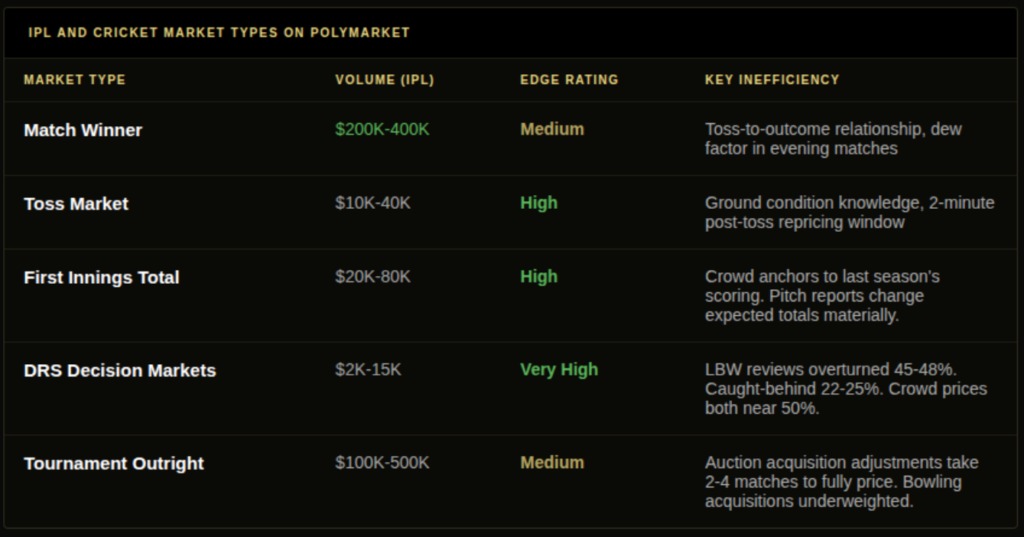
The most liquid category. IPL match winner markets for high-profile fixtures (Mumbai Indians vs Chennai Super Kings, for example) can reach $200,000-400,000 in total volume. Smaller market fixtures between lower-ranked teams have $20,000-60,000 in volume. The edge is correspondingly wider on the smaller fixtures because fewer informed traders are participating.
Series and Tournament Outrights
IPL winner, playoff qualifier markets, and bilateral series winners. Less efficient than match-by-match because the crowd has lower participation on multi-match modeling. The 2026 IPL outright winner market at the start of the tournament regularly has teams mispriced by 4-8 cents relative to a careful simulation model. The Fair Value guide covers how to calculate and apply fair value systematically.
In-Match Markets
First innings total (over/under), team powerplay runs, wickets in powerplay, and session-level markets where available. These are the most exploitable IPL markets for traders who understand T20 cricket mechanics at the pitch condition level. A good batting pitch in Chinnaswamy Stadium with dew expected by the 15th over is mathematically a different game than a Chepauk green-top with no dew. The crowd prices them differently but not differently enough.
Player Prop Markets
Top scorer, most wickets, player-of-the-match markets. These have the thinnest liquidity on Polymarket and the most extreme inefficiency. A batsman who is in form, batting at number 3, against a bowling attack with a specific weakness they historically exploit: pricing this correctly requires IPL-specific knowledge that the crowd does not have. The spreads are wide. The edge is larger. The market depth is a constraint on position size.
Toss Markets
An underrated market type. In T20 cricket, toss outcomes affect match winner probabilities by 5-10 cents depending on ground conditions. A market that correctly tracks the toss effect and updates match winner probabilities in real time after the toss is almost always slower than the actual implied probability shift. The 2-minute window between toss announcement and full market adjustment is the highest-value timing edge in IPL prediction markets.
The 5 Cricket-Specific Edges
Edge 1: Dew Factor Timing
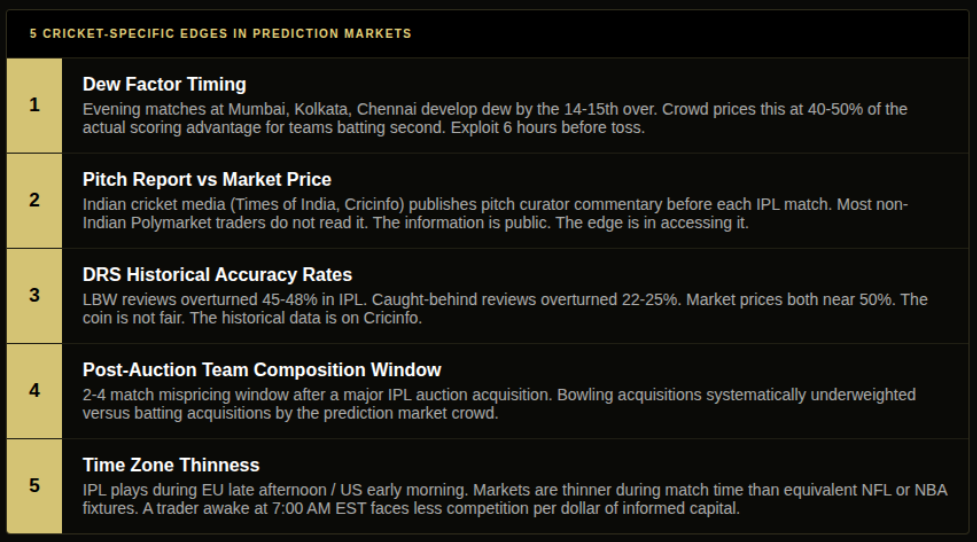
Dew forms on outfield grass during evening matches in tropical climates, making the ball harder to grip for bowlers and easier to hit. In IPL matches starting at 7:30 PM IST in high-humidity venues (Mumbai, Kolkata, Chennai), dew becomes a factor by approximately the 14th-15th over of an innings. This systematically advantages the team batting second, because the ball is harder to bowl and easier to hit during their innings.
The edge is in knowing this 6 hours before the match while the market is still pricing on generic team quality rather than specific ground conditions. By the time the toss confirms which team bats second, the market adjusts but incompletely, because the dew effect is larger than the crowd assumes.
Edge 2: Pitch Report vs Pitch Report
IPL venues have published groundsman and curator commentary available from local Indian cricket media that most non-Indian traders do not access. A curator at Wankhede Stadium saying “good batting pitch, true bounce” means something specific: high expected scoring, genuine first-innings total above 180 in a standard 20-over format. A curator at Chepauk saying “will hold moisture for the first innings” means spin-friendly conditions, lower expected scoring, and a real advantage for the team batting second on a pitch that should deteriorate.
This information is public. It is published in Times of India, Cricinfo, and broadcaster pre-match coverage. It is systematically underpriced in Polymarket markets because the majority of prediction market traders are not reading it.
Edge 3: DRS Historical Accuracy Rates
The Decision Review System in IPL allows teams to challenge umpire decisions. Reviews are categorised by type: LBW (leg-before-wicket), caught-behind, caught-in-field. Each category has a documented historical overturn rate in IPL specifically, which differs from overall cricket rates due to the DRS technology deployed in IPL and the umpiring panel.
A DRS review market priced at 50% “will be overturned” on an LBW review in a Mumbai venue is mispriced at a known rate. The historical data is available from Cricinfo’s ball-by-ball data. The market is priced by the crowd as a coin flip. The coin has a known bias.
Edge 4: Team Composition After Auction
IPL teams conduct player auctions before the season and can make targeted acquisitions. A team that has just acquired a world-class leg-spin bowler for Indian conditions will have their match winner probability adjusted upward on spin-friendly pitches and adjusted downward on flat decks. The crowd prices this acquisition based on the price paid at auction (a proxy for perceived value) rather than on the specific pitch-condition combinations where the new player creates edge for the team.
The 2-4 match window after a major acquisition is where the mispricing is largest, before the crowd has absorbed the bowler’s actual performance in the new team’s context.
Edge 5: Time Zone Thinness
IPL matches play during UK late afternoon/early evening and US early morning. The majority of Polymarket’s active trading base is in Europe and North America. Match-time liquidity is thinner than during the build-up, and pre-match pricing is set by a smaller pool of active traders. A trader who is awake at 7:00 AM EST (12:30 PM IST) and actively monitoring IPL pre-match markets has less competition per dollar of informed capital than they would on an NFL Sunday afternoon.
Common Mistakes
Most non-Indian cricket traders on Polymarket make one of three errors. They treat all T20 cricket as equivalent regardless of ground conditions (a match in Rajasthan and a match in Kolkata are played under completely different conditions with completely different expected scoring patterns). They price team quality linearly without adjusting for the specific pitch-condition matchup (a team with three quality spinners is a different probability entity on a Chennai track versus a Mohali batting paradise). And they ignore the toss entirely until it happens, rather than positioning on pre-toss markets where the conditions already imply a directional bias.
The fourth mistake is the one that costs the most money: copying IPL outright winner odds from Indian betting platforms directly onto Polymarket without adjusting for the different liquidity and participant composition. Price Discovery in Prediction Markets vs Sportsbooks explains why the two markets price the same event differently. Indian sportsbook prices on IPL outrights reflect extremely sharp domestic betting markets with years of accumulated line-setting expertise. Polymarket IPL outright markets are set by a global crowd that includes many non-expert participants. The prices are often the same but the efficiency level is not. The mismatch is the opportunity.
How DG3 Covers IPL Markets
DG3’s Edge Finder shows which IPL markets have the widest EV gap in real time. The Intelligence pane’s Whale tab tracks large wallet entries on the selected match market, helping identify whether a pre-match move is informed or retail-driven.
For evening IPL matches, the Fair Value Engine shows the devigged probability for each outcome. The dew factor adjustment described in this guide is research you apply before comparing your probability estimate against the DG3 fair value. Bayesian Updating covers the correct process for revising your probability estimate as pre-match information arrives.
Frequently Asked Questions
Q: What cricket prediction markets are available on Polymarket? A: Polymarket covers IPL match winners, series and tournament outrights (IPL winner, qualifier markets), first innings total markets, toss markets, DRS decision markets, and player performance props. IPL match winner markets for high-profile fixtures reach $200,000-400,000 in volume. Smaller fixtures and in-match markets have lower volume but wider edges.
Q: Why are cricket markets systematically underpriced on Polymarket? A: The combination of a smaller informed participant pool relative to the market’s complexity, European and US time zone barriers that reduce active participation during Indian match times, and a crowd that applies generic sports-betting intuition to conditions-specific markets that require local knowledge. Toss effects, pitch conditions, dew factor, and DRS review rates are all systematically mispriced because the crowd treats them as smaller or more random than the data shows.
Q: What are the best market types for IPL trading on Polymarket? A: Toss markets and first innings totals offer the widest systematic edges because they require specific domain knowledge the crowd lacks (dew factor, pitch conditions, DRS historical rates). Tournament outright markets offer longer edge windows. In-match markets during the toss-to-match-start window (approximately 2 minutes) offer the most concentrated information timing edge of any cricket market type.
Q: What edges are specific to cricket prediction markets? A: Dew factor timing (systematically advantages teams batting second in evening matches at tropical venues), pitch report information (publicly available in Indian cricket media but rarely accessed by the majority of prediction market traders), DRS historical overturn rates by review type (LBW at 45-48%, caught-behind at 22-25%, crowd prices both near 50%), team composition changes from auction windows (2-4 match mispricing window after major acquisitions), and time zone thinness (fewer informed traders active during Indian match times).
Q: How does DG3 cover IPL markets? A: DG3’s Edge Finder ranks all active IPL markets by divergence from fair value in real time. The Intelligence pane’s Whale tab shows large wallet activity on the selected market during the pre-match and toss window. The pitch condition and dew factor research described in this guide feeds into your own probability estimate, which you then compare against the Edge Finder’s fair value to identify the edge.
Q: Can I trade IPL on Polymarket? A: Yes. Polymarket has covered IPL markets since 2023 with expanding coverage each season. The 2026 IPL season runs from March through May, with the final in late May. Match winner markets, first innings totals, and tournament outrights are all available. Access requires USDC on Polygon and the standard Polymarket onboarding.
Q: What is the toss edge in IPL prediction markets? A: In high-dew evening matches at tropical IPL venues, the team winning the toss and choosing to field wins approximately 58-62% of matches. Polymarket pre-toss markets price this effect at roughly 53-55%. The 3-5 cent systematic gap across 74 IPL matches per season represents consistent exploitable edge for traders who model the toss correctly rather than treating the pre-toss price as already reflecting the full ground-condition information.
Final Thoughts
Cricket prediction markets are the most exploitable sports category on Polymarket for a trader willing to do specific preparation. Not general sports knowledge. Specific preparation: understanding dew factor, reading pitch reports from local Indian cricket media, tracking DRS historical rates by venue, and knowing which team compositions are favoured by which ground conditions.
The crowd in IPL markets is large in absolute terms but thin in domain expertise. Most participants are either importing sportsbook odds from Indian platforms without adjusting for Polymarket’s different efficiency level, or they are casual cricket fans who treat T20 cricket as a coin flip between two teams. Neither approach is correct. Both approaches are beatable.
The 2026 IPL season represents 74 group stage matches, 4 knockout rounds, and a final. That is 79 match winner markets, plus outrights, totals, and props. A systematic approach at 4-5 cents of consistent edge across 50 well-researched positions is a genuine annual opportunity for traders who treat this as a discipline rather than a casual activity. Calibration is the measurement system that tells you whether your cricket edges are real or luck.
For how cricket-specific signals fit into the broader prediction market signal framework, the Trading Signals guide covers how to layer sport-specific knowledge against general signal categories.
Also read:
Sports Betting vs Prediction Markets
Kelly Criterion for Prediction Markets: Sizing Positions When Odds Move
Edge Decay in Prediction Markets: Why Alpha Disappears