The Prediction of Market Crash in CS2: What It Means for Prediction Market Traders
Understanding the prediction of market crash events in CS2 requires a clear-eyed read of what matters and what doesn’t. A Valve update drops on a Tuesday. The AK-47 Redline falls 28% by Thursday. Three Discord servers are panicking. Prediction market traders on Polymarket are doing something different: checking whether any active CS2 match markets have moved.
They haven’t.
That gap, between the noise that looks like signal and the signal that’s actually there, is what this piece is about. Understanding the prediction of market crash events in CS2 requires knowing which type of crash matters for which type of trading. Get that distinction wrong and you’re either ignoring genuine edge or chasing ghosts through the skin market data.
Table of Contents
Two Markets, One Game: How the Prediction of Market Crash Works Differently in Each
The CS2 skin market and CS2 prediction markets share a name and nothing else that matters.
Skin prices are driven by supply and demand for digital cosmetic items. Case pool rotations, operation releases, Valve patch notes, and player count trends, these move the market. A case rotation that removes three items from the active drop pool sends prices up. A new operation with 40 new drops sends prices of older items down. None of this has a logical path to changing the win probability of NaVi in their next BLAST match.
CS2 prediction markets price binary outcomes. Will Team A win the series? Will a specific player hit their kill threshold? Who makes it out of the group stage? These resolve on match results, not on Valve’s economy decisions. The research that makes you good at one has essentially zero transfer value to the other.
The traders who conflate the two tend to make one of two mistakes. They either ignore Valve announcements entirely, missing the ones that genuinely do reprice prediction markets, or they react to everything Valve does, wasting research time on skin economy updates that have no prediction market implication at all.
The prediction of market crash events worth tracking in CS2 prediction markets sits in a narrow category. Here’s exactly where that is.
Also read: CS2 Skin Market vs Prediction Markets: Two Ways to Trade Counter-Strike
The Valve Announcement Taxonomy
Not every Valve announcement is created equal. For prediction market traders, they fall into three buckets.
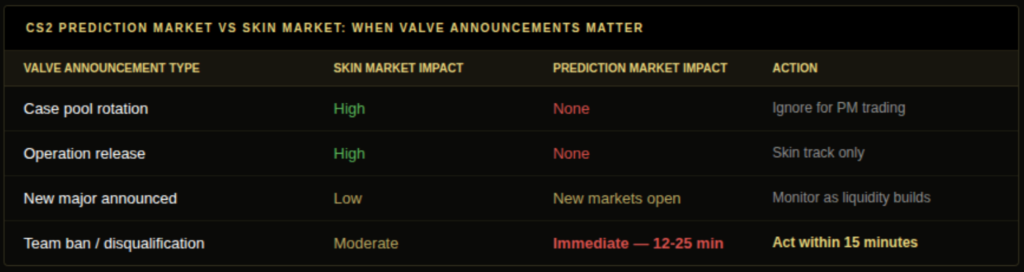
Bucket 1, Prediction market irrelevant (ignore): Case pool rotations. Drop system changes. Operation releases. New weapon finishes. Trade restriction policy updates. Steam marketplace fee changes. These affect skin prices exclusively. In documented analysis of 200+ CS2 Polymarket markets from 2024-2025, zero showed a meaningful price reaction to any case or economy announcement. Zero.
Bucket 2, Indirect, monitor over time: New major tournament announcements. When Valve announces a new CS2 major on the calendar, new Polymarket markets open within 1-2 weeks. The announcement itself doesn’t give you an edge, thin early liquidity means the initial prices are unreliable. But it puts a new set of markets on your radar. Watch them as liquidity builds.
Bucket 3, Act within 15 minutes: Team disqualification. Player or organisation ban. Tournament format change affecting a specific fixture. These directly alter who’s playing what and when. A documented team ban from ESL or BLAST reprices match winner markets within 12-25 minutes. The price path is predictable: all markets involving that team update, the probability mass redistributes, and the traders who acted in the first 15 minutes got in before the repricing was complete.
That’s the entire useful taxonomy for a prediction market trader. Two buckets to monitor. One to trade. Most of the noise is in the first bucket.
What the Prediction of Market Crash Looks Like in Practice
When prediction market traders talk about a market crash, they mean something structurally different from what skin traders mean.
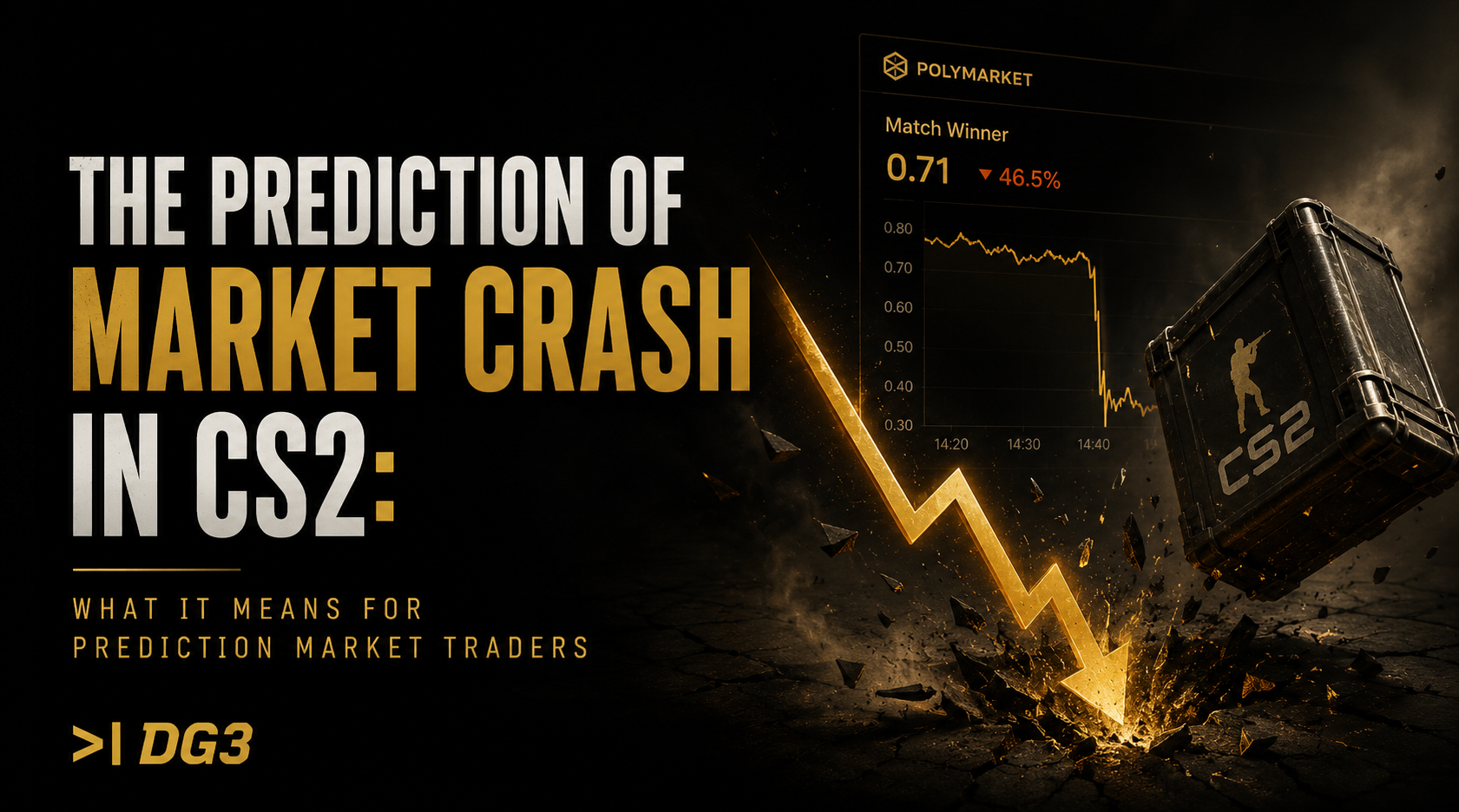
In prediction markets, a crash isn’t a sustained decline in asset value. It’s a rapid repricing event. A match winner market at 0.71 moving to 0.38 in 18 minutes after a stand-in announcement is a prediction market crash. It’s sudden, it’s directional, and it’s driven by a specific piece of information, not supply and demand dynamics playing out over weeks.
This matters because the window to act during a prediction of market crash event in CS2 prediction markets is measured in minutes, not hours. In the skin market, a 30% price drop plays out over 2-3 days as the information spreads, traders react, and the new equilibrium forms. In prediction markets, the same magnitude of price shift from a comparable information event happens inside 25 minutes at T1 match depth.
Three CS2 prediction of market crash scenarios that actually occur:
Stand-in announcement. A team’s primary AWPer is replaced by a rifle player 18 hours before the match. The expected kills distribution changes, team system changes, and the match winner probability shifts 8-14 cents. The market reprices within 12-25 minutes of the official announcement on team social media. Traders who saw the tweet first captured the full repricing.
Team disqualification. A squad is removed from a tournament for a violation, match-fixing investigation, or visa issue. All scheduled matches involving that team become walkovers or cancellations. Every market on that team reprices immediately to near-zero or void. The redistribution across remaining outright markets takes 20-40 minutes to fully settle.
Format change announcement. A group stage format changes from Bo1 to Bo3, or the schedule moves a match from one event day to another. This affects both the expected number of maps played and the in-play positioning of any open markets tied to that fixture.
In all three cases, the prediction of market crash event is created by information. Track the right information sources, and you’re positioned to act before the price has moved.
Why the Skin Market Data Isn’t Useful Here
A lot of CS2 trading content implies that tracking skin prices gives you an edge in prediction markets. The reasoning usually goes: team performance affects viewership, viewership affects case opening rates, case opening rates affect skin prices, therefore skin price movements signal team performance changes.
The problem is latency. By the time a skin price signal has propagated to a point where it’s visible, 48 hours to 2 weeks depending on the mechanism, the prediction market for the relevant match has long since resolved. You’re reading an echo, not a signal.
The one genuine cross-market window is the pre-major capsule period. In the 2-4 weeks before a CS2 major, both skin speculators buying capsule series exposure and prediction market traders entering early outright markets are active simultaneously. Your probability model built for the outright market is genuinely relevant to capsule positioning too. The research overlaps. Run it once, use it in both directions.
Outside that window? Keep the research tracks separate.
Also read: CS2 Market Predictions 2026: What Skin Prices and Tournament Odds Are Telling You
Monitoring the Prediction of Market Crash Signals That Actually Matter
For tracking skin market price movements, third-party tools like PriceEmpire and CSGOStash provide the historical price data and case price indices that the skin research track requires. Keep these completely separate from your prediction market monitoring setup.
The prediction of market crash events worth trading don’t need a complicated monitoring setup. They need the right information sources with notifications on.
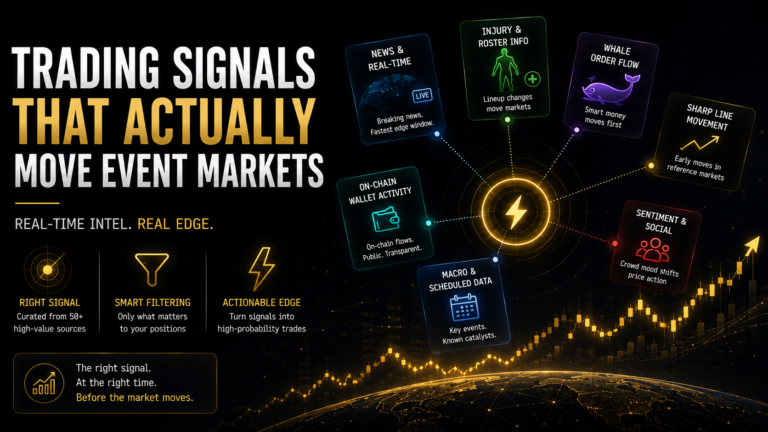
Priority 1, Official team social accounts. X/Twitter notifications on for the top 30 active CS2 teams at T1 level. Stand-in announcements, lineup changes, and player health updates come here first, typically 12-36 hours before match start. This is faster than HLTV, Liquipedia, or any aggregator by 30-90 minutes.
Priority 2, Tournament operator channels. ESL, BLAST, and IEA official accounts for format changes, schedule modifications, and disqualification announcements. These are rarer but higher magnitude when they happen.
Priority 3, DG3 Edge Finder during match windows. When you’re actively trading, the Edge Finder ranks all active CS2 markets by EV gap against the Pinnacle Signal benchmark in real time. A stand-in announcement drops, the Polymarket price reprices, and that market rises in the EV ranking because Polymarket lags the Pinnacle adjustment by 8-20 minutes. You see the gap before it closes.
Priority 4, DG3 News tab. The Intelligence Pane News tab via Optic Odds surfaces match-relevant announcements scoped to open markets. Stand-in confirmations, scheduling updates, and format notes appear here during active trading sessions without requiring separate news monitoring.
That’s four information layers that together cover the prediction of market crash events worth acting on. Simple, targeted, effective.
What This Means for Your Research Process
The practical implication of everything above is this: separate your CS2 research tracks completely.
If you trade skin markets, maintain a skin market research process: PriceEmpire price history, Coinmarketcap for market context, Steam marketplace volume, operation release calendar. Update it when Valve makes announcements that affect supply and demand.
If you trade CS2 prediction markets on Polymarket, maintain a completely separate prediction market research process: HLTV map statistics, Liquipedia roster history, Pinnacle line devigging, stand-in scenario tables, DG3 Edge Finder EV gap ranking. Update it when teams make announcements that affect who’s playing and how well they’re likely to perform.
The overlap is minimal. The research is different. The edge sources are different. The monitoring setup is different. And the window to act when a prediction of market crash event occurs is measured in minutes, which means the only time the two tracks genuinely need to talk to each other is during that specific 2-4 week pre-major window where skin speculation and prediction market positioning happen simultaneously.
Outside that window, keep them separated. The discipline is worth more than any individual trade.
The Research Process That Connects Both Markets
There is one concrete scenario where skin market research and prediction market research genuinely intersect for the same trader in the same session. It’s the pre-major window, and it’s narrow.
In the 2-4 weeks before a CS2 major, both markets are in a speculative phase. Skin speculators are buying capsule series exposure based on which teams they expect to perform well and generate viewership. Prediction market traders are entering early outright markets before the bracket is drawn and liquidity is thin. For a trader doing both, the same underlying question drives both positions: which teams are likely to reach the later stages of this tournament, and what does the current Polymarket price for that outcome look like relative to fair value?
The probability model you build for the outright market answers that question precisely. Your team strength estimates, map pool models, and form-adjusted win probabilities for each team are exactly the inputs that determine which capsule series are worth speculating on. Teams with higher adjusted win probabilities than their Polymarket outright prices suggest are underpriced on both markets simultaneously. The research overlap is genuine and the marginal effort of using it in both directions is minimal once the model is built.
Outside this pre-major window, the two markets diverge. The skin market’s signals operate on weeks-long timeframes driven by supply-side economics. The prediction market’s signals operate on minute-level timeframes driven by information events. Running separate research tracks and separate monitoring setups for each is the correct structural approach for the 48-50 weeks per year that aren’t in a pre-major window.
Three Things to Do Before Your Next CS2 Session
Given everything above, three concrete preparation steps that directly apply to using the prediction of market crash framework in practice.
First, build your Valve announcement filter into your monitoring system explicitly. When you receive any Valve CS2 update notification, run it through the three-bucket taxonomy: ignore (skin economy), monitor over time (new majors), or act within 15 minutes (team availability changes). Training yourself to apply this filter automatically saves you from chasing skin market noise during your prediction market sessions.
Second, verify the current open CS2 Polymarket markets before each event. The prediction of market crash in CS2 prediction markets happens fast. Having the active market list in front of you before the stand-in window opens means the 12-25 minute edge window starts with you already positioned to act, not with you searching for the right market.
Third, check DG3’s News tab when you open the terminal before any CS2 session. A 30-second scan of match-relevant announcements scoped to open markets tells you whether anything has changed since your last session. The prediction of market crash events worth trading arrive through this channel as often as they arrive through your X watchlist.
Frequently Asked Questions
Q: Is the prediction of market crash in CS2 skins the same as a prediction of market crash in CS2 prediction markets? A: Generally they don’t, with one narrow exception. Case pool rotations, drop system changes, and operation releases have zero documented impact on CS2 match winner or tournament outright prices on Polymarket. The causal chain from skin economy to match probability simply doesn’t exist. The one exception is team-related announcements that simultaneously affect skin prices and prediction markets through entirely separate mechanisms: a team ban reduces the value of that team’s sticker capsules (skin market) and voids all their scheduled match contracts (prediction market). The two effects share a trigger but operate through different channels with different timeframes. Case pool rotations, drop system changes, and operation releases have zero documented impact on CS2 match winner or tournament outright prices on Polymarket. The only Valve announcements that directly affect prediction markets are team bans or disqualifications (12-25 minute repricing window) and tournament format or schedule changes.
Q: Which Valve announcements trigger a prediction of market crash in CS2 prediction market prices? A: Team disqualification or ban (immediate, highest magnitude), tournament schedule modification (20-40 minutes), and new major calendar announcements (creates new markets over 1-2 weeks). Case economy announcements, operation releases, and skin market changes have no documented prediction market impact.
Q: How long does it take for a CS2 prediction market to reprice after a team ban? A: In documented cases from ESL and BLAST events in 2024-2025, the average Polymarket repricing lag behind the official announcement was 12-25 minutes. Traders who saw the announcement on team social media first had the full repricing window available.
Q: Can skin market price movements predict CS2 prediction market moves? A: No reliably tradeable relationship exists. Skin price movements that correlate with team performance operate on a 48-hour to 2-week lag relative to match results, which means prediction markets have long since resolved by the time the skin signal is visible. The one genuine overlap window is the pre-major capsule speculation period, where the same probability model is useful in both markets simultaneously.
Q: How does DG3 help traders catch CS2 market repricing events? A: DG3’s Edge Finder ranks all active CS2 Polymarket markets by EV gap against the Pinnacle Signal benchmark in real time. When a stand-in announcement causes Polymarket to lag Pinnacle’s repricing, the affected market rises in the EV ranking. The News tab surfaces match-relevant announcements via Optic Odds scoped to open markets.
Also read: CS2 Prediction Markets: The Complete Guide for Traders in 2026
Trading Signals That Actually Move Event Markets
Information Asymmetry: Who Knows What, and When, in Event Markets