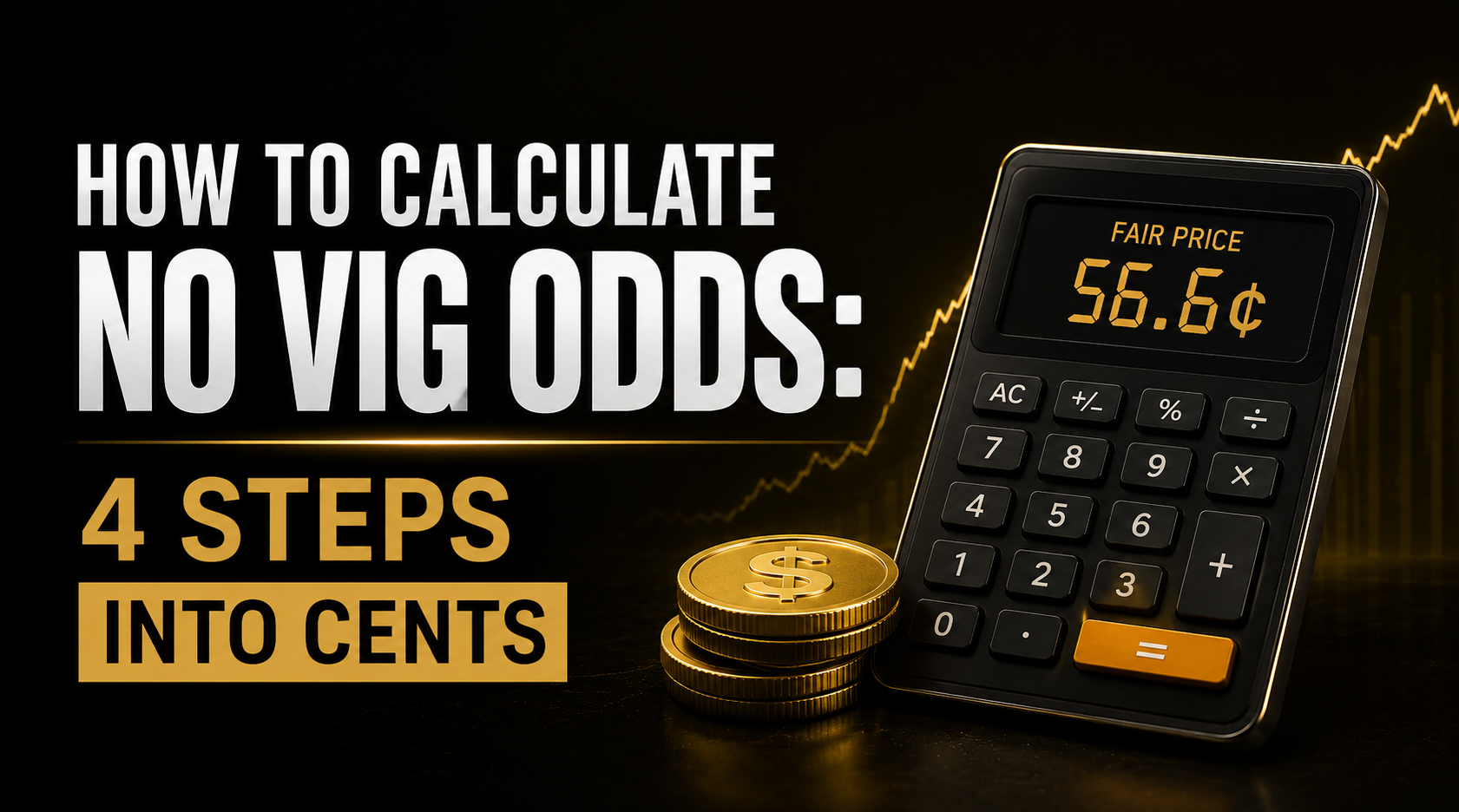
How to Calculate No Vig Odds: 4 Steps Into Cents
You’ve read American odds for years. Minus signs, plus signs, the mental math you do without thinking anymore. Then you open a prediction market for the first time. Every price is just a number between 1 and 99. None of your old shortcuts tell you if 61 cents is a good price or a bad one.
That gap is exactly where knowing how to calculate no vig odds earns its keep. It’s the one calculation that carries cleanly from one format into the other. A no-vig price and a cents price measure the same thing. Probability, with nothing else mixed in.
Table of Contents
Quick Answer
To calculate no vig odds, convert every price in a line to implied probability, add them up, then divide each one by that total. They now sum to exactly 100 percent. On a prediction market, probability and price are the same unit, so a fair probability of 61.4 percent is a fair price of about 61 cents, ready to compare against whatever the market is actually asking.
Key Takeaways
- A sportsbook price and a prediction market price look different but describe the same thing once the vig is out: the market’s estimate of how likely an outcome is.
- American odds convert to implied probability with two different formulas, one for negative numbers and one for positive. Mix them up and everything downstream is wrong.
- The vig you remove isn’t small. On a standard two-way line it usually runs 4 to 5 percent, which is the gap between a real edge and an imagined one.
- Turning a no-vig probability into cents isn’t a second calculation. Multiply by 100. A cent on a prediction market already is a percentage point.
- Which sportsbook you pull the line from changes the answer more than which devig formula you use. A Pinnacle line and a FanDuel line on the same game can land two or three cents apart after both are devigged.
- People often check their fair price against a market’s midpoint instead of the price they can actually buy at. That’s the most common way this whole exercise produces a number that never survives an order ticket.
- The conversion tells you what a position is worth. It says nothing about whether there’s enough size on the book to actually fill it at that price.
Converting American Odds to Implied Probability
Before any devigging, every price on the line has to become a probability. American odds use one of two formulas depending on the sign.
Negative price (usually the favorite): divide the number’s absolute value by itself plus 100. A price of -150 becomes 150 divided by 250, or 60 percent.
Positive price (usually the underdog): divide 100 by the number plus 100. A price of +130 becomes 100 divided by 230, or 43.48 percent.
Add those together. You get 103.48 percent. That 3.48 points over 100 is the vig sitting inside this line. It’s the thing you calculate no vig odds to remove.
Vigorish (vig): The bookmaker’s built-in margin, visible as the amount by which implied probabilities exceed 100 percent when added together. It isn’t a separate fee. It’s baked into the price itself. That’s why two prices that each look reasonable alone can add up to something that was never a fair coin flip.
The Four-Step Conversion, From Book Price to Market Price
This is the full bridge. Book odds in one end, a number you can actually trade on out the other.
- Pull the sharpest line you can find, the same starting point as any no vig calculator run. Pinnacle if you can see it, a low-margin exchange price if not. A soft retail line devigs into a fair price with the book’s public bias still baked in.
- Convert every price on the line to implied probability, using the sign-based formula above.
- Divide each implied probability by the sum of all of them. That’s the no-vig probability, and it’s your answer to “how do I calculate no vig odds” in percentage form.
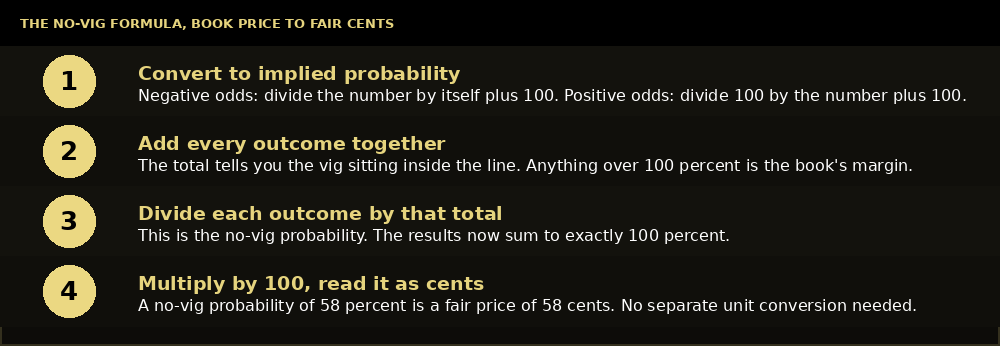
- Multiply the no-vig probability by 100 and read it as cents. A fair probability of 60.10 percent is a fair price of 60 cents. There’s no separate unit conversion, because probability and price are already the same number on a prediction market.
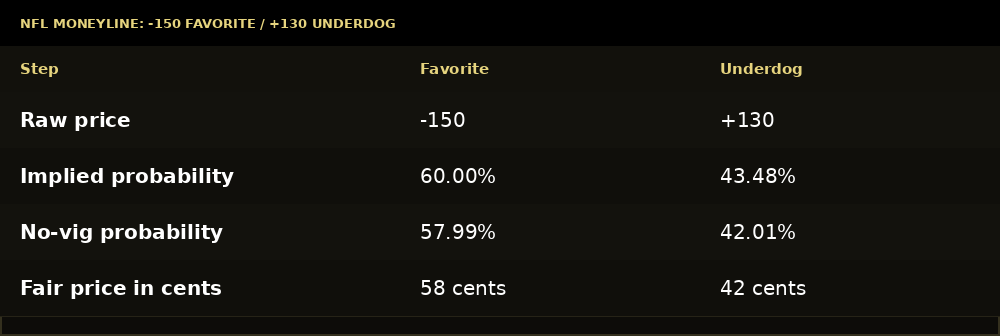
That 58-cent number is the one worth carrying forward. Not the -150, not the 60 percent the raw price implied. The book was charging 2 full cents of margin on the favorite alone before anyone placed a trade.
The same four steps hold regardless of which numbers you start with. It helps to see them as one continuous flow rather than four separate calculations.
Why the Reference Book You Pick Changes the Answer
Here’s what catches people off guard the most. The devig formula is fixed. The input isn’t. The input matters more.
Pull a -150/+130 line from a retail book carrying 6 percent overround. You calculate a no-vig probability shaped by whatever the public was doing on that game.
Pull the same matchup from Pinnacle, running closer to 2 percent overround. The number moves, sometimes a full point or two, because there’s less margin sitting on top of the real signal.
Retail books like FanDuel and DraftKings set lines partly to balance their own action. A lopsided public bet can shift the price away from the sharpest available estimate.
Pinnacle prices to attract sharp money instead of protecting against it. That’s why serious bettors treat it as the reference line rather than a book to actually bet at.
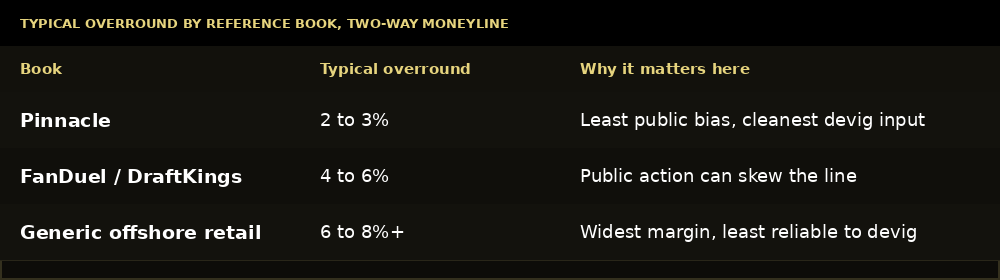
Spend more time finding the sharpest input than picking between devig formulas. That’s true whenever you’re calculating no vig odds as a step toward a prediction market trade. The formula is one line of arithmetic.
The input decision is the one that actually moves your fair price.
Reading a Prediction Market Price Against Your Devigged Number
This is the step people skip. Not because it’s hard, but because years of reading American odds never trained anyone to expect a market that shows price discovery working differently than a bookmaker’s line.
A price between zero and 99 cents on a prediction market isn’t a betting line dressed up differently. It’s the market’s live read on probability, full stop. Shares settle at a dollar if the outcome happens, nothing if it doesn’t. So a price of 58 cents means the market is pricing that outcome at 58 percent. No conversion required.
That’s why calculating no vig odds from a sportsbook line and reading a market price are, for the first time, directly comparable. Both are already probabilities. One came from a book with a margin baked in and needed stripping. The other came from buyers and sellers meeting directly, with no margin to strip. Read Polymarket’s own documentation for more detail on the mechanics behind how those prices form.
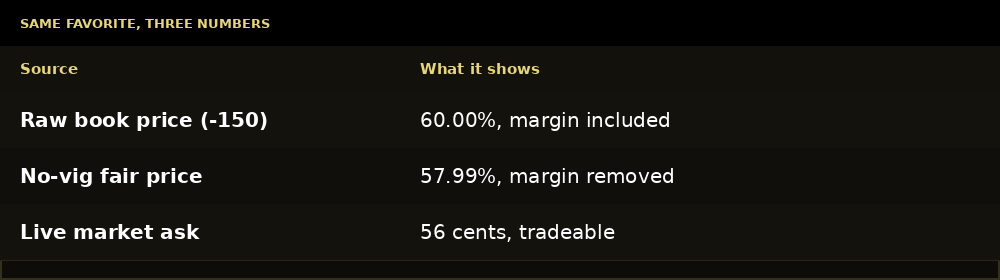
Read the last row against the middle one. There’s roughly 2 cents of daylight between what the sportsbook, once devigged, thinks this outcome is worth, and what the market is actually asking. That gap is the whole reason to learn how to calculate no vig odds in the first place. Without it, you’re comparing a 60 percent book price to a 56-cent market price. You’re learning nothing, because one of those numbers still has a margin sitting inside it.
Build Your Own No-Vig Sheet in Five Minutes
You don’t need software for this. A basic spreadsheet does the job. Building it yourself is the fastest way to trust the output.
Set up four columns: raw price, implied probability, no-vig probability, fair price in cents. For American odds, the implied probability formula depends on the sign. Use an IF statement: =IF(A2<0, -A2/(-A2+100), 100/(A2+100)). That single formula handles both favorites and underdogs without you needing to remember which one applies.
Add a row for every outcome in the market, sum the implied probability column, then divide each individual cell by that sum to get the no-vig column. Multiply by 100 for the cents column. Now you have a working sheet you can paste any line into.
Two things are worth adding once the basic version works. First, add a column that flags when the total implied probability exceeds a threshold you set, say 106 percent. That’s a signal the book you’re pulling from is running a wider margin than usual. Second, add a manual entry field for the live market price, sitting next to your fair price, so the comparison that matters is always one glance away instead of a separate lookup.
This isn’t a replacement for a purpose-built calculator when you’re moving fast across a full slate. It’s the fastest way to actually understand what the calculator is doing. That makes it easier to catch the moment a tool gives you a number that doesn’t look right.
Common Mistakes
Comparing the raw book price straight to the market price. This skips the entire point. A -150 line and a 56-cent market price look comparable because they’re both single numbers, but one carries a margin and the other doesn’t. The comparison means nothing until the vig comes out of one of them.
Devigging against the midpoint instead of the ask. A prediction market usually shows the midpoint of its bid-ask spread. Check your fair price against the price you can actually transact at, not the number sitting in the middle. A real 2-cent edge against the midpoint can shrink to a fraction of a cent against the ask, or disappear completely once slippage on a thin market eats the rest.
Using a retail line as the reference out of convenience. FanDuel and DraftKings are the two books most people already have accounts with, which makes them the default input. That convenience comes with public bias baked into the price. The fair number calculated from it inherits that bias.
Mixing up the sign rules. A favorite and an underdog use different formulas to reach implied probability. Treat a positive number like a negative one and the implied probability is wrong before the devig step even starts.
Treating the devigged number as the trade itself. A fair price tells you what an outcome is worth. It says nothing about fees, slippage on size, or whether the position fits your bankroll. The calculation ends at a number. The decision to trade starts after that.
Frequently Asked Questions
Q: How do I compare sportsbook odds to prediction market prices? A: Convert the sportsbook line to a no-vig fair probability first, then read that number directly as cents. Prediction market prices are already probabilities, so once the sportsbook side has its margin removed, the two numbers sit on the same scale.
Q: What is a no vig line? A: A no vig line is a set of odds with the bookmaker’s margin already stripped out, so the implied probabilities sum to exactly 100 percent instead of 103 to 108 percent. It’s the fair version of whatever price the book originally quoted.
Q: How do you convert American odds to cents? A: Convert the American price to implied probability first: negative odds divided by themselves plus 100, positive odds as 100 divided by themselves plus 100. Devig that against the other side of the line, then multiply by 100. A no-vig probability of 58 percent becomes a fair price of 58 cents.
Q: Is a prediction market price the same as a no-vig price? A: They measure the same thing, probability, but come from different structures. A no-vig price is a sportsbook line with the margin manually removed. A prediction market price already reflects buyers and sellers meeting directly, with no margin baked in to begin with.
Q: Why is the sportsbook price worse than the market price? A: It usually isn’t “worse,” just structured differently. The sportsbook price includes vig by design, which is how the book gets paid regardless of outcome. Once that margin is calculated out, the fair price often lands close to the market’s own price, sometimes better, sometimes worse. That’s the whole comparison this exercise makes possible.
Q: How do I calculate no vig odds from a sportsbook line by hand? A: Convert each price to implied probability, add every outcome on the line together, then divide each individual probability by that total. The results sum to 100 percent, and each one is the fair, no-vig probability for that outcome.
Q: Does the no-vig calculation change between American, decimal and fractional odds? A: No. The initial conversion to implied probability looks different depending on the format, but the devig step itself, divide each implied probability by the total, is identical regardless of where you started.
Q: Is there a difference between “no vig line” and “no vig price”? A: Not meaningfully. Both describe the same output, a price or probability with the bookmaker’s margin removed. “Fair odds” and “true price” get used the same way too, though “true price” is the loosest term since nobody can observe a literal true probability.
Final Thoughts
Learning how to calculate no vig odds is really learning to distrust the number a sportsbook hands you by default. Not because the book is hiding anything. The margin is visible to anyone who adds up both sides. It’s that almost nobody adds up both sides before deciding a price looks good.
Once that habit sets in, a prediction market stops feeling like a foreign format. It’s the same probability you were already estimating, just quoted honestly from the start instead of with a margin folded in.
The arithmetic here takes thirty seconds by hand and less once it’s automatic. What it buys you is a fair comparison between two markets that speak different languages until someone translates one of them.